
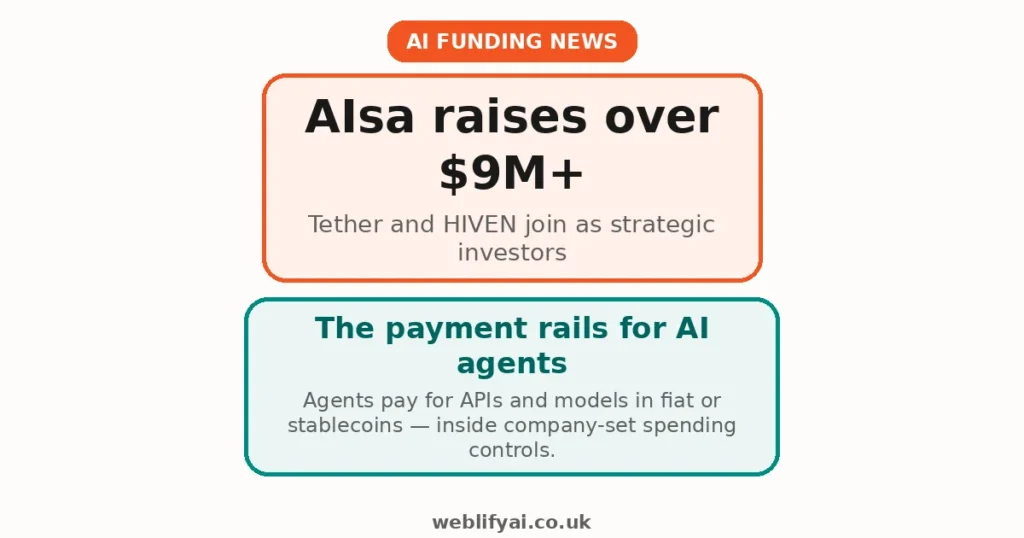
Direct answer: Enterprise AI startup AIsa has completed a seed extension round with Tether and HIVEN joining as strategic investors, taking its total funding past $9 million. The company is building what it calls a “trusted resource and transaction network” for AI agents — infrastructure that lets agents access APIs, data and models and pay for them within company-set spending controls. The round was announced in October 2026.
What happened
AIsa, a San Francisco-based startup led by founder and CEO Jordan Liu, announced the completion of its seed extension round on 15 October 2026. Tether and HIVEN joined as strategic investors, alongside existing backers Alibaba, Tribe Capital, Sumitomo Corporation, Draper Associates and Saison Capital, taking AIsa’s total funding to more than $9 million. The exact size of the extension round itself was not disclosed.
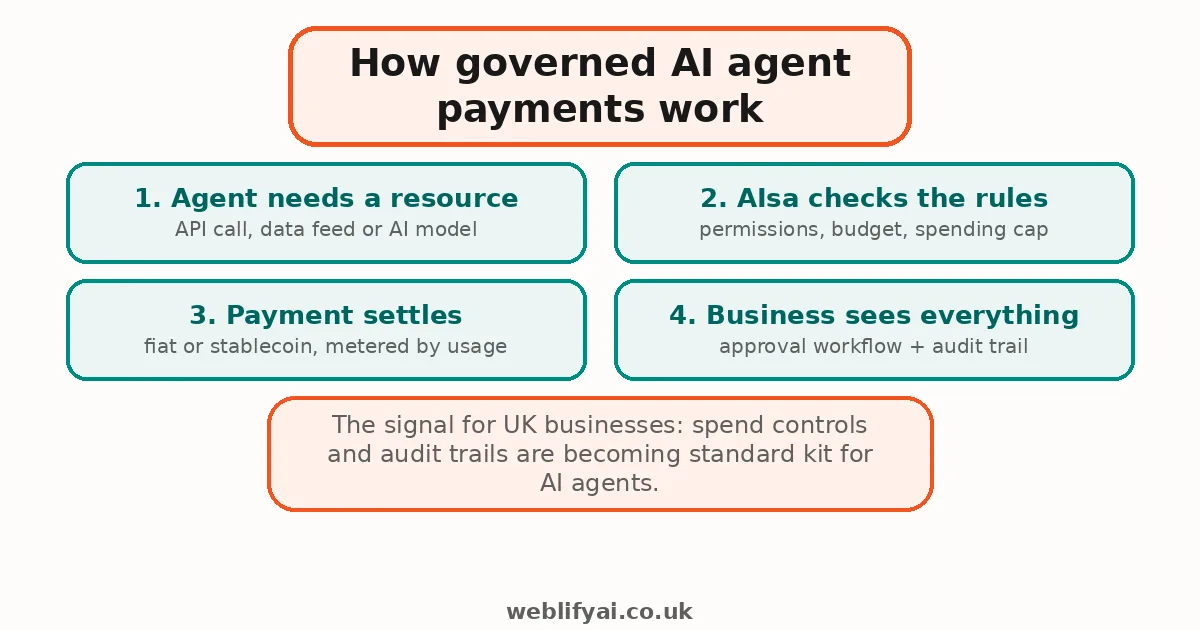
The platform addresses a practical problem: as companies move AI agents into production, those agents need access to real-time information, specialised models, APIs and business tools — and finance teams need visibility into what data sources were used, what permissions were granted, and what was spent. AIsa bundles resource discovery, access and transactions into one governed, usage-based network, reached through a single programmable interface.
The transaction layer supports usage metering, billing and settlement. Enterprise controls include permissions, budgets, spending limits, approval workflows and audit trails, plus source provenance, freshness and quality signals so agents draw on reliable information. Payments can be made in fiat or stablecoins — the agentic-commerce angle that explains Tether’s interest.
AIsa says it has begun strategic pilot programmes with several enterprises across financial intelligence, market research, supply-chain management and commerce, though it has not named the participants or disclosed results. The company claims more than 250,000 agents run on its platform and that it has processed over 100 million transactions — figures reported from a company LinkedIn post, without stated measurement cutoffs or a transaction breakdown.
What it means for UK small businesses
You won’t be buying AIsa — it’s enterprise-only for now. But the direction of travel matters for any UK business experimenting with AI agents, because spend control is the missing piece in most agent setups today.
- Agents that spend money are coming. The moment an agent can subscribe to a tool, order stock or pay for an API call, the question becomes “who approves that and what does it cost?” AIsa’s model — budgets, spending limits, approval workflows, audit trails — is a preview of the governance features you should demand from any agent platform before you connect it to your company card.
- Agentic commerce is a real budget line. If your business uses AI agents for procurement, ad buying or customer service, start thinking of agent spend the way you think of software subscriptions: metered, capped and auditable. Platforms like agentic commerce are pushing this toward the mainstream.
- Start with the guardrails, not the agent. If you’re exploring AI agents for your small business, write the spending policy before you grant access: which tools the agent may touch, a per-day cap, and who gets the alert when a purchase needs approval. The tooling will catch up; your policy shouldn’t wait.
Honest limits / what to watch
- The numbers need context. “250,000 agents” and “100 million transactions” come from a company LinkedIn post with no stated cutoffs and no breakdown of what counts as a transaction. Treat them as traction signals, not audited metrics.
- The extension round size is undisclosed. Only the cumulative $9M+ figure was announced — the market can’t tell how much of that is fresh capital versus earlier rounds.
- Stablecoin settlement is unproven in enterprise procurement. Payments in fiat or stablecoins sounds neat, but cross-border stablecoin payments still raise accounting, tax and compliance questions for UK firms. The governance layer is the genuinely useful part; the settlement rail needs watching.
- Tether’s involvement is strategic, not a product. Don’t read this as “Tether validates agentic commerce” — it’s one strategic cheque from a crypto company diversifying into AI infrastructure. Judge AIsa on its enterprise pilots, not its cap table.
FAQs
What is AIsa?
AIsa is a San Francisco-based enterprise AI infrastructure startup building what it calls a “Trusted Resource and Transaction Network” for AI agents — a governed, usage-based network that lets AI agents discover resources, access data and APIs, and execute authorised payments within company-set controls.
How much has AIsa raised and from whom?
AIsa announced in October 2026 that its total funding now exceeds $9 million after a seed extension round with Tether and HIVEN joining as strategic investors. Earlier backers include Alibaba, Tribe Capital, Sumitomo Corporation, Draper Associates and Saison Capital.
Why is Tether investing in an AI agent startup?
Tether, the company behind the USDT stablecoin, has been backing AI infrastructure. AIsa’s platform lets AI agents pay for APIs, models and services in fiat or stablecoins — so the investment aligns with Tether’s push into agent-to-agent payments and settlement.
How do AI agent payments work on AIsa?
Through a unified programmable interface, an agent can access external data, AI search, models, APIs and business tools while AIsa meters usage and handles billing and settlement. Businesses set permissions, budgets, spending limits, approval workflows and audit trails, so agents can only spend within predefined guardrails.
Is this relevant to small UK businesses yet?
Directly, no — AIsa is enterprise-only for now. Indirectly, yes: it signals that governed agent-to-agent payments are becoming real infrastructure. If you plan to let AI agents buy or subscribe to tools on your behalf, expect spend controls and audit trails to be standard features within the next couple of years.
Thinking about putting AI agents to work in your business — without the spending surprises?