
Direct answer: Singapore vision AI startup Ailytics has raised $7.4 million in a Series A funding round led by Tin Men Capital, to expand its industrial safety and operations platform across Asia-Pacific, the United States and the Gulf. The company’s platform turns existing industrial CCTV cameras into a real-time safety layer, and it has grown from 70 projects in four countries to more than 400 deployments across 15 countries since its $2.7 million pre-Series A in April 2024. For UK firms in construction, manufacturing, logistics and facilities work, the story matters because it is about using cameras that are already on site, rather than buying a new sensor network — and because a safety system that watches workers raises questions about accuracy, privacy, and trust that no funding announcement can answer on its own.
What happened
Ailytics announced its $7.4 million Series A on 26 October 2026, in a statement carried by PR Newswire and reported by outlets including Channel NewsAsia, TNGlobal and TipRanks. The round was led by Tin Men Capital, an enterprise and frontier technology venture firm. Other participants included SEEDS, part of SG Growth Capital, Safie, described as Japan’s largest cloud camera company, and one of Japan’s largest construction companies, alongside family offices and existing investors.
The round follows a $2.7 million pre-Series A led by Tin Men Capital in April 2024. In the period since that earlier round, Ailytics has scaled sharply. The company reports more than 400 deployments across 15 countries, up from 70 projects in four countries. It also reports more than 5.7 million hazards detected and more than 500 million square metres of active worksites monitored. Those figures come from the company and its investors, and they should be read as company-reported scale, not as independently audited results. What they do show is a business that has moved well beyond a pilot: its reference deployments include NatSteel, the PaxOcean shipyard in Indonesia, DHL, Rome’s Leonardo da Vinci International Airport, and more than 1,000 cameras at the Changi Airport Terminal 5 construction site in Singapore.
The company’s own framing is about building a global industrial AI company from Singapore. Lenard Tan, Ailytics’ co-founder and CEO, said: “This round strengthens our local teams in the US, Japan, Australia and the Gulf, as we focus on harsh outdoor industrial environments. We are building a global industrial AI company from Singapore.” The geographic spread is the point. Industrial safety is a local business — regulations, languages, site practices and subcontractor chains all differ by country — so a company that wants to sell into the US, Japan, Australia and the Gulf needs people on the ground, not just a model in the cloud.
Prateek Manocha, the co-founder and chief technology officer, pointed to the product direction the new money will fund: “This round lets us build our own domain-specific reasoning models and keep the cost of running AI low as demand grows.” That sentence contains two distinct bets. The first is that models trained specifically for industrial scenes will outperform general-purpose vision models on the messy reality of a worksite. The second is that keeping inference costs down matters as much as accuracy, because a system that watches hundreds of cameras all day cannot afford to be expensive per camera.
Jeremy Tan, co-founder and managing partner at Tin Men Capital, gave the investor’s version of the same story: “Ailytics has reached 15 markets with very robust unit economics and client churn below 1 per cent. We want to be right behind the team as it scales globally.” Churn below 1 per cent, if accurate, is a strong claim for an industrial software business, where deployments are sticky once cameras, workflows and reporting are integrated. Again, it is an investor claim, not an audited figure, but it helps explain why a Series A investor would back a company at this stage: the question is no longer whether anyone wants the product, but whether the company can staff and support its expansion without breaking what already works.
How Ailyssa actually works
Ailytics’ core platform is called Ailyssa. Its central idea is simple to state and hard to execute: take the video feed from an existing industrial CCTV camera, and derive useful understanding from it in real time, without replacing the camera.
The first step is spatial understanding. Ailyssa derives three-dimensional spatial understanding from a single two-dimensional feed. In plain terms, that means the system tries to understand not just what is visible in a flat image, but where things are in relation to each other: how close a worker is to a moving vehicle, whether someone has entered a restricted zone, whether a load is being lifted over people, whether a walkway is blocked. A single camera gives no depth sensor, so this understanding has to be inferred from the image itself, from the known geometry of the site, and from patterns learned across many deployments. That is why the company emphasises five years of live deployments: the model has, in its telling, learned to work in rain, dust, poor lighting, obstructed views, and with older cameras.
The second step is the reasoning engine. In June 2026, Ailytics deployed AilyssaX, a contextual reasoning engine that processes scenes in context and verifies multi-step procedures. The distinction matters. An older style of video analytics might flag a single event: a person without a helmet, a vehicle moving, a barrier missing. A reasoning engine is meant to follow a sequence: is the worker wearing the right equipment, in the right zone, following the right steps, in the right order? That is the difference between spotting a hazard and understanding a procedure. It is also where false alarms are won or lost. A system that cries wolf will be ignored. A system that understands context can, in principle, alert only when a sequence actually goes wrong.
The third step is the alert itself. Ailytics says its platform provides real-time, actionable insights. For a site manager, that means an alert that says something specific enough to act on, soon enough to matter: a worker entering a crane’s swing radius, a missing guardrail in a zone where work is active, a vehicle reversing towards a pedestrian area. The value of such an alert depends entirely on its precision. A vague alert is worse than no alert, because it trains people to ignore the system. A precise alert, delivered to the right person, can prevent an incident. The company’s reported customer outcomes — a 73 per cent reduction in total recordable incident rate and 84 per cent fewer safety non-compliances, as reported by TNGlobal from the company’s statement — are striking, but they are customer-reported figures via the company, not the results of a controlled study. A careful reader should treat them as a signal to investigate, not as proof.
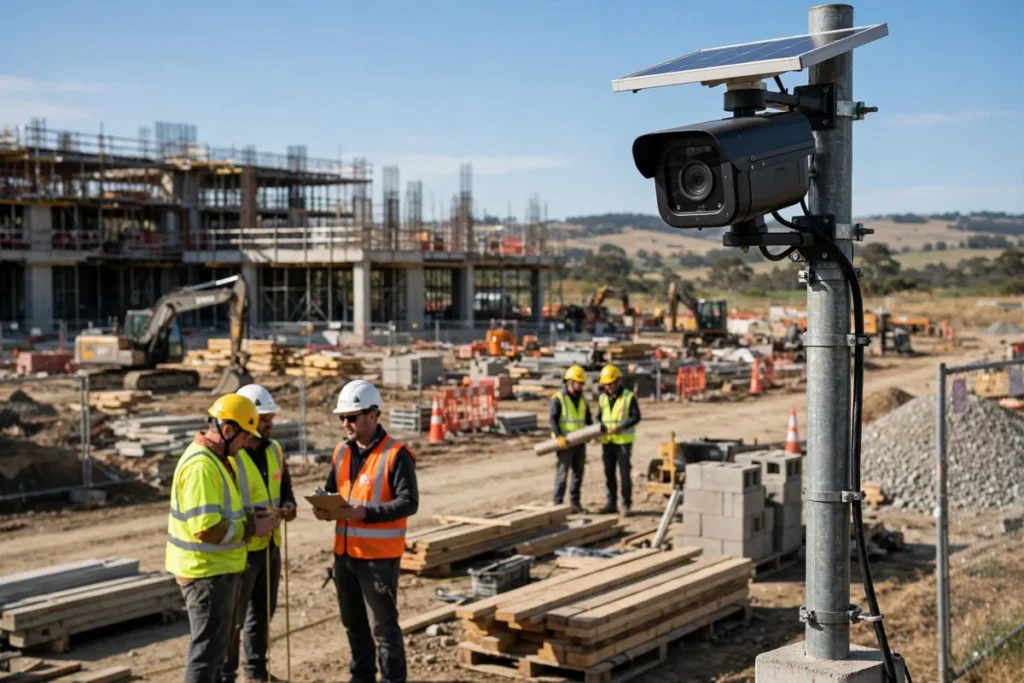
The fourth step is working with what is already there. Ailytics began on Singapore public housing projects and now runs large industrial deployments, but the pitch has stayed consistent: most worksites already have cameras, and most of that footage is reviewed only after an incident. Turning a retrospective record into a live safety layer is attractive precisely because it avoids a hardware rip-and-replace. For a smaller firm, that distinction is the difference between a project that needs capital approval and a project that can start with existing infrastructure. It does not remove the need for cameras to be positioned well, maintained, and connected, but it lowers the starting cost.
Why industrial vision AI is different from office AI
It is tempting to file Ailytics under the general heading of AI, but industrial vision AI faces a different set of problems from the chatbots and agents that dominate headlines, and those differences explain both the opportunity and the risk.
The environment is hostile. Office AI works in clean, well-lit, predictable conditions. A worksite camera works in rain, dust, glare, darkness, vibration, and with lenses that get dirty. A model that performs well on a clean test set can fail badly on a muddy site at dusk. Ailytics’ emphasis on harsh outdoor environments is therefore not marketing colour. It is the core technical challenge. A buyer should ask how a system was tested in conditions like their own site, not just how it performs in a demo video.
The cost of a mistake is asymmetric. If a chatbot gives a wrong answer, a human can correct it. If a safety system misses a real hazard, someone can be hurt. If it raises too many false alarms, people stop listening, and the next real hazard is missed anyway. That is why accuracy, in this market, is not a single number. It is a balance between missed detections and false alarms, measured on a buyer’s own site, with their own cameras, in their own conditions. Any vendor that will not discuss that balance openly is not ready for a safety-critical deployment.
The data is sensitive in a different way. Office AI processes documents. Industrial vision AI processes images of people at work. That raises questions about consent, monitoring, and retention that go beyond a standard software contract. Workers need to know they are being watched by an AI system, what it records, how long footage and alerts are kept, and who can see them. Unions and works councils, where they exist, will rightly ask these questions. A system deployed without that conversation will create distrust, however good its safety record, and distrust is itself a safety risk: workers who feel watched may avoid cameras, which creates blind spots.
The buyer is different, too. The buyer of office AI is often an individual or a small team. The buyer of industrial vision AI is usually a site operator, a main contractor, or a facilities manager, working through layers of subcontractors. That means the system has to work across organisations, with different employers, different safety cultures, and different levels of digital maturity. A deployment that works for a main contractor’s own staff but confuses subcontractors will fail in practice. Training, signage, and clear responsibility for acting on alerts are part of the product, not an afterthought.
These differences are also why a $7.4 million Series A in this sector should not be compared directly with the multi-hundred-million rounds seen in general AI. Industrial AI companies grow by deployment, not by viral sign-ups. Each new country, each new site type, each new camera estate is work. The funding is meant to pay for local teams, domain-specific models, and support — the unglamorous work that determines whether a safety system actually stays switched on.

What it means for UK small businesses
Ailytics is a Singapore company selling into large industrial sites, so a UK small business might reasonably ask why this story matters to it. The answer is that the same logic — use existing cameras, add real-time understanding, act before an incident — is moving downmarket, and the questions a large contractor asks today are the questions a small firm will need to ask tomorrow.
Start with the sites that already have cameras. Many UK small firms in construction, warehousing, manufacturing, and facilities already have CCTV, installed for security. That footage is usually stored and reviewed only after something goes wrong. The Ailytics model suggests a different use for the same hardware: live safety and operations insight. A small firm does not need 1,000 cameras to benefit. A handful of cameras covering a yard, a loading bay, a workshop entrance, or a high-risk zone could be enough to test whether live alerts change behaviour. The test, though, must be honest: does the system catch real risks on this site, with these cameras, in British weather, without flooding the site manager with false alarms?
Think about the safety case, not just the technology. In the UK, employers have duties under health and safety law that cannot be outsourced to a software vendor. A vision AI system can support a risk assessment, but it does not replace one. A small firm considering this kind of tool should involve its competent safety adviser from the start, document what the system is meant to catch, and keep human responsibility for acting on alerts explicit. If a system flags a hazard and nobody acts, the firm is in a worse position than if it had never been flagged. The alert log becomes evidence. That is a reason to get the response process right before switching the system on, not after.
Get the worker conversation right. UK GDPR and employment practice both point in the same direction: be transparent. Tell workers what the system does, what it does not do, how long data is kept, and who sees alerts. Distinguish safety monitoring from performance monitoring, and mean it. A system introduced as a safety tool but used to discipline workers for unrelated behaviour will destroy trust quickly. Where there is a union or employee representatives, consult early. Where there is not, still explain, in plain language, on site, not just in a policy document nobody reads. A safety system that workers trust will be used properly. One they resent will be worked around.
Count the full cost. The headline appeal of using existing cameras is real, but it is not the whole cost. There is the software subscription, the connectivity and storage, the time to position and maintain cameras, the time to respond to alerts, and the time to review and tune the system so false alarms fall. A small firm should run a pilot on one zone, with a named owner, for a defined period, and measure three things: genuine hazards caught, false alarms per week, and time spent responding. If the system catches nothing and alarms constantly, it is not saving money, however cheap the subscription looks.
Watch for the operations benefits beyond safety. Ailytics describes its platform as a safety and operations layer, and that second word matters for a small business case. The same camera understanding that spots a safety breach can also show bottlenecks, idle equipment, blocked walkways, and unauthorised access. For a small firm, an operations insight — a loading bay that is blocked for an hour a day, a delivery route that conflicts with pedestrian traffic — can be easier to measure in pounds than a prevented incident, however important prevention is. A pilot that tracks both safety and operations outcomes will give a clearer business case.
Finally, do not confuse a funding round with a product available in the UK. Ailytics’ announced expansion targets the US, Japan, Australia and the Gulf. The UK is not named in the expansion list in the announcement. That does not mean UK firms cannot use similar technology — there are UK and European vendors in this space — but it does mean a UK small business should not assume Ailytics itself is about to open a UK sales and support operation. The value of this story for a UK reader is the direction of travel: industrial CCTV is becoming a live AI layer, and the firms that prepare their camera estate, their safety processes, and their worker communications now will be ready to adopt whichever vendor fits, when the time is right.
Timeline and key facts
| Item | Detail |
|---|---|
| Company | Ailytics, Singapore |
| Product | Ailyssa vision AI platform, plus AilyssaX reasoning engine (deployed June 2026) |
| What it does | Turns existing industrial CCTV into a real-time safety and operations layer |
| Funding announced | $7.4 million Series A, 26 October 2026 |
| Lead investor | Tin Men Capital |
| Other participants | SEEDS (SG Growth Capital), Safie, a major Japanese construction company, family offices, existing investors |
| Previous round | $2.7 million pre-Series A, April 2024, led by Tin Men Capital |
| Scale reported | 400+ deployments, 15 countries, up from 70 projects in 4 countries |
| Hazards and area reported | 5.7 million+ hazards detected, 500 million+ square metres monitored |
| Reference sites | NatSteel, PaxOcean shipyard, DHL, Rome Leonardo da Vinci Airport, Changi Airport Terminal 5 |
| Expansion focus | Local teams in the US, Japan, Australia and the Gulf |
| Co-founders | Lenard Tan (CEO), Prateek Manocha (CTO) |
| What is not yet public | Independently audited accuracy, false-alarm rates, UK availability, pricing |
The growth from 70 projects to more than 400 deployments in about two and a half years is the most important number in the announcement, because it suggests repeatable deployments rather than one-off pilots. The next question is whether that growth can be sustained in new markets, with new site types, without the quality of alerts falling. That is what the Series A money is meant to prove.
Honest limits and what to watch
Several limits should be kept in view when reading this announcement.
First, the impressive figures are company-reported. Deployments, hazards detected, area monitored, incident-rate reductions, and churn are all figures from the company or its investors, carried in a funding announcement. They are not the output of an independent study, and they are not broken down by site type, camera count, or time period in the public coverage. A buyer should ask for a reference site they can visit, and for performance data from a site like their own, before committing.
Second, the UK is not in the announced expansion. Readers should not assume UK pricing, support, or data hosting from this announcement. The broader lesson — that existing CCTV can become a live safety layer — applies in the UK, but the vendor choice, the regulatory context, and the support model will differ. UK firms should look at vendors with UK deployment experience and UK GDPR-compliant hosting, and should check where video and alert data are stored.
Third, vision AI in safety-critical settings needs a safety case. No funding announcement can provide one. A system that works well in a Singapore housing project or an airport build may behave differently on a small UK yard with older cameras, different lighting, and different work patterns. A pilot on the buyer’s own site, with measured missed detections and false alarms, is the only honest test. Any vendor unwilling to run such a pilot should be treated with caution.
Fourth, worker trust is a deployment risk, not a communications afterthought. Cameras that watch people for safety can easily be experienced as surveillance. If workers are not consulted, if data retention is unclear, or if alerts are used for discipline, the system will face resistance, and resistance creates blind spots. The firms that succeed with this technology are usually the ones that involve workers early, publish clear rules, and keep safety and performance monitoring visibly separate.
Fifth, the market is moving, and Ailytics is not alone. Large camera makers, cloud providers, and safety software firms are all adding vision AI to their products. A small business that buys today should ask about interoperability: can alerts feed into its existing safety reporting, can footage and data be exported, and what happens if the vendor is acquired or changes direction? A safety system that locks a firm into one vendor’s cameras and formats is a long-term liability, however good its first year looks.
What to watch is therefore practical. Watch for Ailytics’ expansion hires in the US, Japan, Australia and the Gulf, and for any UK presence. Watch for named customers willing to discuss measured results, and for published accuracy and false-alarm data. Watch for partnerships with camera makers and safety software firms, which often matter more than funding for reaching smaller customers. And watch for how regulators and industry bodies in the UK treat AI-assisted safety monitoring, because guidance in this area will shape what a responsible deployment looks like.
For readers following the wider AI story, our coverage of the Axon Body 5 AI body camera shows a different kind of vision AI — wearable, rather than fixed cameras — and our look at AI agents in text messages shows how AI is moving into everyday operational channels. Together, they show a pattern: AI is leaving the screen and entering the physical workplace, and the firms that prepare their processes, people, and data governance first will get the benefit without the backlash.
FAQs
What is Ailytics?
Ailytics is a Singapore vision AI startup whose platform, Ailyssa, turns existing industrial CCTV cameras into a real-time safety and operations layer. It derives three-dimensional spatial understanding from a single two-dimensional camera feed, and its AilyssaX reasoning engine, deployed in June 2026, verifies multi-step procedures in context.
How much did Ailytics raise in its Series A?
Ailytics raised $7.4 million in a Series A led by Tin Men Capital, announced on 26 October 2026. Participants included SEEDS (part of SG Growth Capital), Safie, a major Japanese construction company, family offices and existing investors. It follows a $2.7 million pre-Series A in April 2024.
How big is Ailytics now?
The company reports more than 400 deployments across 15 countries, up from 70 projects in four countries since its pre-Series A. It also reports more than 5.7 million hazards detected and more than 500 million square metres of worksites monitored. These are company-reported figures, not independently audited results.
Where is Ailytics expanding?
The Series A is meant to strengthen local teams in the US, Japan, Australia and the Gulf, with a focus on harsh outdoor industrial environments. The UK is not named in the announced expansion, so UK firms should check availability, support and data hosting before assuming the product is offered locally.
Does Ailytics replace CCTV cameras?
No. The pitch is the opposite: it uses existing industrial CCTV, turning footage that is usually reviewed only after an incident into a live safety layer. Cameras still need to be well positioned, maintained and connected, and the system still needs human owners to act on alerts.
Should a UK small business buy vision AI now?
A pilot is a sensible step, but a company-wide rollout on announcement evidence alone is not. Test on one zone with existing cameras, measure genuine hazards caught against false alarms, involve workers and a safety adviser early, confirm UK GDPR and data-retention terms, and keep human responsibility for acting on alerts explicit.
Sources: PR Newswire statement on the Ailytics $7.4 million Series A (26 October 2026), as carried by Channel NewsAsia, TNGlobal and TipRanks, including quotes from CEO Lenard Tan, CTO Prateek Manocha and Tin Men Capital’s Jeremy Tan, and company-reported deployment, hazard and worksite figures.