
Direct answer
Direct answer: Axon announced its Body 5 and Body 5 Pro body-worn cameras on 24 October 2026, pitching them as cameras built for what it calls the AI era. The headline claim is 25 times the AI processing power of earlier-generation Axon cameras, alongside better video, connectivity and 20 percent more battery life than the previous generation. A new set of real-time AI features, called Axon Guardian, is designed to flag possible conflicts as they unfold and alert a human reviewer, rather than simply recording events for later review. General availability dates and pricing have not been announced yet, so for now this is a product announcement to watch, not something a business can order and test tomorrow.
What happened
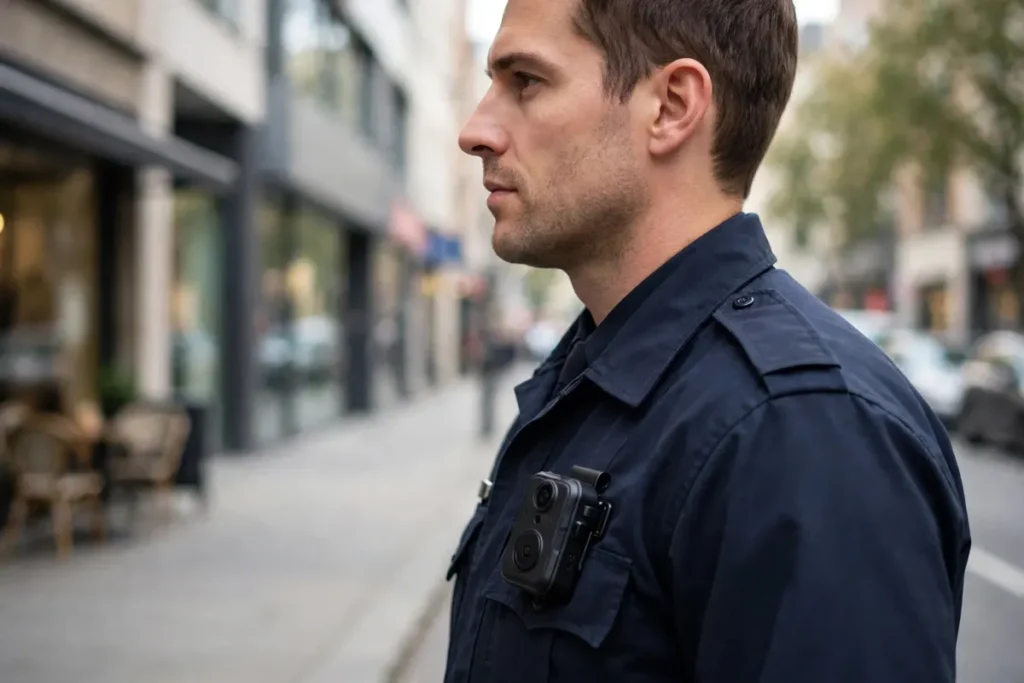
Axon, the Scottsdale, Arizona company best known for TASER devices and body cameras, said Body 5 is its newest body-worn camera, designed to bring more powerful intelligence, connectivity and real-time support directly to officers in the field. The company’s own framing is worth quoting because it explains the whole shift: for years, Axon body cameras have helped agencies capture evidence and create transparency after an incident. Body 5, Axon says, is built to help officers during the call, with information, assistance and backup on the spot.
Founder and chief executive Rick Smith put it in practical terms. Officers, he said, should not have to choose between getting information and watching the scene. With Body 5, they do not. They can capture a licence or document with the camera, keep their hands free and their eyes up, and get information back faster than writing it down and calling it in by radio. An officer fully engaged with the person in front of them, Smith argued, is a safer officer and a better-served community. That is a bold claim, and it is important to separate it from what has actually been demonstrated: the announcement describes intended capabilities, not published field results from Body 5 deployments.
For the first time, Axon is offering two versions of its flagship camera. The standard Axon Body 5 and the Axon Body 5 Pro share the core upgrades, and the Pro adds extra hardware and extra memory. That two-tier approach matters because it signals how Axon expects customers to buy AI capability in future: the camera is no longer a single fixed device, but a platform whose AI capacity grows with the model and the plan attached to it. Axon says the Body 5 Pro will continue to gain new AI capabilities as they become available, growing along with what it calls the AI Era Plan.
Alongside the cameras, Axon announced Guardian, a new category of AI features within that AI Era Plan, created specifically to work with an officer’s field-based devices, starting with body cameras and in-car cameras. Guardian is designed to flag potential risks as situations unfold and create alerts when additional attention may be needed. It is the clearest sign yet that Axon sees the body camera’s future as a live sensor, not just a recorder.
The upgrades, in plain English
Axon’s announcement lists several upgrades, and each one deserves a plain-English translation, because press-release language can hide as much as it reveals.
First, the processing claim. Body 5 delivers, in Axon’s words, 25 times the AI processing power of earlier-generation Axon body cameras, thanks to a powerful new computing architecture. That architecture, Axon says, creates the capacity to support current and future AI features directly on the body camera. The key phrase is “directly on the body camera”. Running AI on the device itself, rather than sending everything to the cloud and waiting for an answer, is what makes real-time features possible in places with patchy connectivity. It also reduces the delay between something happening and an alert being raised. What Axon does not give in the announcement is a chip name, a benchmark, or an absolute measure of processing power. The 25x figure is relative to earlier-generation Axon cameras, and the announcement does not say which earlier generation is the baseline, or what workload the comparison measures. Treat it as a direction of travel, not a verified performance score.
Second, video. Axon says improved video captures clearer evidence across challenging environments, including better low-light performance. For anyone who has watched grainy night-time footage, this is easy to understand: a camera that is supposed to provide an objective record is only useful if the record is actually legible. Low-light performance is therefore not a cosmetic upgrade. It affects whether footage can settle a dispute, support a report, or be used as evidence. Again, Axon gives no sample footage comparisons or technical specifications in the announcement, so buyers will need to see real footage before judging this claim.
Third, connectivity and location. Axon promises seamless connectivity in urban and remote environments, and more precise location capability, helping officers, cameras and remote support teams stay connected when timely information matters most. This is the unglamorous upgrade that often decides whether a smart device works in practice. A camera with powerful AI is useless if it cannot get a signal in a basement, a rural road, or a crowded city centre at peak time. Axon does not name the connectivity technologies involved, so this too is a claim to verify in real deployments, not a specification to take on trust.
Fourth, battery. Body 5 offers 20 percent more battery life than the previous generation, which Axon says helps keep the camera ready and connected throughout an officer’s shift. Battery life is the oldest constraint on body cameras, and a 20 percent improvement is meaningful if it means a camera survives a long shift without a swap or a charge. But note the careful wording: 20 percent more than the previous generation, not a number of hours. Without a shift-length figure, a buyer cannot yet translate that percentage into a working day.
Put together, these four upgrades tell a coherent story. Axon is trying to remove the four reasons a body camera might fail in the field: it cannot think fast enough, it cannot see clearly enough, it cannot stay connected, and it cannot stay powered. Whether Body 5 actually removes all four will only become clear when agencies test it, but the design priorities themselves are informative for any business thinking about wearable or field technology.
What is different about Body 5 Pro
The Pro model is where Axon’s AI ambitions become most concrete, because its extra hardware is tied to specific tasks rather than general processing power.
The first Pro addition is a near-focus camera. This is an additional dedicated camera lens that lets officers scan driver’s licences to check status and search for wants or warrants in seconds, without returning to the patrol vehicle, with relevant information sent to Axon Fusus to support real-time operations. In practice, that means the moment of checking a document moves from the car to the kerbside, and from a manual radio call to a camera scan. For the officer, the benefit is time and attention: less walking back and forth, less time with eyes down. For the person being checked, the benefit is supposed to be speed. For everyone else, the question is accuracy and oversight: a scan that returns a status in seconds is only helpful if the underlying record is correct, and if there is a clear process for challenging a wrong match.
The second Pro addition is front-facing speakers. Four additional speakers project audio toward the person an officer is speaking with, helping real-time translations from Axon Assistant carry more clearly over heavy traffic or crowd noise. This is a small hardware detail with a large practical implication. Translation that only the officer can hear is a one-way tool. Translation projected clearly toward the other person turns the camera into a two-way communication device. In a busy street, a hospital corridor, or a warehouse floor, audibility is not a luxury; it is the difference between a translation feature that works and one that is abandoned after the first noisy shift.
The third Pro addition is additional memory. Extra space lets the camera run several AI tools at once, helping officers stay better informed and work faster. This is the least glamorous Pro feature and possibly the most important for the platform’s future. A camera that can only run one AI tool at a time is a single-purpose device. A camera that can run several at once — transcription, translation, risk detection, document scanning — starts to behave like a small computer worn on the chest. That is exactly the direction Axon is heading, and memory is what makes multitasking possible without the device slowing to a crawl.
Axon says the Pro will continue to gain new AI capabilities as they become available, growing along with the AI Era Plan. That sentence should be read carefully by any prospective buyer. It means the Pro you buy at launch is not the finished product. Its value depends on a pipeline of future software, and on a subscription plan, not just on the hardware in the box. That is normal for modern technology, but it changes how you should evaluate a purchase: you are buying into a roadmap, and roadmaps slip, change, or get repriced.
Axon Guardian: AI that watches in real time
Guardian is the part of the announcement that will attract the most attention, and the most scrutiny, because it moves AI from assistance to intervention.
Axon describes Guardian as a new category of AI features within the AI Era Plan, designed to work with an officer’s field-based devices, starting with body cameras and in-car cameras, to improve safety. It is designed to flag potential risks as situations unfold and create alerts when additional attention may be needed. Two of the first features are named in the announcement.
Escalation Detection works like this: when an Axon Body 4 or Axon Body 5 camera is activated and recording, Guardian has the ability to detect potential conflicts in real time and create an alert in Axon Fusus. A human reviews the livestream and decides if additional support or action is needed. Note the two safeguards built into that description. First, the camera must already be activated and recording; Guardian is not described as a device that watches silently when switched off. Second, the alert goes to a human reviewer, who decides what happens next. The AI does not dispatch backup on its own, and it does not decide that a conflict has definitely occurred. It detects a potential conflict and asks a person to look. That human-in-the-loop design is central to how Axon presents Guardian, and it is the detail that any responsible buyer should test hardest: how often does it alert, how often is it right, and how quickly does the human reviewer actually respond?
Approach Alert works differently. When active on Axon Fleet 3, Guardian can detect if the door of a stopped vehicle opens and alert the officer through the in-car display and their body-worn camera. This is a narrower, more mechanical detection task than escalation detection: a door opening is a visible, physical event, not a judgement about human behaviour. That narrowness is a strength. Systems that detect a single, well-defined event are generally easier to test, easier to explain, and easier to trust than systems that claim to read the emotional temperature of a confrontation. Approach Alert is therefore a useful test case for Guardian as a whole: if a system cannot reliably detect a door opening without flooding officers with false alerts, it is unlikely to be reliable at the harder job of detecting escalation.
Together, these two features illustrate the two directions real-time AI can take. One direction is behaviour detection, which is powerful but hard to prove and easy to get wrong. The other direction is event detection, which is narrower but more testable. A sensible buyer should ask Axon for separate performance figures for each, rather than accepting a single Guardian success rate that blends the two together.
How Body 5 fits into Axon’s wider AI portfolio
Body 5 does not arrive in isolation. Axon says it helps officers get more out of the AI Era Plan by bringing smart tools right to the scene, and it names two existing tools that show what that plan already does.
Draft One helps officers turn body-camera audio into high-quality report drafts. Anyone who has written reports after a long shift will understand the appeal: the administrative burden of policing is enormous, and a draft generated from audio can save hours, provided it is checked carefully. The risk, which applies to every AI drafting tool, is that a plausible-sounding draft is treated as a finished record. A draft is not evidence until a human has read it, corrected it, and taken responsibility for it. That discipline matters even more when the draft is based on audio from a noisy, stressful encounter.
Axon Assistant provides voice-based information access and real-time translation. This is the tool that the Pro’s front-facing speakers are designed to support. Voice access means an officer can ask for information without reaching for a radio or a terminal. Real-time translation means a conversation can happen across a language barrier without waiting for an interpreter. Both are genuinely useful in the field, and both carry the same caveat as every voice AI tool: accuracy drops in noise, with accents, and with specialist vocabulary, and a mistranslation in a high-stakes encounter is worse than no translation at all.
Axon Fusus, mentioned in the context of both licence scanning and escalation alerts, is the real-time operations platform that ties these pieces together. Fusus is where alerts land, where livestreams are reviewed, and where information from the field is brought into one operational picture. For a small business reader, the lesson is not about Fusus specifically, but about architecture: the camera is only the sensor. The value comes from the system behind it — the software that receives, routes, reviews and stores what the sensor captures. A buyer who evaluates only the camera, and not the platform, the subscription, the storage, and the review workflow, is evaluating half the product.
Axon also says its Responsible Innovation framework guides the development of its products, and that Body 5 and Guardian prioritise human oversight and maintain agency control over data. Its independent Ethics and Equity Advisory Council, Axon says, was created to help responsibly develop and deploy new technologies with transparency, while aligning with community expectations. These are important statements, but they are governance claims, not technical guarantees. A framework and a council are only as good as the decisions they actually change, the data they actually publish, and the deployments they actually stop or modify. Buyers and the public should look for published evaluations, error rates, and bias assessments, not just for the existence of a council.
What it means for UK small businesses
At first glance, a police body camera launch may seem remote from the daily concerns of a UK small business. Most readers of this site do not run a police force, and most will never buy an Axon camera. But Axon itself points to a wider market: alongside public safety agencies, its growing enterprise market focuses on protecting critical infrastructure and frontline workers across industries including corporate security, hospitality, retail and healthcare. That sentence is the bridge to the UK small-business story, because frontline workers, customer-facing staff, lone workers and security teams are exactly the people many UK firms already employ, and exactly the people for whom a wearable camera raises both opportunities and obligations.
Start with the most direct parallel. A small security firm, a facilities company, a care provider with lone workers, a retail chain with door staff, or a hospitality business with late-night staff all face the same basic problem Axon is solving for police: how do you protect staff, resolve disputes fairly, and create a reliable record when something goes wrong? A body camera, in principle, does three things for such a business. It deters some bad behaviour, because people behave differently when they know they are being recorded. It provides evidence when accounts differ, which can settle insurance claims, customer complaints, and staff grievances faster and more fairly. And it can be used for training, showing new staff how experienced colleagues handled a difficult situation. Those benefits are real, and they are why body cameras have already spread beyond policing into private security and other frontline roles in the UK.
Body 5 adds a fourth possibility that changes the calculation: real-time help, not just a retrospective record. A camera that can translate a conversation in the moment, scan a document without a trip back to a vehicle or office, or alert a supervisor when a situation looks like it is escalating is no longer just a witness. It is an assistant. For a UK firm, the practical versions of that idea are easy to imagine. A security guard at a busy venue who can translate safety instructions for a visitor who does not speak English. A lone worker in a warehouse who can get information without taking their hands off a task. A supervisor who gets an alert when a confrontation at a door looks like it is heating up, rather than hearing about it afterwards. None of these require buying Axon’s specific product. They are a preview of what wearable AI will soon offer across many vendors, and they are worth planning for now.
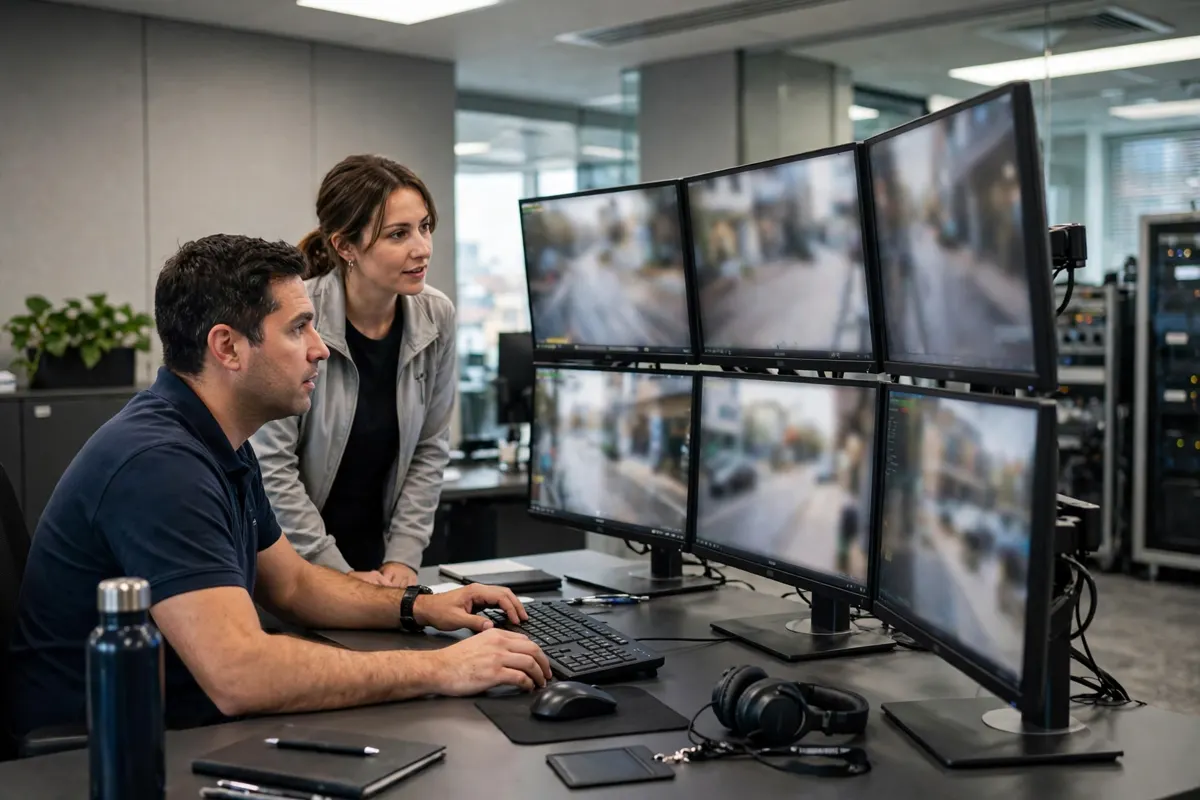
That planning should start with the question Axon’s launch forces every buyer to ask: what problem are you actually solving? A camera that records is a different purchase from a camera that alerts, translates, and drafts reports. The first is mainly a storage and policy problem: how long do you keep footage, who can access it, and when do you delete it? The second is a live-operations problem: who monitors alerts, how quickly do they respond, and what happens when the AI is wrong? A small business that buys a real-time AI camera without staffing the human review side is buying half a system. Axon’s own description of Guardian makes this point clearly: a human reviews the livestream and decides if additional support is needed. If your business has no one available to review an alert at 11pm on a Saturday, the alert is not a safety system. It is a notification that no one read.
The second planning question is about data, and it is where UK law bites hardest. Body cameras capture personal data, often including faces, voices, and conversations, sometimes in private or semi-private settings. Under UK data protection law, a business using such cameras needs a lawful basis, clear signage or notice, a retention policy, access controls, and a process for handling subject access requests and complaints. It also needs to think about special categories of data: a camera in a healthcare setting, for example, may capture health information incidentally, which carries stricter requirements. None of this is new, but AI features make it more complex. A camera that scans a licence, translates speech, or detects escalation is not just recording; it is processing personal data to draw inferences about people. That processing needs its own justification, its own accuracy checks, and its own route for a person to challenge a wrong inference. If you are considering any wearable AI device, read our guide to building an AI policy template for UK small businesses before you buy, and treat the policy as part of the purchase, not paperwork to be done later.
The third planning question is about accuracy and trust. Axon’s 25x processing claim, its low-light video claim, and its escalation detection claim are all company assertions in a launch announcement, not independently verified results. That is normal for a launch, but it means a buyer should demand evidence before committing: sample footage in conditions like your own, false-alert rates for escalation detection, translation accuracy in noisy environments, and battery performance over a full shift, not a percentage. A useful rule of thumb is to ask for the same evidence you would want from any AI vendor: what was tested, on whom, in what conditions, and with what error rate? If a vendor cannot answer those questions, the product is not ready for a high-stakes deployment, however impressive the launch video looks.
The fourth question is about cost and lock-in. Axon has not announced Body 5 pricing or availability, and the Pro’s value depends on the AI Era Plan, a subscription. For a small business, the total cost of a wearable AI system is rarely the camera alone. It includes the plan, the storage, the software licences, the replacement cycle, and the staff time spent reviewing footage and alerts. It also includes switching costs: once your footage, your workflows, and your staff training are built around one vendor’s platform, moving to another vendor is expensive and disruptive. That is not a reason to avoid buying, but it is a reason to compare the whole system, to ask what happens to your data if you cancel, and to avoid a purchase decision based on a single hardware feature.
There is also a broader lesson for UK small businesses that will never buy a body camera at all. Body 5 shows where AI is heading in the physical world: from the cloud to the device, from after-the-fact analysis to real-time assistance, and from single-purpose tools to platforms that run several AI features at once. The same pattern is appearing in voice assistants, in shop-floor devices, and in customer-service tools. Our recent coverage of voice AI that sounds strikingly human, in our post on Block’s Dessa voice model, makes a similar point: the moment AI can hold a natural conversation, translate in real time, or flag a risk as it happens, the job of a business changes from asking “should we use AI?” to asking “who watches the AI, who is responsible when it is wrong, and what do we do when it fails?” Body 5 is a police product, but that question is universal.
Finally, there is a practical, low-cost action any UK small business can take from this launch without spending anything. Audit your current use of recording, transcription, and translation tools, even the humble ones: CCTV, call recording, meeting transcription, and translation apps. Ask the same questions Body 5 raises: what data are we capturing, who can access it, how long do we keep it, what happens when the AI mishears or mistranslates, and who is responsible for checking? Businesses that can answer those questions cleanly for their existing tools will be ready to evaluate wearable AI when it reaches their price range. Businesses that cannot will find that a new device does not solve a governance problem; it multiplies it.
Honest limits / what to watch
The most important limit on this story is also the simplest: this is a launch announcement, not a deployment report. Axon has announced a product, described its intended capabilities, and promised availability dates soon. It has not published pricing, a ship date, independent test results, or field data from Body 5 in service. Every performance claim in this article therefore comes from Axon’s own announcement, and should be read as such. That is not a criticism of Axon specifically; it is how product launches work. But it means the honest verdict on Body 5 today is “promising, unproven”, not “proven”.
Watch first for availability and pricing. A product that cannot be bought cannot be evaluated, and a product whose price is unknown cannot be budgeted for. When Axon announces general availability dates, the next question is which customers get it first: large agencies with existing Axon contracts, or the wider enterprise market? Early availability to a narrow group would mean most UK businesses will be watching from a distance for some time, and should use that time to prepare policies rather than rushing to buy.
Watch second for independent evidence on Guardian. Escalation detection is the feature with the highest potential benefit and the highest potential harm. A system that correctly alerts a supervisor to a genuinely dangerous escalation could prevent harm. A system that alerts too often will be ignored, which is worse than no system at all, because it creates a false sense of coverage. A system that alerts unevenly — more often for some groups of people than others, for example — could create serious fairness and legal problems. Axon’s independent Ethics and Equity Advisory Council is relevant here, but the test of its work will be published evaluations: what data was used to train and test escalation detection, what the false-positive and false-negative rates are, and whether performance differs across demographics, accents, languages, and environments. Until those figures are public, Guardian should be treated as an experimental feature, not a safety guarantee.
Watch third for privacy and data-control details. Axon says Body 5 and Guardian prioritise human oversight and maintain agency control over data. For UK buyers, the practical questions behind that statement are specific: where is footage stored, in which jurisdiction, under whose legal process can it be accessed, how long is it retained by default, and can a customer delete it completely? A UK business that stores footage of members of the public needs answers to all of these before deployment, not after a complaint or a data breach. The same applies to licence scanning: a scan that checks status and warrants involves querying external records, and the accuracy, retention, and audit trail of those queries matter as much as the speed of the scan.
Watch fourth for the accuracy of the supporting AI tools. Draft One’s report drafts and Axon Assistant’s translations are only as good as their underlying models, and both are known weak points for AI in noisy, high-pressure settings. A report draft that misattributes a quote, or a translation that softens a threat or hardens a polite request, can change the meaning of an encounter. The safeguard is human review, every time, without exception. Businesses that adopt AI drafting or translation should build that review into the workflow and measure it: how often are drafts corrected, and by how much? If corrections are frequent, the tool is not saving time; it is moving work from writing to checking.
Watch fifth for what Axon does not say. The announcement does not mention facial recognition, and readers should not assume Body 5 performs it. It does not give a battery life in hours, a chip name, a benchmark, or a price. It does not say how Guardian was trained, or how it handles audio in languages other than English. Absences like these are not proof of a problem, but they are a useful checklist for follow-up questions. A mature vendor should be able to answer them, and a buyer should be wary of a sales process that treats such questions as hostile rather than routine.
Watch finally for the wider market response. Body 5 will not exist in a vacuum. Other body-camera and wearable-device vendors will respond, either with their own on-device AI, or by arguing that cloud-based AI is more powerful and easier to update. The competition will determine prices, standards, and interoperability — whether footage and alerts from one vendor’s camera can work with another vendor’s software. For a small business, interoperability is a quiet but crucial factor: a camera that locks you into one platform is a riskier purchase than a camera that works with open standards and exportable data, even if the locked-in camera looks better on launch day.
Key facts and timeline
| Item | Detail |
|---|---|
| Announcement date | 24 October 2026 |
| Company | Axon (Nasdaq: AXON), Scottsdale, Arizona, founded 1993 |
| Products | Axon Body 5 and Axon Body 5 Pro body-worn cameras |
| Headline AI claim | 25x the AI processing power of earlier-generation Axon cameras (company claim, no benchmark published in the announcement) |
| Battery | 20% more battery life than the previous generation (no hours figure given) |
| Pro extras | Near-focus licence-scanning camera, four front-facing speakers, additional memory for running several AI tools at once |
| New AI category | Axon Guardian, within the AI Era Plan: Escalation Detection and Approach Alert at launch |
| Existing AI tools named | Draft One (report drafts from audio) and Axon Assistant (voice information access and real-time translation) |
| Operations platform | Axon Fusus, where Guardian alerts are reviewed by a human |
| Availability and price | Not announced; Axon says general availability dates will be announced soon |
| Governance named | Responsible Innovation framework and independent Ethics and Equity Advisory Council |
The timeline, in short, is a single day so far: announcement on 24 October 2026, with availability, pricing, and independent testing all still to come. That is why this post is framed as a launch to watch, not a product to buy today. The next meaningful dates will be the availability announcement, the first agency deployments, and the first published performance data — in that order.
FAQs
What is Axon Body 5?
Axon Body 5 is Axon’s newest body-worn camera, announced on 24 October 2026. It is designed to run AI features directly on the camera, with 25 times the AI processing power Axon claims for earlier-generation cameras, better video, better connectivity, and 20 percent more battery life than the previous generation. A Pro version adds a licence-scanning camera, front-facing speakers, and extra memory.
What is Axon Guardian?
Axon Guardian is a new category of real-time AI features within Axon’s AI Era Plan. Its first two features are Escalation Detection, which can detect potential conflicts in real time and alert a human reviewer in Axon Fusus, and Approach Alert, which detects when the door of a stopped vehicle opens and alerts the officer. Guardian is designed to flag risks as they unfold, not just record them for later.
How is Body 5 different from earlier Axon cameras?
The main difference is the shift from recording to real-time assistance. Earlier Axon cameras were primarily evidence-capture devices. Body 5 is built, in Axon’s words, to help officers during the call, with on-device AI processing, real-time alerts, document scanning, and translation support. It is also the first Axon flagship camera offered in two versions, standard and Pro.
When can businesses buy Axon Body 5, and how much will it cost?
Axon has not announced general availability dates or pricing. Its announcement says general availability dates for Body 5 and Guardian will be announced soon, and that features and capabilities vary by configuration. Until those details appear, no business should budget a firm figure or promise a deployment date based on this launch.
Does Body 5 use facial recognition?
Axon’s announcement does not mention facial recognition as a Body 5 feature. Readers should not assume it is included. The features named are on-device AI processing, improved video, connectivity, battery life, licence scanning on the Pro, translation audio, and Guardian’s escalation and approach alerts. Any claim about facial recognition would need a separate, specific source.
What should a UK small business do about wearable AI cameras now?
Start with governance, not hardware. Review your existing recording, transcription, and translation practices, write or update your AI policy, and decide who would monitor live alerts and who is responsible for checking AI-generated drafts and translations. Ask any vendor for tested accuracy figures, false-alert rates, data storage and deletion terms, and total system cost including subscriptions, before committing. That preparation is useful whether you eventually buy Axon, a competitor, or nothing at all.
[CTA: Get a Free AI Consultation] Get a Free AI Consultation — if you are thinking about wearable AI, cameras, or any AI tool that records staff or customers, talk to us first about the policy, data, and human-review side, before you sign a contract.
Sources: Axon press release: Axon Announces Body 5; PR Newswire via TradingView: Axon Announces Body 5.