
Direct Answer
Direct answer: A Nielsen survey of 1,700 directors and senior managers across seven countries, commissioned by Monday.com, finds AI is creating as many management problems as it solves: more than half say it’s now harder to evaluate employees’ work, nearly half spend *more* time reviewing output than before, and most have ended up with more tools, not fewer. Yet 94% remain excited about AI — the problem is that AI is developing faster than company processes can adapt.
What happened
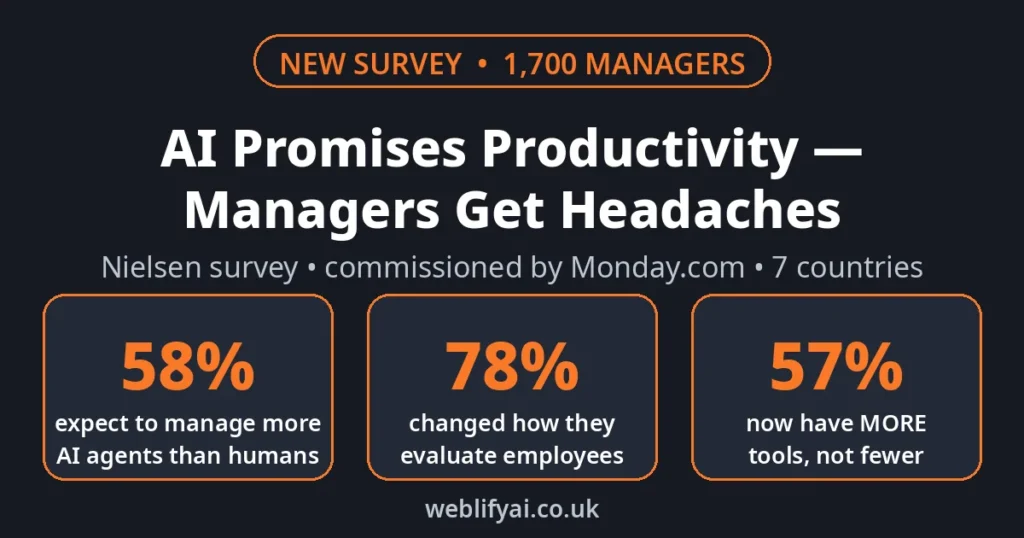
Monday.com released research by Nielsen polling 1,700 directors and senior managers across seven countries about how AI has changed their working lives. The headline findings, reported by TechCrunch:
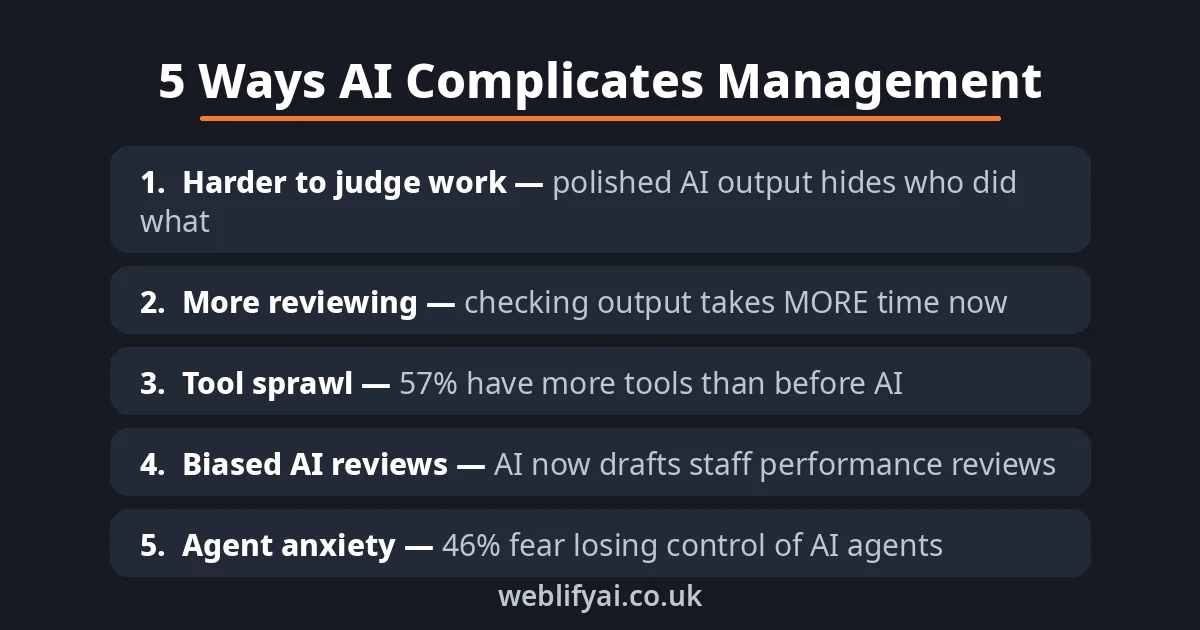
- Judging work got harder. Employees’ output arrives polished in managers’ inboxes, making it difficult to tell how much came from the employee and how much from AI. Nearly half of managers now spend more time reviewing and guiding their teams’ output than before.
- Evaluation criteria are shifting. 78% of respondents changed how they evaluate employees after adopting AI, putting greater weight on prompt skills, knowing which tasks to delegate to AI, and experimenting with new ways of working.
- Managers use AI to judge people — with risks attached. 46% use AI to inform decisions; 39% of leaders use AI to draft performance reviews. Research from the Luxembourg Institute of Socio-Economic Research suggests LLMs tend to rate performance similarly to humans when objective standards are absent — and an early-2025 research paper found models can show significant bias varying across social groups.
- The tool stack exploded. Businesses expected AI to consolidate their software. Instead, 57% of managers say they have more tools in circulation than before AI, with shadow AI — staff using unapproved tools — spreading fast. Only 29% call their AI infrastructure fully optimised and centralised.
- The agent era is arriving fast. 58% expect to oversee more AI agents than human employees within the next year; 46% worry about losing control of agents’ actions, and 35% fear being held responsible for decisions AI makes.
Michal Miller Levi, Monday.com’s head of market research, compared the excitement to the early internet in the 2000s — the struggle is that “AI is just moving faster than the organizational processes.”
What it means for UK small businesses
This survey is really about organisations with layers of management — but small UK businesses should read it as an early warning, not a problem for someone else:
- Output quality is no longer proof of competence. If you outsource or employ anyone using AI, “great-looking work” isn’t evidence it was done carefully. Verify the reasoning behind deliverables, not just the finish.
- You need a one-page AI policy before the mess starts. Decide which tools are approved, what business data can be pasted into them, and who reviews AI-produced work before it reaches clients. This is basic GDPR hygiene too.
- Buy AI for outcomes, not output volume. The survey shows polished volume isn’t productivity. Pilot AI on one measurable workflow — like automating lead follow-up — and track hours saved or errors avoided.
- Expect the agent conversation soon. If your agency or software suppliers talk about “agents handling it end to end,” ask who reviews the agent’s actions and who is liable when it’s wrong — 35% of managers are already afraid of that answer.
Honest limits / what to watch
- Commissioned research, read carefully. The survey was commissioned by Monday.com, a work-management company that sells exactly the kind of consolidation the report recommends. The findings are plausible and consistent with other research, but treat them as directional, not gospel.
- Seven countries, unspecified mix. The report doesn’t detail how UK managers compare with the rest — British employment law on performance reviews and data protection (GDPR) makes the AI-drafted-review trend riskier here than elsewhere.
- Agents overseeing is still a prediction. The 58% figure is an expectation, not a measurement — treat “managers will oversee more agents than humans” as a signal of direction, not a 2027 fact.
- This won’t reverse. The headache comes from adoption running ahead of governance. Businesses that build simple approval and review habits now will feel the productivity gain; those that don’t will just feel the chaos.
FAQs
Why are managers finding AI harder to manage than expected?
Employees’ work now arrives polished and AI-assisted, making it hard to tell how much effort or judgement came from the person. Nearly half of managers say they spend more time reviewing and guiding output than before AI, and 78% have changed how they evaluate staff — weighing prompt skills, task delegation to AI, and experimentation instead.
What is shadow AI and why does it worry managers?
Shadow AI is employees using AI tools outside their company’s approved systems. The Nielsen/Monday.com survey found 57% of managers now have more tools in circulation than before AI, and only 29% describe their AI setup as fully optimised and centralised. More tools means more data scattered in places the business can’t see or secure.
Are managers using AI to evaluate employees?
Yes — 46% use AI to inform decisions and 39% of leaders use AI to draft performance reviews. The risk is bias: large language models are prediction machines trained on human patterns, and research has found they can reproduce human biases, including varying ratings across social groups, when objective standards are absent.
Will managers soon oversee more AI agents than people?
58% of surveyed managers expect exactly that within the next year. Nearly half worry about losing control over agents’ actions, and 35% fear being held personally responsible for decisions an AI makes. For small businesses, this underlines why agent deployments need clear guardrails and human checkpoints before scaling.
How should a small business manage AI without creating this mess?
Start with a short approved-tools list and a one-page AI usage policy covering what data can go into tools and who reviews AI-produced work. Assign one person to own the tool stack, and judge AI pilots on business outcomes — time saved, errors avoided — not on output volume. Consolidate before you expand.