
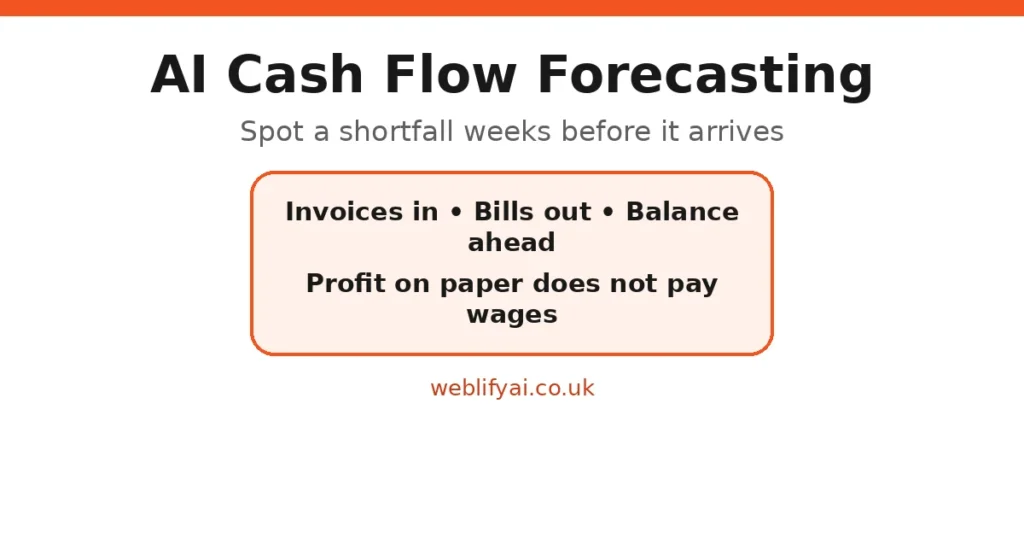
Direct answer: AI cash flow forecasting for a small business means software that looks at your issued invoices, your upcoming bills, your payroll dates, and how your customers actually pay, and projects your bank balance forward week by week — so a shortfall shows up while you still have time to fix it. It does not predict the future. It turns the information already sitting in your accounts into an early warning, updated every time money moves. For a UK small business, that warning is worth more than any profit figure, because profit on paper does not pay wages, suppliers, VAT, or HMRC on the day they fall due.
Profit is not cash, and that distinction closes businesses
Every accountant has met the profitable business that ran out of money. The pattern is familiar. A trades firm wins a large job, buys materials, pays staff and subcontractors, and waits sixty days for the client to pay. A design agency finishes a project, issues the invoice, and the client queries one line and delays payment by a month. A retailer stocks up for Christmas in October and pays suppliers in November, while the sales arrive in December and January. On paper each business is profitable. In the bank account, each one hits a week where outgoings exceed what has actually arrived.
Cash flow is simply that timing gap, tracked day by day. Money in means money received, not money invoiced. Money out means money that must leave the account on a specific date: wages, rent, supplier payments, loan repayments, VAT, and tax. A forecast lines those two streams up over the coming weeks and shows the balance at each point. If the line dips below zero in week six, you have six weeks to act. If you only discover the dip in week six, you have no time at all.
Traditional forecasting failed small businesses for the same reason traditional expense tracking did: it asked a busy owner to build and update a spreadsheet by hand, from memory, at the exact moment they were busiest. Spreadsheets went stale within a fortnight, and a stale forecast is worse than no forecast, because it gives false confidence. AI forecasting changes the updating, not the underlying maths. The software refreshes the forecast as invoices are issued, bills arrive, and payments land, so the picture stays current without a weekly spreadsheet session.
What AI cash flow forecasting actually does
At its core, a forecasting tool does four things, and understanding each one tells you what to trust and what to question.
First, it gathers. It connects to your bank accounts and your accounting software, pulls in open invoices and their due dates, recurring bills, and scheduled outgoings, and builds a timeline of expected receipts and payments. Some tools also read invoice payment behaviour: if a particular customer usually pays twenty days late, the forecast can reflect that reality rather than the due date on paper.
Second, it projects. For the weeks ahead, it places each expected receipt and payment on the date it is expected to happen, and calculates a running bank balance. Recurring items — rent, software subscriptions, loan repayments — are carried forward automatically. One-off items you have entered, such as a planned equipment purchase or a tax bill, appear on their dates.
Third, it updates. When a customer pays early, the forecast improves immediately. When a bill arrives that was not expected, the forecast worsens immediately. When a new invoice is issued, the expected receipt moves into the timeline. The forecast is a living picture, not a document produced once a quarter.
Fourth, it scenarios. Most tools let you ask “what if” questions: what if our largest customer pays a month late, what if we take on that extra member of staff, what if we buy the van now instead of in three months. Scenarios do not tell you what will happen. They show you which futures you can survive and which ones need a plan.
What the tool cannot do is equally important. It cannot know about a deal that has not been invoiced, a cost you have not entered, or a customer who has quietly decided not to pay. It forecasts from recorded data. Anything that lives only in your head or in an unrecorded conversation is invisible to it until you enter it. That is why the most important forecasting habit is not technical at all: it is entering expected income and costs promptly, including the awkward ones.
The UK dates that must be in every forecast
A UK forecast that omits the big statutory and payroll dates is a work of fiction. These are the outflows that most often surprise small businesses, because they are large, infrequent, and easy to forget until the letter arrives.
Payroll comes first, because it repeats every month and because missing it damages trust faster than any other failure. Include gross wages, employer National Insurance contributions, and pension contributions, on the dates they leave the account, not the dates they are calculated. If you run payroll through software, those dates should be visible; make sure they feed the forecast rather than sitting in a separate system.
VAT comes second. VAT-registered businesses account for VAT quarterly in most cases, and the payment date follows the quarter end. The standard VAT rate is 20%, and the registration threshold is £90,000 of taxable turnover. A quarter with strong sales can produce a VAT bill that dwarfs a normal month’s costs, and it arrives whether or not your customers have paid you yet. That timing trap — paying VAT on sales invoiced but not yet received — is one of the most common cash flow shocks for growing businesses, and it is entirely foreseeable if the VAT dates are in the forecast.
Tax comes third. For a limited company, corporation tax is generally payable nine months and one day after the end of the accounting period, and the amount depends on profits, so it needs an estimate entered well in advance. For sole traders and partners, self-assessment payments on account fall on 31 January and 31 July, with a balancing payment on 31 January. These dates are fixed and knowable years ahead. There is no excuse for a forecast that first mentions a tax bill in the month it falls due, and no tool can rescue a business that has not set money aside for it.
Loan and finance payments come fourth. Loan repayments, asset finance, and any director’s loan account movements should be dated exactly. A forecast that shows the loan payment but not the month a finance agreement ends, or a balloon payment falls due, is only half a forecast.
Finally, seasonal patterns deserve explicit attention. If your business is quiet in January, busy in summer, or dependent on Christmas trading, that pattern should be visible in the forecast as a shape, not as a surprise. AI tools that learn from your history can help here, because they can reflect last year’s pattern, but they cannot know about a new season, a lost contract, or a market change. You supply the context; the tool supplies the arithmetic.
Building your first forecast: a practical method
You do not need to buy software to understand the method, and understanding the method first means you will judge any tool properly when you trial it. Work through these steps in order, on paper or in a spreadsheet, before you automate anything.
Step one is to list your fixed monthly outgoings: rent, salaries, loan repayments, insurance, core software, and any retainer or subscription that leaves the account every month. These are the floor of your forecast. Whatever else happens, this money leaves.
Step two is to list your variable but predictable outgoings: materials or stock tied to jobs in progress, subcontractor costs, fuel, and utilities that vary by season. Tie each one to the work it supports, not to a generic monthly average, or the forecast will smooth over the very spikes that cause trouble.
Step three is to list your expected receipts, invoice by invoice, with the date you realistically expect payment, not the due date. If a customer reliably pays two weeks late, forecast two weeks late and treat on-time payment as good news. For work not yet invoiced, enter it only when you have a firm order or contract, and date it at the realistic invoice date plus the realistic payment lag.
Step four is to add the large infrequent items: VAT payments, tax payments, annual insurance renewals, equipment purchases, and any planned hiring. Date each one precisely and check it against the calendar, not against memory.
Step five is to calculate the running balance week by week, starting from today’s actual bank balance, not from an average or a hoped-for figure. The opening balance is the one fact in the whole forecast that is not an estimate. Get it right.
Step six is to look at the lowest point, not the average. A forecast that averages out fine but dips below zero for two weeks in March is a forecast with a problem in March. The question is always: what is the lowest balance, when does it happen, and what will we do about it?
Once you have done this once by hand, automating it makes sense, because the tool will repeat steps one to six every day from live data, and you will only need to check the assumptions and add the one-off items the tool cannot know about.
A worked example: spotting a shortfall eight weeks early
Consider a small marketing agency with three staff, monthly payroll, office rent, and a handful of retainer clients plus project work. In early September the agency looks healthy: invoices issued, work in progress, and a comfortable bank balance. A manual glance at the account would show no problem.
The forecast tells a different story. Two large project invoices are due in late September, but both clients have a history of paying around three weeks late. Payroll, rent, and software costs fall in early October. A quarterly VAT payment is due in early November, calculated on a strong summer quarter. And the agency’s largest retainer client has given notice, ending in October, which means November’s retainer income drops.
Week by week, the forecast balance falls through October as payroll and rent leave before the late project payments arrive, recovers briefly when those payments land, and then falls again in early November when the VAT payment leaves before November’s reduced retainer income arrives. The lowest point is a shortfall in the second week of November, eight weeks away.
Eight weeks is enough time to act. The agency chases the two project invoices now, politely and early, offering a small prompt-payment incentive the owner can afford. It agrees a short extension with one supplier before any payment is missed. It confirms the VAT figure with the accountant and sets the amount aside in a separate account immediately, rather than treating the full bank balance as available. It brings forward a piece of retainer work that can be invoiced in October. None of these actions is dramatic. All of them are only possible because the problem was visible in September, not discovered in November.
That is the entire value proposition of forecasting in one story: time. The forecast did not create money. It created eight weeks in which to move money, chase money, and negotiate, instead of a week in which to panic.
How AI forecasting differs from a spreadsheet
A spreadsheet forecast and an AI forecast contain the same logic. The differences are in updating, in payment behaviour, and in visibility, and each difference matters in a specific way.
Updating is the biggest difference. A spreadsheet is correct on the day it is built and drifts out of date from the next morning, unless someone maintains it. An AI tool rebuilds the forecast from live bank and invoice data, so a payment received yesterday is reflected today without anyone opening a file. For a business where the owner is also the salesperson, the project manager, and the bookkeeper, that automatic updating is often the difference between having a forecast and having an abandoned spreadsheet.
Payment behaviour is the second difference. A spreadsheet usually assumes customers pay on their due dates. A tool that has seen your history can adjust for reality: this customer pays late, that one pays early, this sector slows down in August. That adjustment is only as good as the history behind it, and a new business with no history gets little benefit from it. But for an established business, forecasting from actual behaviour is materially more honest than forecasting from due dates.
Visibility is the third difference. A forecast inside your accounting software is visible where you already work, and it can be shared with your accountant without exporting files. A spreadsheet lives on one person’s computer, and when that person is on holiday, nobody else can update it. Shared visibility matters most in the week a problem appears, when decisions need to be made quickly and by more than one person.
None of this means a spreadsheet is wrong. A well-maintained spreadsheet, updated weekly by a disciplined owner, beats a neglected AI tool every time. The honest question is not which method is better in theory, but which one will still be current in three months in your actual business, with your actual workload. Choose the one you will maintain, and be honest about your own habits when you answer.
Reading a forecast without fooling yourself
Forecasts invite a particular kind of self-deception, and it is worth learning its shapes before you trust one.
The first shape is optimistic receipts. Every future invoice is entered at full value and on time, every prospective client is counted as won, and no allowance is made for late payment, disputes, or bad debts. The fix is a simple discipline: forecast only invoiced work and firm orders at realistic payment dates, and show prospective work as a separate scenario, not in the main forecast.
The second shape is missing costs. The forecast includes rent and payroll but forgets the annual insurance renewal, the accountant’s fee, the software renewal that bills annually, or the director’s drawings. The fix is to review a full year of bank statements when you build the forecast and ask, for each large outflow, whether it repeats and when it repeats next.
The third shape is treating the forecast as a promise. A forecast is a model built from assumptions, and assumptions change. A customer goes bust, a supplier raises prices, a job is delayed. The forecast must be re-read when reality changes, and the scenario feature exists for exactly this reason. Run the pessimistic scenario regularly, not just when things already look bad.
The fourth shape is ignoring the forecast when it turns red. This is surprisingly common. An owner sees a shortfall in six weeks, feels anxious, and avoids opening the forecast again, as if not looking changes the arithmetic. The forecast is not a judgement. It is information, and information is only useful when acted on. If the forecast shows a problem, the next step is a conversation — with customers, suppliers, your accountant, or your bank — while options are still open.
What to do when the forecast shows a shortfall
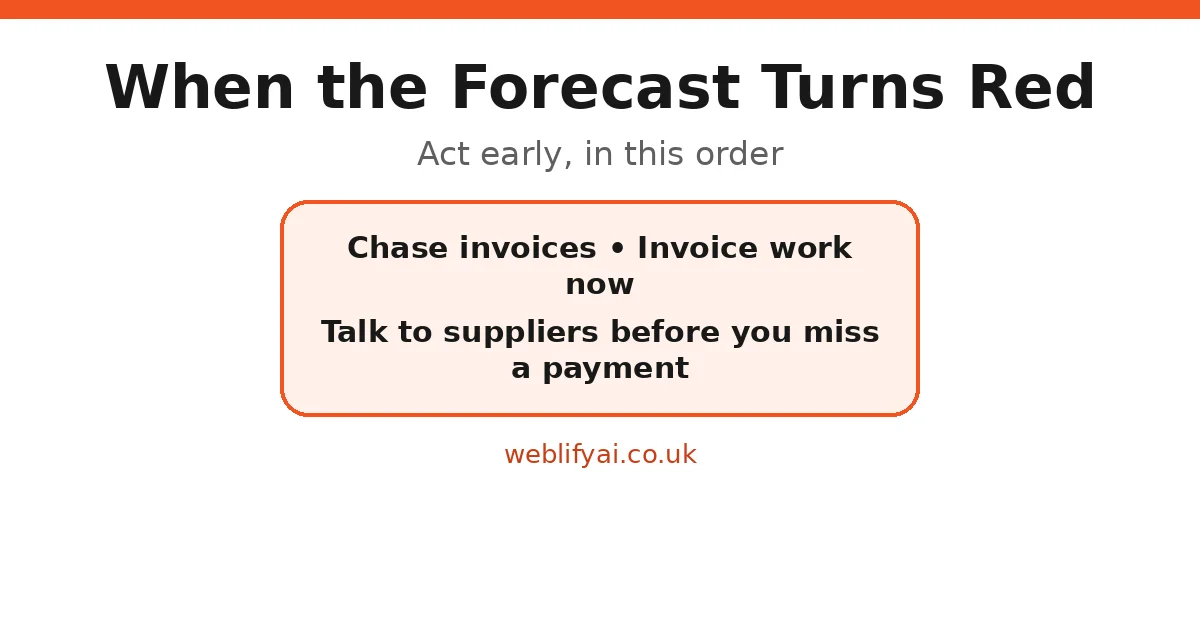
A red week in a forecast is not a crisis. It is a timetable. Work through actions in order of speed and cost, and start with the ones that cost nothing.
Chase overdue invoices first, and chase them personally. A phone call from the owner recovers money faster than a third automated reminder, and it often reveals a simple problem — an invoice sent to the wrong person, a query nobody raised — that can be fixed the same day. Check first whether anything you are owed is actually overdue, rather than merely not yet due.
Bring forward invoicing second. If work is complete or a milestone is reached, invoice it now rather than at month end. Agree milestone billing on larger jobs so that cash arrives during the work, not only at the end of it.
Negotiate with suppliers third, and do it before you miss a payment, not after. Suppliers would generally rather agree a short extension with a customer who communicates early than chase a customer who goes silent. The same applies to HMRC: if a tax payment will be difficult, contact HMRC early to discuss time to pay. Early, honest contact preserves options that silence destroys.
Review discretionary spending fourth. Pause or delay purchases that are not needed before the shortfall passes. This is not about cutting costs permanently; it is about moving spending to the other side of the dip.
Talk to your accountant and, if needed, your bank fifth, while the forecast still shows a path through. An accountant can check whether the forecast is realistic, whether tax can be managed differently, and whether a short-term facility is sensible. A bank approached with a forecast, a plan, and eight weeks of notice is in a very different position from a bank approached with an empty account and no plan.
What you should not do is ignore the forecast, borrow without a repayment plan, or pay yourself or a dividend while the business faces a shortfall it cannot cover. Cash flow problems become insolvency problems when directors keep extracting money a business does not have. If the forecast shows a sustained problem rather than a temporary dip, take professional advice promptly. That advice is part of running a business, not a sign of failure.
Choosing a forecasting tool
Forecasting features now appear in accounting platforms, in dedicated cash flow tools, and as add-ons, and the right choice depends on where your financial data already lives.
If your accounting software already offers forecasting, start there. The data is already connected, the learning curve is small, and the forecast will reflect your invoices and bills without a new integration. Check whether it handles payment behaviour, scenarios, and the large UK dates described above, or whether it is simply a chart of past balances, which is not a forecast at all.
If you need deeper forecasting — multi-entity views, detailed scenarios, or project-level cash flow — a dedicated tool may be justified. Check that it connects to your bank and your accounting software, that it updates daily, and that you can enter one-off items and assumptions easily. A tool that makes assumptions hard to change will be abandoned the first time reality diverges from the model.
If you run payroll, invoicing, and expenses in separate systems, the forecasting decision is also an integration decision. Cash flow visibility improves when the pieces connect, and that is true beyond forecasting itself. Businesses that have sorted their expense capture, for example, already have cleaner cost data feeding any forecast, and our guide to AI bookkeeping for UK small businesses shows how the underlying records fit together. On the invoicing side, how to automate invoicing with AI explains getting invoices out promptly, which is what turns expected income into received cash. For the income side, automated payment reminders for UK businesses covers the chasing that turns invoiced work into received cash, which is what a forecast ultimately depends on.
| Option | Best for | Strengths | Watch out for |
|---|---|---|---|
| Forecasting inside your accounting software | Most small businesses | Data already connected, low cost, easy to maintain | May lack scenarios or payment-behaviour adjustment |
| Dedicated cash flow tool | Larger or project-based businesses | Scenarios, multi-entity views, deeper analysis | Extra subscription, integration to verify |
| Spreadsheet forecast, updated weekly | Very small or new businesses | Free, fully transparent, forces understanding | Goes stale fast, depends on one person’s discipline |
| Accountant-prepared forecast | Businesses facing a decision or a difficulty | Professional assumptions, lender-ready format | Snapshot in time, not a living daily picture |
Trial any tool on your real data for a full month, including a payroll run and, if possible, a VAT quarter. Check whether the forecast changed sensibly when a customer paid late, whether one-off tax dates appeared correctly, and whether you actually opened it more than once. A tool nobody opens is decoration, however sophisticated its model.
Common forecasting mistakes
Entering income at invoice value without allowing for late payment is the most common mistake, and the most easily fixed: use realistic payment dates from your history. Forgetting annual and quarterly costs is the second: review twelve months of bank statements when you build the forecast, not just last month. Counting prospective work as certain income is the third: keep it in a scenario until it is ordered. Treating the bank balance as available cash when tax and VAT are still owed is the fourth: mentally, and ideally physically, separate money owed to HMRC from money the business can spend. And building a forecast once and never revisiting it is the fifth: a forecast is a routine, like checking the bank, not a project with a finish date.
One more mistake deserves a mention because it is easy to make with AI tools specifically: trusting the model’s confidence. A beautifully presented forecast with a precise balance in week twelve can feel more certain than it is. Week twelve’s balance rests on a chain of assumptions, each of which can move. Treat near-term weeks as planning and distant weeks as scenarios, and keep the distinction explicit when you discuss the forecast with staff, partners, or a lender.
Honest limits
AI cash flow forecasting is a genuinely useful early-warning system, and its limits are worth stating plainly. It forecasts from recorded data, so unrecorded income, unentered costs, and verbal agreements are invisible to it. It learns payment behaviour from history, so it is weakest for new businesses, new customers, and changed circumstances, exactly when a forecast would be most valuable. It cannot foresee a customer going bust, a contract being cancelled, or a market shock, and a forecast that looks comfortable can become wrong overnight. It depends on bank feeds and integrations that occasionally break, and a broken feed silently freezes the forecast unless someone notices. It also cannot make decisions: whether to chase a customer firmly, delay a purchase, or seek finance remains a human judgement, informed by the forecast but not made by it.
There is also a data-protection point. Forecasting tools hold bank and invoice data, which is sensitive. Check who can access the forecast, what happens to your data if you cancel, and whether the provider’s security meets the standard your accountant would expect. And remember that a forecast shared with a lender or investor will be read as a statement about your business. Share the assumptions alongside the numbers, including the pessimistic scenario, or the forecast will be read as more certain than it is.
None of this is a reason not to forecast. It is a reason to forecast with your eyes open, to check the assumptions as carefully as the arithmetic, and to keep a human review in the loop before any decision that commits money. The tool gives you time. What you do with that time is still the business.
A weekly forecasting routine that survives busy periods
The routine that works is short enough to survive a busy week, because a routine that needs an hour will be dropped in the week it matters most.
Once a week, at the same time, open the forecast and check three things. First, the lowest balance in the next thirteen weeks: has it moved, and why? Second, the unmatched or unentered items: is there income or cost that the system does not yet know about? Third, the assumptions: has any large customer changed their payment behaviour, has any large cost moved, has any expected order changed? Update what has changed, note what you still need to find out, and move on. Ten minutes, once a week, keeps a forecast honest. An hour once a quarter does not.
Once a month, do the longer check: reconcile the forecast’s opening balance to the actual bank balance, review the last month’s forecast against what actually happened, and ask where it was wrong and why. That monthly review is how you learn whether your payment assumptions are right, whether costs are missing, and whether the tool is earning its place. If the forecast was consistently wrong in the same direction, fix the assumption, not the tool.
FAQs
What is AI cash flow forecasting for a small business?
It is a forecast of money coming in and going out, built from your invoices, bills, bank history and payment patterns, and updated automatically as new transactions appear, so you can see a shortfall coming instead of discovering it on payday.
How far ahead can AI forecast cash flow reliably?
Short-term forecasts of four to thirteen weeks are usually the most useful, because they rest on invoices already issued and bills already due. Longer forecasts are scenarios to plan around, not predictions to rely on.
Does AI cash flow forecasting replace a spreadsheet forecast?
It replaces the manual updating of a spreadsheet, not the thinking behind it. You still set the assumptions, enter expected one-off costs, and decide what to do when the forecast turns red.
What data does AI cash flow forecasting need?
It needs connected bank accounts, issued invoices with due dates, recurring bills, and payroll dates. The more complete and current that data is, the more the forecast reflects reality rather than guesswork.
Can AI forecasting help with VAT, tax and payroll dates?
Yes, if those dates and amounts are entered or recognised in the system. VAT quarters, corporation tax or self-assessment payments, and payroll runs are often the large outflows that catch businesses out, so they belong in the forecast explicitly.
What should I do when the forecast shows a shortfall?
Act early and in order: chase overdue invoices, bring forward work you can invoice, agree payment terms with suppliers before you miss a payment, and talk to your accountant or bank while you still have options, not after the account is empty.