Direct answer:
Direct answer: A flock of tiny waddling robots just became the most talked-about product of the week. After NVIDIA CEO Jensen Huang played with Microduck robots during his keynote at the company’s GTC Berlin conference, a video of the moment went viral — and by the next day, preorders had passed 20,000 units. The robots, made by Pollen Robotics, walk, sit, fall down for a “nap” and do somersaults on voice command, and they are expected to arrive in time for Christmas. Cute? Unquestionably. A serious signal about consumer robotics and open-source AI hardware? Also yes.
What happened
The story, reported by TechCrunch on 23 October 2026, begins earlier in the week at GTC Berlin, NVIDIA’s developer conference. During his keynote, Jensen Huang played with a flock of Microducks on stage. The robots stomped their little feet, made tiny noises that TechCrunch likened to R2-D2, sat down, fell over “dead” for a nap, and performed somersaults on voice command. It was, by every account, an irresistibly charming demo — the kind of moment that escapes the tech press entirely and lands in everyone’s social feed.
The numbers followed fast. By the next day, preorders of the Microducks had surpassed 20,000 units, according to a post by Hugging Face CEO Clem Delangue. Delangue went further, suggesting the robots might end up being the best-selling robot of the year — and possibly not even for children, since the promotional videos show adults playing with them too. TechCrunch’s verdict was that the robots might already be on their way to becoming the hottest toy for the holiday season, given that deliveries are expected in time for Christmas.
It is worth being precise about what that 20,000 figure is. It is a preorder count, reported by the CEO of the company behind the product, not an independently audited sales figure, and preorders are not deliveries. Customers have committed to buy; the robots still have to be manufactured, shipped and delivered on time for Christmas. That caveat does not make the story less interesting — 20,000 preorders in a day for a small open-source robot is remarkable by any measure — but it does mean the “best-selling robot of the year” claim is a prediction, not a result. Keep that distinction in mind when you see the number quoted elsewhere without qualification.
The corporate story behind the ducks is almost as interesting as the ducks themselves. Microducks are open-source devices produced by Pollen Robotics, a company acquired by Hugging Face in 2025. Hugging Face, in turn, was acquired by NVIDIA in September 2026, according to TechCrunch — which makes Microducks, in the article’s phrasing, now an NVIDIA company product. That chain matters because it explains how a small French robotics company’s charming toy ended up on stage with the world’s most valuable chipmaker: Pollen Robotics is Hugging Face’s robotics arm, Hugging Face is NVIDIA’s open AI platform, and Microducks are a showcase for what happens when open models, simulation and consumer hardware meet.
This is Hugging Face’s second robot, after the also-cute Reachy Mini, a small desktop robot that has become something of a mascot for open robotics. Reachy Mini matters here for two reasons. First, it established Pollen Robotics’ formula: small, expressive, open, affordable-ish robots that people actually want on their desks. Second, it is the same robot family that featured in NVIDIA’s Nemotron Bolt demo, where a Reachy Mini chatted and moved using a locally run language model and vision model. Microducks are the next step in that formula: simpler, cheaper, more numerous — a flock rather than a single companion — and designed to be trained, customised and shared by their owners.
How Microducks actually work
A Microduck is not a remote-controlled toy with a few pre-recorded movements, and it is not a miniature version of a humanoid robot either. Understanding how it works explains both why people love it and why engineers are paying attention.
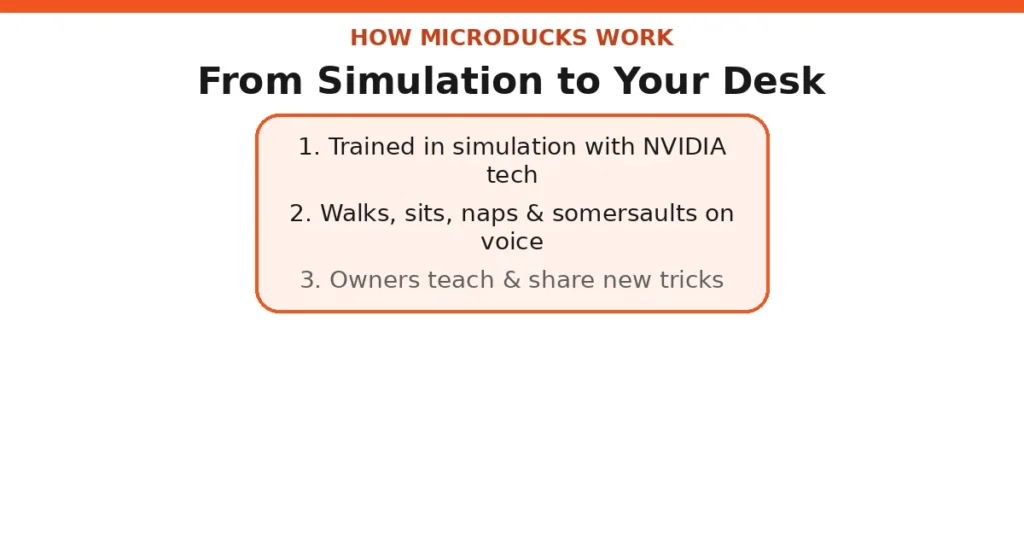
The starting point is simulation. Microducks were trained using NVIDIA’s technology stack, in which simulations of the robots were taught basic tricks — walk, sit, stand and similar movements — that they ship with. Training in simulation, rather than only on physical robots, is a standard technique in modern robotics, and it is worth explaining why. A physical robot can only practise so many times before its motors wear out, its battery dies or it falls off a table. A simulated robot can practise millions of times, in parallel, in varied conditions, without breaking anything. The skills learned in simulation are then transferred to the real robot, with adjustments for the differences between the simulated world and the physical one — friction, weight, motor delays, sensor noise. That transfer, from simulation to reality, is one of the hardest problems in robotics, and it is precisely the problem NVIDIA’s robotics stack is built to solve.
Once shipped, the ducks respond to voice commands — sit, somersault, and the rest of their repertoire — and they make small expressive sounds while they move. The viral video’s details are telling: the ducks did not just execute commands, they performed. They stomped, they waddled, they fell down “dead” for a nap. That performative quality is deliberate. A robot that moves with character feels alive in a way that a robot that merely moves does not, and that feeling is what turns a gadget into a companion, a gift and a social media moment. Pollen Robotics’ design philosophy, visible across Reachy Mini and Microducks, is that expressiveness is a feature, not decoration.
The second half of the design is openness. Pollen Robotics says owners can train their robots with new tricks and then share them with the community. Because Microducks are open source, the hardware designs, software and training approaches are available for owners, hobbyists, students and developers to inspect, modify and extend. That is a fundamentally different proposition from a typical toy robot, where the owner gets whatever behaviours the manufacturer shipped and nothing more. A Microduck owner who teaches their duck a new dance, a new greeting or a new trick can share it, and other owners can try it. Over time, the community’s library of behaviours becomes part of the product’s value — assuming the community forms, the tools are usable, and the sharing infrastructure works. Those are real assumptions, and they will be tested in the months after delivery.
The third piece is the AI agent connection. NVIDIA’s own social post, quoted by TechCrunch, framed the demo in agent terms: “When Jensen Huang asks for a somersault, you deliver. See how AI agents on NVIDIA RTX Spark help bring Hugging Face’s Microduck from simulation to the real world.” RTX Spark is NVIDIA’s small AI computer line, and the point is that the same agent infrastructure that runs on developer hardware can drive a consumer robot. That is the strategic thread running through this whole story: NVIDIA is not just selling chips for data centres. It is building a stack — simulation, models, agent runtimes, small computers, robots — that runs from the cloud to the living room. Microducks are the cutest possible demonstration of that stack, and cuteness, in this case, is a distribution strategy.
What Microducks are not, at least on current reporting, is equally important. There is no claim in the TechCrunch report that a Microduck is a general-purpose household assistant, a tutor, a security device or a replacement for a pet. It does not cook, clean, guard or diagnose. It waddles, sits, naps, somersaults and charms. Its intelligence is narrow and embodied: movement, expression, voice response and learnable tricks. Judged as a companion toy and an open robotics platform, that is plenty. Judged as a serious domestic robot, it would be a disappointment — but that is the wrong yardstick, and part of the product’s appeal is that it does not pretend otherwise.
Two practical facts are conspicuously absent from the reporting so far, and buyers should note them. TechCrunch’s article does not state a retail price for Microducks, and it does not state an age recommendation, battery life or warranty terms. Do not trust any price, age rating or specification you see quoted without a source that traces back to Pollen Robotics or Hugging Face. Preorder listings, retailer pages and the official product page are the places to check before ordering, and if a listing cannot tell you the price, delivery date and returns policy clearly, treat that as information in itself.
Why a toy robot matters to serious people
It is easy to dismiss a viral duck video as a palate cleanser — TechCrunch itself called it exactly that, “after the scary black eye the AI industry gave itself this week, as AI involvement was blamed for cyberattack after cyberattack.” But there are at least four serious reasons why engineers, investors, retailers and educators are paying attention.
First, consumer robotics has a long history of overpromising and underdelivering. Household robots have been “five years away” for decades, and most consumer robots that actually shipped were either expensive, fragile, boring or all three. A robot that sells 20,000 preorders in a day, at a price point implied by its toy positioning, suggests the market may finally be ready for simple, expressive robots that do a few things delightfully rather than many things badly. If Microducks deliver on time and owners love them, expect a wave of imitators, accessories and community projects — and expect larger companies to take the “flock” model seriously: many cheap, expressive robots rather than one expensive, capable one.
Second, open-source hardware changes who gets to innovate. When a robot is open, a school can teach robotics with it, a university lab can modify it, a startup can prototype on it, and a hobbyist can fix it instead of throwing it away. That ecosystem effect is why Hugging Face’s acquisition of Pollen Robotics mattered, and why NVIDIA’s acquisition of Hugging Face matters more: an open robotics platform backed by the world’s leading AI chip company has resources, distribution and credibility that a small startup alone could not command. The risk, of course, is that openness fades as the product scales — community tools neglected, designs closed, repairs restricted. Watch whether Pollen Robotics keeps publishing designs, code and training tools after the Christmas rush. That behaviour, more than any launch statement, will tell you whether “open source” is a philosophy or a marketing line.
Third, simulation-trained robots are a proof point for physical AI. NVIDIA has invested enormously in the idea that robots should be trained in simulation and deployed in the world, and Microducks are a small, visible test of that pipeline. If thousands of owners train new tricks and share them, the data and feedback from real homes will improve the next generation of simulation-trained robots — including more capable ones for warehouses, hospitals and factories. The duck is a toy; the pipeline is industrial. Investors in robotics will read the preorder numbers not as toy sales but as evidence that the simulation-to-reality pipeline can produce products people actually want.
Fourth, the timing matters. A Christmas delivery window concentrates attention, gift budgets and media coverage into a few weeks. If Microducks arrive on time and delight their owners, they will dominate social feeds through December and become the default example of “AI you can touch” in year-end coverage. If they slip, arrive faulty or disappoint, the same concentration will amplify the disappointment. Manufacturing at scale, quality control across thousands of units, and customer support for a community of new owners are unglamorous problems, and they are where many viral hardware products stumble. The next two months are the real test.
What it means for UK small businesses
For UK small businesses, Microducks are not a product to stock on a whim, but they are a useful lens on several real opportunities. Work through them by sector.
For toy retailers, gift shops, department stores and online sellers, the immediate question is whether to stock or list Microducks, and the answer depends on your channel. If you sell through a marketplace or distributor that carries Pollen Robotics products, the preorder surge is a demand signal worth acting on — but check the terms before committing: wholesale price, delivery guarantee for Christmas, returns policy for faulty units, and whether you can actually get stock in time. A toy that arrives in January is a different product from a toy that arrives in December. If you cannot guarantee Christmas delivery, say so plainly rather than taking orders you cannot fulfil; nothing damages a small retailer’s reputation faster than a missed Christmas delivery. Also consider the accessory and companion opportunity: display units, demo videos, gift wrapping, and bundled items for the adults who, per the promotional videos, are a real part of the audience. A demo duck in a shop window, waddling and somersaulting, is marketing that pays for itself if footfall follows.
For educators, tutors, STEM clubs, coding schools and training providers, Microducks are a teaching tool with a rare advantage: students already want one. A robot that children and adults find charming is a robot they will persist with when programming gets hard. If the open-source tools are usable, a Microduck can anchor lessons in movement, sensors, simulation, voice control and community sharing — concepts that are abstract on a screen and concrete on a desk. Before building a course around them, verify the practical details: what software is required, what age groups the tools suit, how long setup takes, and what happens when a duck breaks. Order one unit first, teach with it, and only then commit to a class set. The same caution applies to schools considering bulk orders for Christmas or term: one working unit in a teacher’s hands is worth more than a brochure.
For content creators, marketers and agencies, the Microduck moment is a case study in how a demo becomes a movement. The formula is instructive: a credible person (a CEO, but also a creator, a teacher, a customer) playing with a product on camera; a short, shareable moment (a somersault, a nap); a clear next step (preorder); and a community promise (train your own tricks, share them). Small businesses launching a product can learn from that structure without copying the ducks: show the product doing something delightful in under thirty seconds, let a real person react genuinely, and give viewers something to do next. What you should not copy is the scale of the platform — Jensen Huang’s keynote audience is not your audience — but the structure scales down. A local maker, baker or crafts business can film a genuine moment of delight with a fraction of the budget and still earn attention, because delight, unlike production value, is not expensive.
For robotics, engineering and software small businesses, Microducks are a prototyping platform and a hiring signal. If you build automation, inspection, logistics or assistive technology, the simulation-to-reality pipeline behind the ducks is directly relevant to your work, and a team member who has trained a Microduck trick understands that pipeline in a practical way. Consider setting a small internal challenge: buy a few units, train a new behaviour, share it with the community, and see what your team learns about simulation, transfer and user experience. The cost is small, the learning is real, and the community contribution is visible evidence of capability for future clients. For hardware startups, the caution is equally clear: if a cute, open, community-driven robot can sell 20,000 units in a day, your product’s design, story and community matter as much as its specifications. Spec sheets do not go viral. Moments do.
For everyone else — the café, the salon, the accountancy firm, the consultancy — Microducks are a reminder, not a purchase. The reminder is that AI is becoming physical, personal and present in everyday spaces, and that customers, especially younger ones, will increasingly expect to encounter it. A café with a Microduck on the counter is not a technology strategy, but it is a conversation starter, and conversations are how small businesses learn what their customers think about AI. More practically, the Microduck story is a prompt to review your own Christmas and seasonal planning: what is your delightful moment, your shareable demo, your clear next step? If you cannot answer that by November, you are leaving seasonal attention on the table.
Key facts
| Fact | Detail |
|---|---|
| Product | Microduck robots, open-source devices by Pollen Robotics |
| Maker | Pollen Robotics, acquired by Hugging Face in 2025 |
| Owner chain | Hugging Face acquired by NVIDIA in September 2026 (per TechCrunch) |
| Demo | Jensen Huang at GTC Berlin keynote, week of 19 October 2026 |
| Preorders | Passed 20,000 units the day after the viral video (per Hugging Face CEO Clem Delangue) |
| Delivery | Expected in time for Christmas 2026 |
| Behaviours | Walk, sit, stand, somersault, fall down for a “nap”, voice command, R2-D2-like sounds |
| Training | Trained in simulation using NVIDIA’s technology stack |
| Customisation | Owners can train new tricks and share them with the community |
| Predecessor | Reachy Mini, Hugging Face’s earlier robot |
| Not stated in reporting | Retail price, age recommendation, battery life, warranty terms |
Honest limits / what to watch
Begin with the numbers. Twenty thousand preorders is a claim from an interested party — the CEO of the company selling the product — reported by TechCrunch, not an audited sales report. Preorders can be cancelled, delivery can slip, and early enthusiasm can fade. The claim that Microducks could be “the best-selling robot of the year” is a prediction from the same source, not a measured result. Treat the preorder figure as a strong demand signal, not as a sales record, and wait for delivery reports, reviews and any updated figures before repeating it as fact.
Next, the product itself is unproven at scale. A stage demo with a handful of ducks is not the same as thousands of ducks in thousands of homes, with different floors, lighting, noise levels and Wi-Fi conditions. Manufacturing quality, battery safety, durability when dropped by children (or enthusiastic adults), software stability and customer support will all be tested for the first time at scale this Christmas. Early reviews from independent owners — not launch coverage, not promotional videos — are the evidence to wait for. If you are buying for a child, a classroom or a shop, read those reviews before you buy in bulk.
Third, openness needs verification over time. Open-source claims are easy to make at launch and hard to sustain under commercial pressure. Watch whether Pollen Robotics continues to publish hardware designs, software, training tools and documentation after launch, whether community contributions are welcomed or merely tolerated, and whether repairs are supported with parts and guides. A product that starts open and drifts closed still has value as a toy, but it loses the ecosystem value that makes it interesting to educators, developers and makers.
Fourth, privacy and safety deserve a plain-language check before any deployment with children or in a classroom. A voice-controlled robot with a microphone raises obvious questions: what audio is recorded, where is it processed, is it stored, and who can access it? The reporting so far does not answer those questions, and neither should this article invent answers. Before buying for a school, nursery or care setting, read the official privacy information, check whether voice processing happens on the device or in the cloud, and confirm safeguarding and data protection compliance for your setting. Cuteness is not a privacy policy.
Finally, do not let a viral toy distract from the structural story. Microducks matter because they show that open, simulation-trained, expressive robots can capture public imagination and commercial demand. They do not prove that household robots are solved, that AI agents are safe, or that every viral demo becomes a lasting product. The history of consumer robotics is littered with delightful demos that never became reliable products. Microducks have a better starting position than most — a real company, a real platform, a real community promise, and a real preorder surge — but the distance from viral video to beloved product is measured in deliveries, reviews and second-year sales, not in retweets. Watch December closely. The ducks will tell us, by arriving or not, whether this was a moment or a movement.
FAQs
What are Microduck robots?
Microducks are small, open-source robots made by Pollen Robotics that walk, sit, fall down for a nap and do somersaults on voice command. They were trained in simulation using NVIDIA’s technology stack.
Why did Microducks suddenly sell out of attention?
A video of NVIDIA CEO Jensen Huang playing with a flock of Microducks during his GTC Berlin keynote went viral. By the next day, preorders had passed 20,000 units, according to Hugging Face CEO Clem Delangue.
Who makes Microducks?
Pollen Robotics, a company acquired by Hugging Face in 2025. Hugging Face itself was acquired by NVIDIA in September 2026, which makes Microducks, in TechCrunch’s words, now an NVIDIA company product line.
When will Microducks be delivered?
TechCrunch reports they are expected to be delivered in time for Christmas 2026, which is why they are being tipped as a possible hit toy for the holiday season.
Can owners teach Microducks new tricks?
Yes. Pollen Robotics says owners can train their robots with new tricks and share them with the community, because the devices are open source.
Are Microducks only for children?
Not according to the promotional videos, which show adults playing with them too. Hugging Face’s CEO has suggested they could end up being the best-selling robot of the year, and not only for children.
Sources: TechCrunch, “Hottest toy for Christmas? Nvidia CEO plays with adorable Microduck robots, 20,000 sell” (23 October 2026); NVIDIA RTX Spark post quoted therein. Related WeblifyAI reading: NVIDIA and TCV back Higgsfield’s AI video funding and inDrive’s robotaxi tests with Pony.ai and NVIDIA.