
Direct answer:
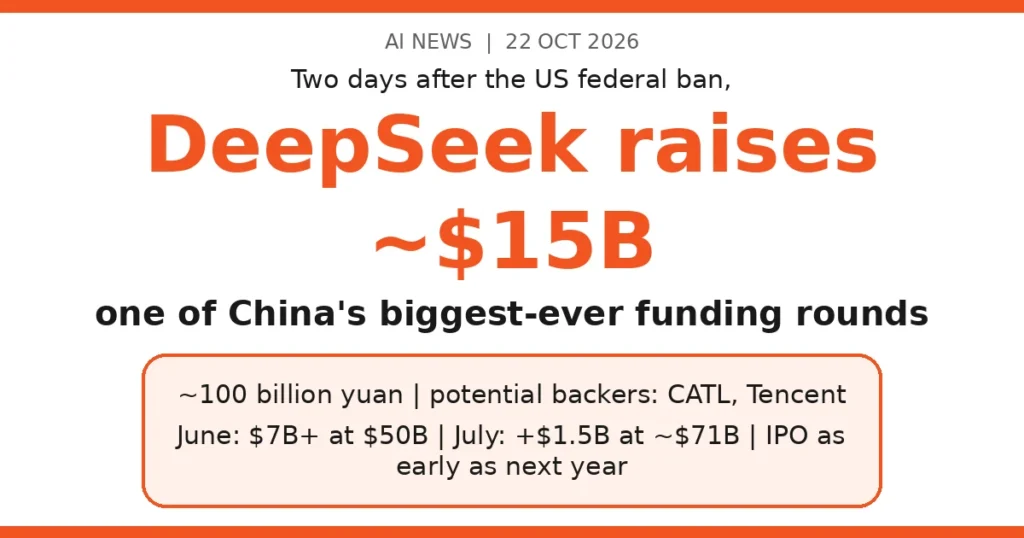
Just two days after the United States ordered federal civilian agencies to strip DeepSeek’s AI technology from their systems over security concerns, the Chinese AI lab has raised about $15 billion — roughly 100 billion yuan — in what Bloomberg reports is one of the biggest funding rounds in China’s history. Potential backers include battery giant CATL and Tencent, the company behind WeChat. DeepSeek is ramping up spending on AI infrastructure and open models even as US restrictions bite.
What happened
The sequence of events is striking. Earlier this week, the US ordered federal agencies to remove DeepSeek from government IT systems, citing national security — a story we covered when the ban landed. Forty-eight hours later, Bloomberg reported that the Hangzhou-based lab had closed a round of roughly $15 billion.
This follows an extraordinary funding run for DeepSeek this year: more than $7 billion at a $50 billion valuation in June, and a reported raise of another $1.5 billion at around $71 billion in July — with plans for a potential IPO in China as early as next year. Founder Liang Wenfeng, who previously co-founded the quant hedge fund High-Flyer that financed DeepSeek’s early development, still holds an estimated 81.6% stake in its Chinese operating entity, according to corporate ownership data analysed by WireScreen.
The money, per the report, is going toward AI infrastructure and open models aimed at both domestic and international markets — a direct push to intensify competition with domestic rivals as well as US labs.
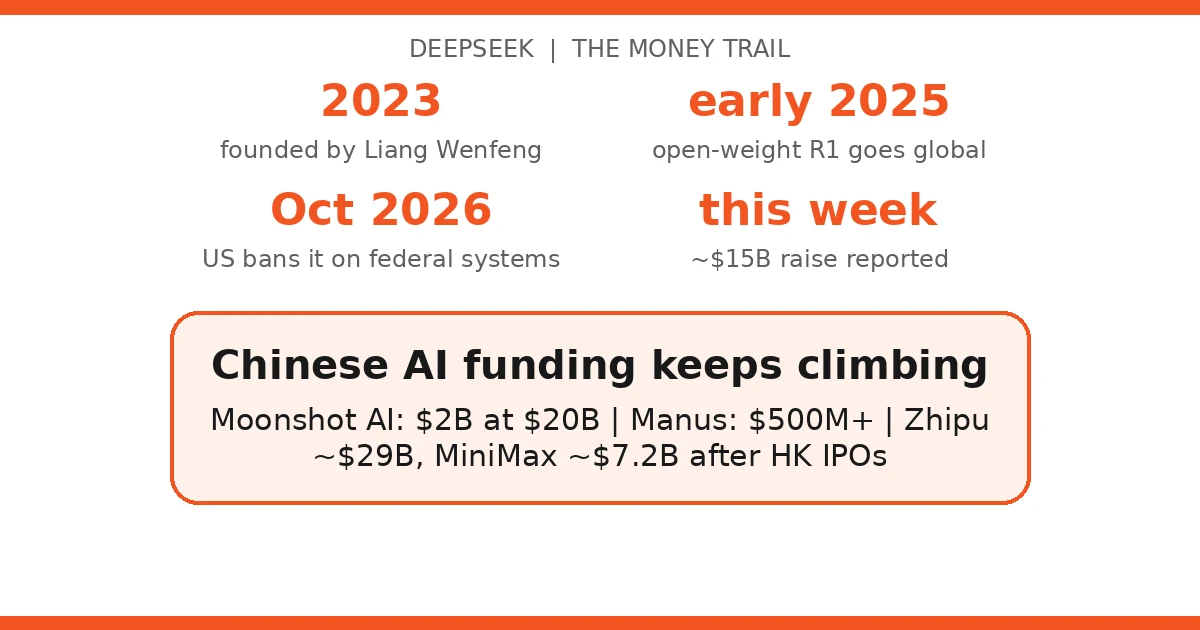
DeepSeek’s rise has been fast. Founded in 2023, it became globally famous in early 2025 when its free-to-use, open-weight R1 reasoning model challenged the dominance of American AI companies — its upgraded V4.1 Flash model launched just days ago. DeepSeek did not immediately respond to TechCrunch’s request for comment on the new raise.
The round also sits inside a wider Chinese funding boom: Kimi developer Moonshot AI secured $2 billion at a $20 billion valuation in May, Manus AI raised more than $500 million earlier this month, and Zhipu AI (Z.ai) and MiniMax both listed in Hong Kong in January, now worth roughly $29 billion and $7.2 billion respectively.
What it means for UK small businesses
For most UK small firms, DeepSeek is not a name on a procurement form — but its pricing pressure is. The lab’s open-weight models have repeatedly undercut Western AI pricing, which is one reason capable AI tooling has got cheaper for everyone. A $15 billion war chest means more of that: more open models, more competition, and continued downward pressure on the cost of AI features in the tools British businesses already buy.
The geopolitical layer matters for planning. The US ban and the Chinese funding push are two sides of the same split — AI infrastructure and model supply are being carved into US-aligned and China-aligned stacks. If your business depends on a specific model or API, vendor diversity is no longer paranoia; it is procurement hygiene. Don’t build your customer-facing automation on a single provider without a fallback you have actually tested.
There is also a sourcing lesson here for any UK firm buying “cheap AI”. Open and cheap is wonderful for margins, but it comes with real questions about data handling, model provenance and long-term support. The due-diligence question is simple: where does your data go, and what happens to your product if the model behind it changes overnight?
Honest limits / what to watch
- “Reportedly” is doing heavy lifting. The $15 billion figure comes from Bloomberg reporting, not a DeepSeek announcement — and DeepSeek has not commented. Treat the number as reported, not confirmed, until the company speaks.
- A ban and a bonanza can coexist — uncomfortably. US restrictions target government systems, but they signal how regulators view the company. Western enterprise buyers may grow cautious regardless of what the models can do.
- Concentration risk. An 81.6% founder stake and state-adjacent investor names (CATL, Tencent) mean decisions about DeepSeek’s future are made by very few people, in one jurisdiction.
- An IPO next year is a plan, not a fact. “As early as next year” leaves a lot of room. Funding announcements and listings have a habit of slipping.
- The open-model advantage is not permanent. US labs are closing the efficiency gap, and export controls on chips still constrain Chinese infrastructure build-outs. DeepSeek’s lead is real but not guaranteed.
The big picture: investors are pouring billions into AI on both sides of the Pacific — and the companies spending it are the ones setting the prices British businesses will pay for AI capability next year. Watch the models, not just the money.
CTA: Get a Free AI Consultation
FAQs
How much did DeepSeek raise?
About $15 billion (roughly 100 billion yuan), according to Bloomberg — one of the largest funding rounds in Chinese history.
Who is investing in DeepSeek’s $15B round?
Potential investors include battery giant CATL and Tencent, according to Bloomberg’s report.
Why did the US ban DeepSeek?
US federal civilian agencies were ordered to remove DeepSeek’s AI technology from their systems over national security concerns.
What did DeepSeek raise before this?
More than $7 billion at a $50 billion valuation in June 2026, and it was reportedly seeking another $1.5 billion at around $71 billion in July, with a possible China IPO as early as next year.
Who founded DeepSeek?
Liang Wenfeng, who previously co-founded the Chinese quant hedge fund High-Flyer, founded DeepSeek in 2023. It broke through globally in early 2025 with its free, open-weight R1 reasoning model.