

Direct answer
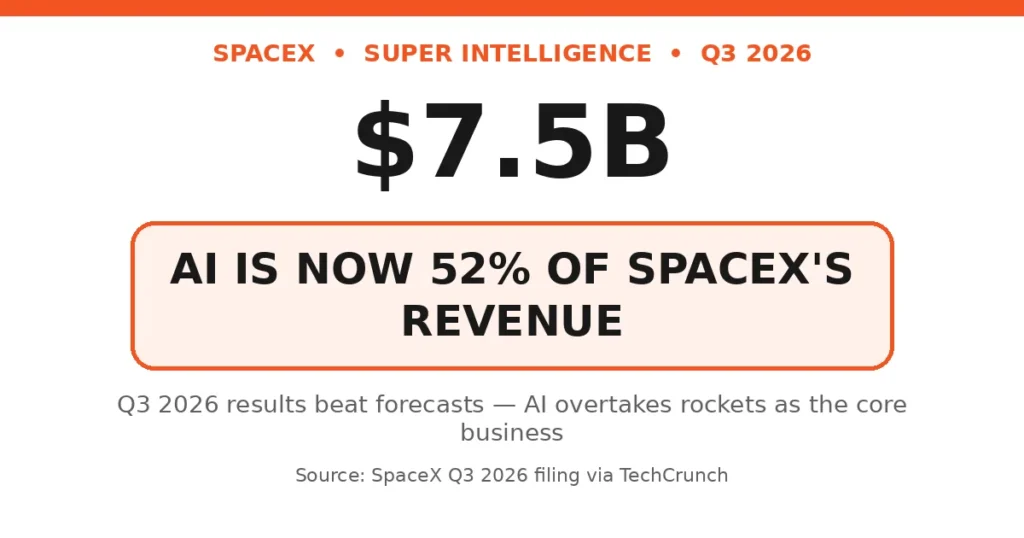
Direct answer: SpaceX reported on Tuesday that its AI business is now the company’s core — its “Super Intelligence” division generated $7.5 billion in Q3 2026 revenue, about 52% of the company’s $14.6 billion total, and turned a $431 million profit. The numbers, from TechCrunch’s report on SpaceX’s filing, beat investor expectations and mark SpaceX’s shift from a space company to an AI infrastructure company.
What happened
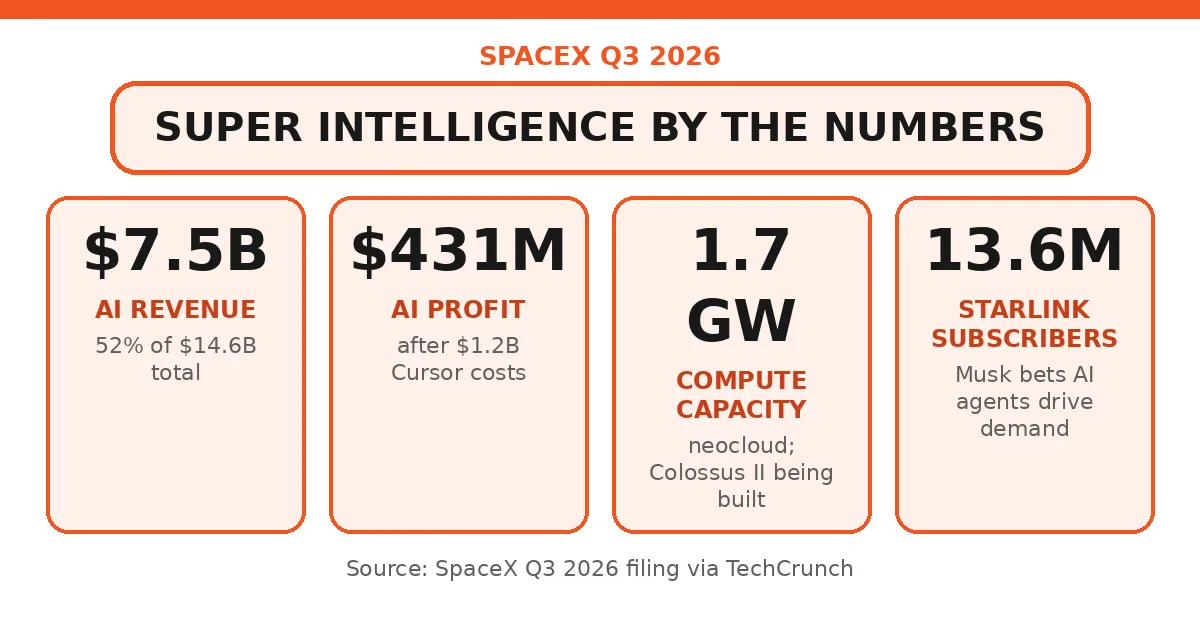
SpaceX’s third-quarter results, disclosed in a regulatory filing on Tuesday 20 October, show the renamed “Super Intelligence” business line outpacing the rest of the company. The $7.5 billion came from three sources: the neocloud business (renting out AI compute, now at 1.7 GW of capacity), the recently acquired Cursor coding tool, and the Grok bot. The division’s $431 million profit would have been larger without $1.2 billion in one-off stock-based compensation costs tied to the Cursor acquisition.
Other highlights from the quarter:
- $14.6 billion total revenue, boosted by roughly $1 billion of income linked to Bitcoin’s price recovery and related-party income.
- $4.4 billion net income — a sharp swing from a $1 billion loss in Q3 last year. (Caveat: the first nine months of 2026 still show a $413 million net loss.)
- $19.6 billion in capital expenditure, with CFO Bret Johnsen forecasting $35–40 billion of capex in Q4 as SpaceX builds the Colossus II data centre in Memphis, Tennessee, and keeps investing in Starship.
- Starlink grew to 13.6 million subscribers, with Musk arguing AI agents will drive more demand for connectivity.
Musk told investors he now spends four days a week in Memphis bringing Colossus II online, and made his boldest claim of the day: that SpaceX’s Super Intelligence annual recurring revenue could hit $500 billion to $1 trillion by the end of 2027. The nearer-term official forecast is more measured: $33–37 billion of total revenue in Q1 2027. Musk also framed the data-centre race as a power and cooling problem, not a chips problem, and said SpaceX is using its rocket-grade metal casting to build turbine components for power generation, bypassing the 12–18 month delays other operators face.
What it means for UK small businesses
A few things worth taking from this, even if you’re not in the business of launching rockets:
- AI compute is getting cheaper and more abundant — eventually. SpaceX is throwing tens of billions at data-centre capacity because demand for AI compute is enormous. Every new entrant with 1.7 GW of compute pushes the cost of running AI tools down over time. The AI assistants and AI agents small UK businesses are adopting get their economics from exactly this kind of infrastructure build-out.
- Coding assistants are now a big business, not a hobby. Cursor being counted inside a $7.5 billion revenue line shows how fast AI coding tools have moved into the mainstream. If you’re commissioning custom software — say, automating your lead follow-up — your developers are almost certainly already using tools like this, and it should be cutting your build costs.
- Watch the connectivity angle. Starlink’s 13.6 million subscribers keep growing, and Musk is betting AI agents will need always-on connectivity. For rural UK businesses with patchy broadband, satellite internet paired with cloud AI tools is becoming a genuinely viable setup.
- Prediction discipline matters. A $1 trillion recurring-revenue prediction for 2027 would make SpaceX’s AI arm bigger than any software company that has ever existed. Treat it as marketing; watch the actual quarterly numbers instead.
Honest limits / what to watch
- The profit beat leans on one-offs: ~$1 billion from Bitcoin price recovery is not an operating result, and the $431 million AI profit was weighed down by acquisition costs. The underlying trend is real, but the headline is flattered.
- The company is still spending far more than it earns: $19.6 billion of capex against $14.6 billion of revenue, with $35–40 billion more coming in Q4. This is a bet that demand holds — if AI demand cools, that spend becomes very painful.
- Musk’s $500B–$1T prediction is not a forecast from the finance team; the official guidance is $33–37 billion for Q1 2027. Don’t plan your tech strategy around the optimistic number.
- SpaceX’s “Super Intelligence” name is not the US government’s separate SI.gov initiative — same buzzword, different thing.
FAQs
How much of SpaceX’s revenue now comes from AI?
In Q3 2026, SpaceX’s renamed “Super Intelligence” business line generated $7.5 billion of the company’s $14.6 billion quarterly revenue — roughly 52% — driven by its neocloud compute business, the Cursor coding tool, and the Grok bot.
What is SpaceX’s neocloud business?
It is SpaceX’s AI data-centre and compute-rental arm, which now has 1.7 GW of compute capacity. The company is expanding fast, with a second Colossus data centre in Memphis, Tennessee, under construction.
Is SpaceX profitable now?
In Q3 2026, yes: it reported $4.4 billion net income, reversing a $1 billion loss a year earlier. But over the first nine months of the year it was still $413 million in the red.
What did Elon Musk predict for SpaceX’s AI revenue?
Musk said SpaceX’s Super Intelligence annual recurring revenue could be “somewhere between $500 billion and $1 trillion” by the end of 2027. CFO Bret Johnsen gave a nearer-term forecast of $33–37 billion total revenue for Q1 2027.
Why is SpaceX spending so much on capital investment?
SpaceX spent $19.6 billion in capex in Q3 and expects to spend $35–40 billion in Q4, building data centres (Colossus II) and the Starship rocket needed to deploy next-generation Starlink satellites and, eventually, orbital data centres.