
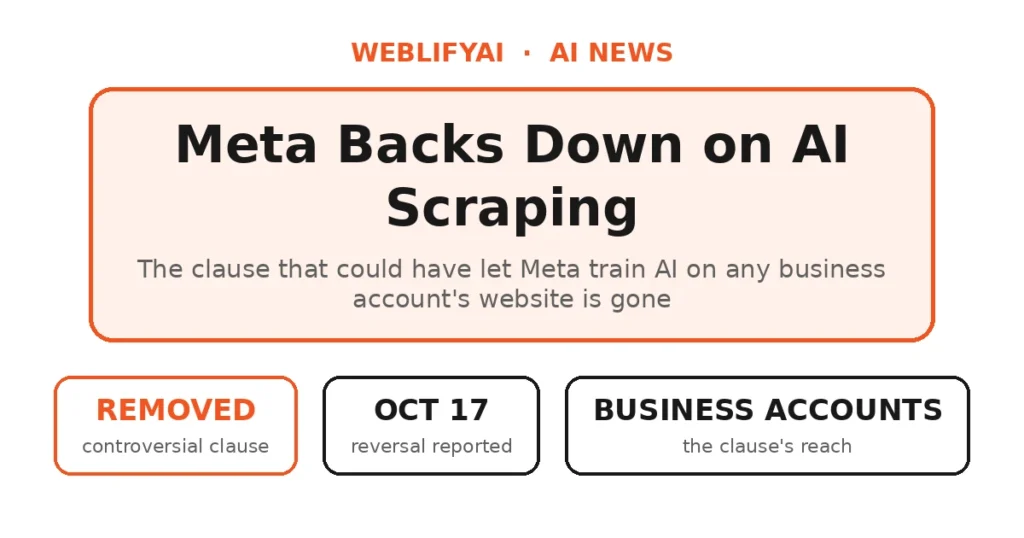
Direct answer: Meta has removed a controversial clause from its commercial terms after legal experts warned the wording could let the company scrape any website tied to a Meta business account and use its content to train AI models. Meta insists nothing ever changed about how its crawlers work — but the clause is gone, and the backtrack is worth reading if your business advertises on Meta.
What happened
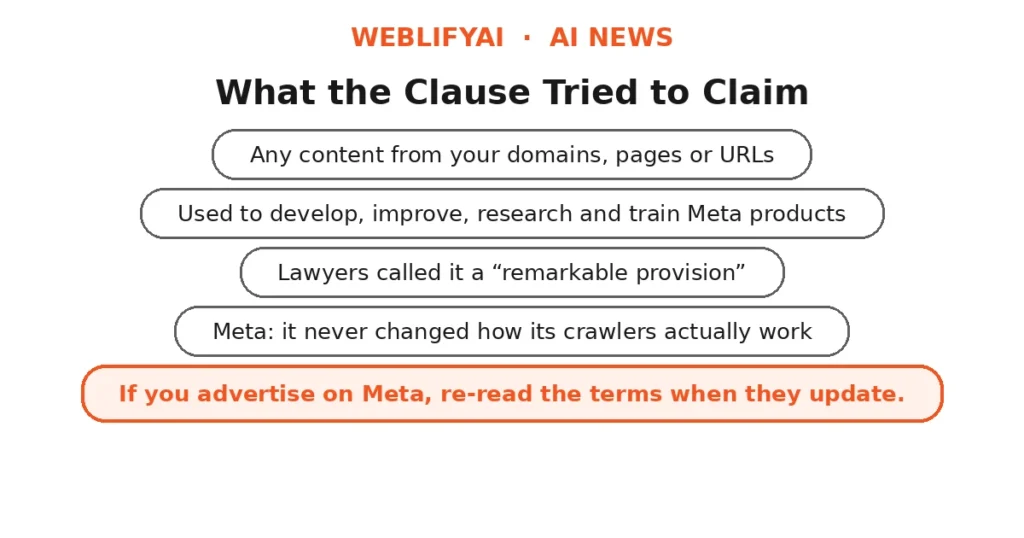
Meta recently updated its commercial terms of use with language declaring it could “use any content from [a business account’s] domains, web pages, or URLs” to provide, develop, improve, research, train, and maintain the integrity of” Meta products and services, as TechCrunch reported.
Lawyers interviewed by Nieman Lab called it a “remarkable provision.” On a plain reading, it appeared to give Meta permission to scrape the website of any publisher or business holding a Meta business account and feed that content into its AI training pipelines — a far broader licence than anything most businesses knowingly signed up for when they bought an ad.
A Meta spokesperson responded that the updated terms did not reflect a change in how Meta crawls the web. Now, The Verge reports the provision has been removed entirely. Meta’s statement:
“We’ve heard you and want to clarify: the crawling terms we consolidated only applied to our ads and business products, and we’ve clarified that in the terms themselves. It does not change how Meta uses web crawlers.”
Context matters here. Meta defeated a high-profile copyright lawsuit over AI training data last year, but other cases against AI companies — including Meta — continue, so the legal ground under training data is anything but settled.
This is also the second Meta terms controversy in a week: we covered the separate provision that looked designed to sidestep millions in AI licensing fees.
What it means for UK small businesses
If you advertise on Facebook or Instagram — and most UK SMEs do — you hold a Meta business account, which is exactly the group this clause applied to. Three practical takeaways:
- Re-read platform terms when they change. This clause arrived quietly in a consolidation update. Nobody’s asking you to become a lawyer, but a five-minute scan when the “we’ve updated our terms” email lands is cheap insurance.
- Your robots.txt is your practical shield. Court cases will take years; your robots file and crawler settings work today. Check who is actually crawling your site and what you’ve granted.
- Watch the UK angle. UK data-protection rules treat AI training on website content as an open question — see our UK GDPR guide for AI use for what the rules mean in practice.
Honest limits / what to watch
Let’s be clear about what this reversal is — and isn’t:
- This was a wording retreat, not a practice change. Meta says its crawlers operate exactly as before. If you were comfortable with Meta’s crawling last month, nothing technical has moved; if you weren’t, this removal doesn’t fix your underlying concern.
- “Business products only” is still broad. Meta’s clarification says the crawling terms applied to ads and business products. That’s nearly everyone who pays Meta — advertisers, agencies, anyone running Business Manager.
- The training-data question is unresolved. A removed clause doesn’t settle whether Meta — or any AI company — can legally train on your website content. Copyright cases are still running on both sides of the Atlantic.
- Read it against last week’s story. The licensing-fee provision and this scraping clause both appeared in the same wave of commercial terms changes. Both suggest Meta is aggressively widening what its terms grant it; only public pressure reversed this one.
The honest read: this is a win for public scrutiny, not for web publishers’ legal rights. Nothing about your site’s exposure to AI scraping changed this week — only the paperwork did.
FAQs
What did Meta’s commercial terms say?
The updated terms said Meta could use any content from a business account’s domains, web pages or URLs to provide, develop, improve, research, train and maintain Meta products and services. Legal experts said that wording could give Meta permission to scrape any publisher’s website that holds a Meta business account and use the content to train AI.
Has the clause actually been removed?
Yes. After Meta insisted the updated terms did not reflect a change in how it crawls the web, The Verge reported the provision has now been removed from the terms. Meta said the crawling language only applied to its ads and business products and has been clarified in the terms.
Did Meta actually change how it crawls websites?
According to Meta, no. The company said the update did not change how its web crawlers operate, and that the consolidated terms were intended only for ads and business products. The removal appears to be a response to the backlash rather than a technical reversal.
Does this affect how UK businesses should handle Meta?
Most UK small firms should still check their robots.txt and crawler settings, since the default treatment of Meta’s crawlers is unchanged. If you run ads or hold a Meta business account, it is worth re-reading the commercial terms whenever they update — clauses can arrive before the announcement.
Can AI companies train on UK website content?
This is still being fought out in courts. Meta defeated a high-profile copyright lawsuit last year, but other cases against AI companies, including Meta, continue. In the UK, the text and data mining exception and your site’s robots.txt are the two practical levers that matter most today.