

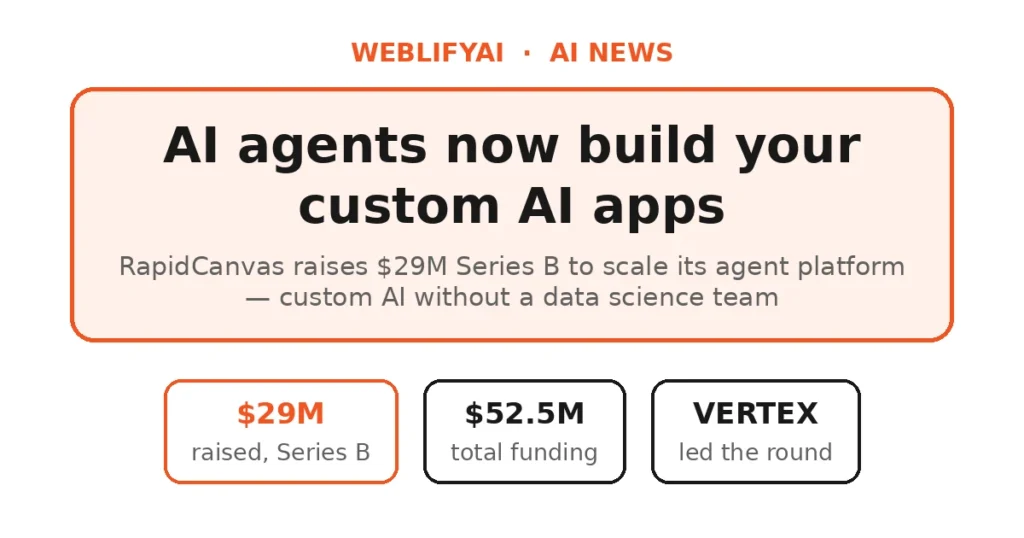
Direct answer: Austin-based AI startup RapidCanvas has raised $29 million in a Series B round led by Vertex Ventures Southeast Asia & India, taking its total funding to $52.5 million. The company uses AI agents to help businesses build and deploy custom AI applications — work that normally needs an in-house data science team — and it plans to spend the new money expanding its US sales team and engineering operations.
What happened
The round was confirmed by co-founder and CEO Rahul Pangam to Axios Pro on Wednesday. Vertex Ventures led, with Hitachi Ventures and existing investors Accel, Peak XV Partners, Valley Capital Partners and Titanium Ventures also participating.
RapidCanvas’s pitch is straightforward: AI agents combined with a no-code interface that handle the data preparation, modelling and deployment behind custom AI applications. Instead of hiring data scientists to build a bespoke forecasting or document-processing tool, a company uses the platform’s agents to do the heavy lifting.
The fresh capital will fund two things: a bigger US sales team and more engineering capacity. The company is headquartered in Austin, Texas, and the expansion reflects where demand is coming from — American enterprises racing to turn generative AI experiments into production applications.
The round sits in the upper third of comparable enterprise AI deals by size, which says something about investor appetite: even with AI funding concentrating in a handful of giants, there’s still serious money for startups building the infrastructure layer — the tooling that helps everyone else deploy AI.
What it means for UK small businesses
Here’s the honest read: you’re probably not RapidCanvas’s customer. Their platform targets enterprises that lack in-house AI talent but still need custom applications. That’s a specific middle market, and most UK small businesses don’t need to build bespoke AI from scratch.
But the funding round still tells you three useful things:
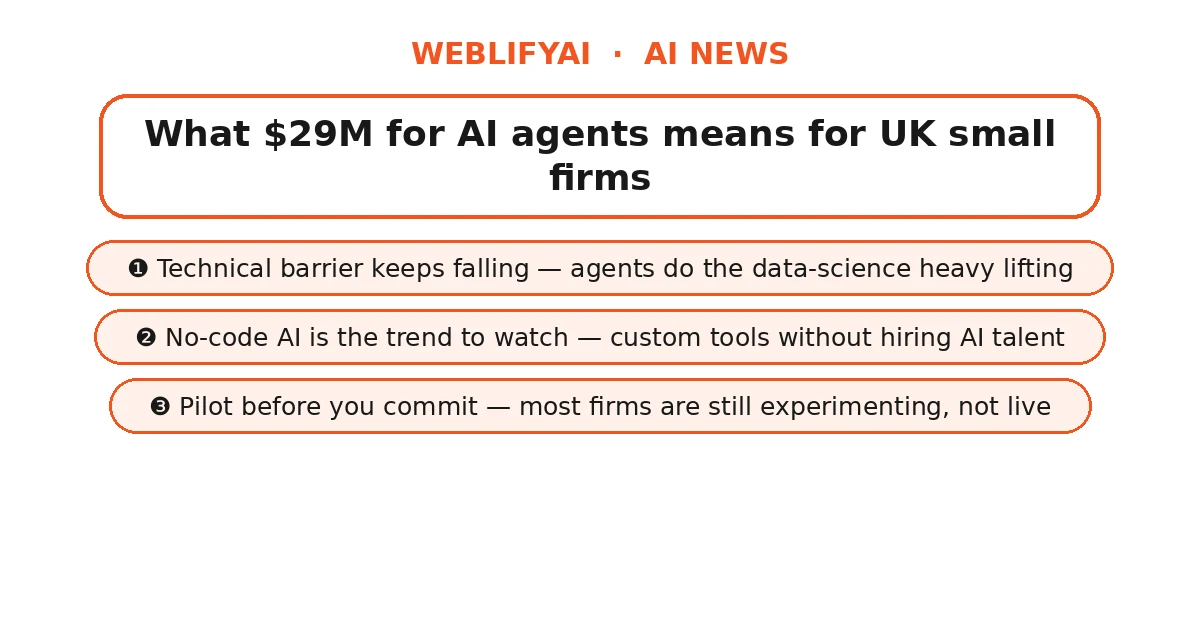
The technical barrier is falling fast. Investors are betting that AI agents will automate the work data scientists currently do — data cleanup, model training, deployment. For a small business, that means the cost of custom AI keeps dropping. What needed a consultancy engagement last year may be a self-serve platform next year.
No-code AI is the trend to watch. RapidCanvas’s no-code interface matters more than its funding. Small businesses that can’t hire AI talent can still get value from tools where agents do the technical work. Keep an eye on this category, but buy for today’s needs, not tomorrow’s promises.
Agent hype has a gap in it. Research (McKinsey’s 2025 State of AI, among others) keeps finding the same thing: most organisations are experimenting with AI agents, but few have them running in production. If you’re considering an agent platform for your business, that’s your caution flag — pilot it on a small, measurable task before signing anything long-term.
If you want a reality check on what’s actually worth doing right now, start with AI agents for small businesses in the UK — and keep an eye on how AI startup funding is shaping the market.
Honest limits / what to watch
First, “agents build your custom AI” is a bold claim, and the proof standard should be high. Ask for customer references with measurable results — not demos — before trusting any platform with your data or workflows.
Second, a Series B company expanding its sales team is going to sell aggressively. Expect to hear from vendors in this space soon. Being educated about what agent platforms can and can’t do is your best defence against an overpromising pitch.
Third, there’s competitive pressure from above. RapidCanvas’s challenge is proving its narrower, specialised tooling adds value that the big bundled platforms — Google’s Gemini agents, OpenAI’s Dots, Microsoft’s agent tooling — don’t. Smaller vendors can win on focus, but they can also get absorbed or outbuilt. That’s not a reason to avoid them, but it’s a reason to prefer tools that let you export your work.
Still, the direction is unmistakable: custom AI is becoming accessible to companies without data teams. For UK small businesses, the smart move is to keep one use case ready — a repetitive, data-rich process that’s clearly costing you time — and watch this category mature around it.
Sources: The Economic Times (16 Oct 2026); Dealroom News (15 Oct 2026); Axios via Techmeme (15 Oct 2026).
FAQs
What is RapidCanvas?
RapidCanvas is an AI startup headquartered in Austin, Texas, whose platform uses AI agents to help businesses build and deploy custom AI applications — automating the data preparation, modelling and deployment work normally done by in-house data science teams.
How much did RapidCanvas raise and who invested?
The company raised $29 million in a Series B round led by Vertex Ventures Southeast Asia & India, with Hitachi Ventures and existing investors Accel, Peak XV Partners, Valley Capital Partners and Titanium Ventures joining — taking total funding to $52.5 million.
What will RapidCanvas do with the $29 million?
Co-founder and CEO Rahul Pangam said the money will go toward expanding the company’s US sales team and engineering operations, scaling the platform as enterprise demand for agentic AI tools grows.
Do small businesses without data teams actually need platforms like RapidCanvas?
A full custom platform is usually overkill for a small firm. The real signal is the direction of travel: AI agents are steadily taking over the technical heavy lifting — data cleanup, model building, deployment — so a small business can start with simpler AI tools today and scale up when the need is real.
Should I invest in a custom AI platform now or wait?
Wait for a concrete use case. Custom AI makes sense once you have a repetitive, data-rich process — quoting, forecasting, lead scoring — that’s clearly costing you money. Until then, off-the-shelf AI tools give you most of the value at a fraction of the cost.
Is the AI agent hype cycle sustainable?
Investor appetite is clearly still strong, but adoption lags funding: research shows most organisations are experimenting with agents while only a minority have moved them into production. Treat agent platforms as maturing infrastructure, not magic, and pilot before you commit.


