

Direct answer: Amazon’s devices chief Panos Panay told TechCrunch Disrupt on Thursday that ambient AI devices — gadgets that work quietly in the background using sensors and AI — will reshape personal computing. His prediction: a coming generation won’t ask for an app at all, because the device will simply understand what they need.
What happened
Speaking at TechCrunch Disrupt on Thursday, Amazon’s SVP of Devices, Alexa & Leo argued that the way we use smartphones today is clunky: you have to remember what you’re asking your tool to do for you. As he put it, it’s “point, shoot, return” — find the right app, tap through it, come back.
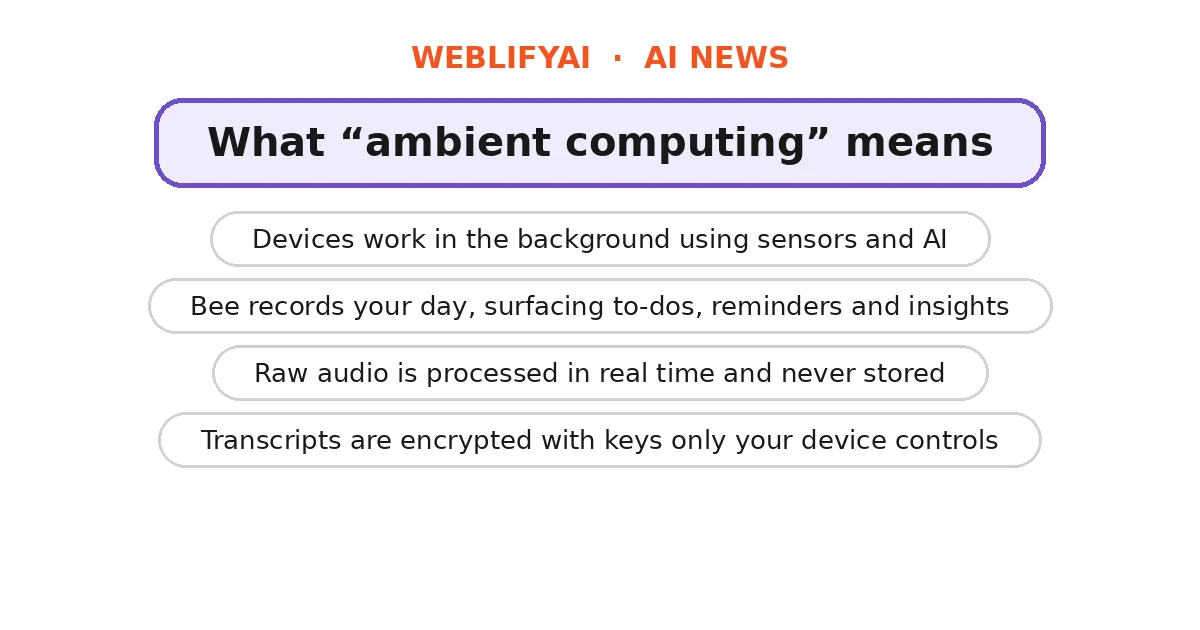
His alternative is what he calls ambient computing: devices that work in the background, using sensors and AI to figure out what needs doing, instead of the other way round. “As it works in the background, you’re able to stay more present. You’re able to get more done,” he said, arguing that you’d never worry about missing something because the device is paying attention for you.
Amazon’s biggest bet on that future is the Bee devices it launched on Thursday — a band you can wear on your wrist or as a pendant, plus a credit-card-sized device that attaches magnetically to the back of a smartphone. They passively record your day and take notes, surfacing to-dos, reminders and insights you might later need. On privacy, Amazon says the raw audio is processed in real time and then deleted — nothing stored — and transcripts are encrypted with keys created and controlled by your own device, so nobody, including Amazon employees, can read them unless you deliberately share them.
Panay was careful to say this isn’t about killing the smartphone. “I’m not a proponent that says one form factor is going to replace another,” he said. What he sees instead is “an intelligence layer that connects it all” — a new crop of sensor-driven devices that sit alongside the phone and quietly do more of the thinking. (Source: TechCrunch)
What it means for UK small businesses
This matters to small businesses twice over. First, as customers: always-on AI that captures your meetings, remembers your follow-ups and surfaces your to-dos could be genuinely transformative for a busy owner juggling everything. Imagine never losing a client request mentioned in passing on a phone call. AI meeting assistants are already moving in this direction, and ambient devices take it further.
Second, as a business owner thinking about how customers find you. If the next generation stops reaching for apps, they also stop browsing your website, your booking page or your app listing in the same way. When an AI decides what your customer needs instead of the customer choosing it themselves, the businesses that get recommended will be the ones whose services are legible to machines — accurate listings, reviews, structured information. That’s a quiet but real shift in how you market.
And then there’s the privacy question. Devices that listen all day raise obvious GDPR concerns, especially if used around staff or customers in a business setting. Amazon’s pitch — process in real time, delete the audio, keep the keys on the device — is the right shape of answer, but you’d want to see the details before wearing one into a client meeting or a shop floor.
Honest limits / what to watch
Panay’s vision is a keynote narrative, not a product review. Ambient devices only work if the AI is genuinely reliable, and today’s AI assistants still hallucinate, miss context and misunderstand accents. A device that quietly acts on what it thinks you need is only as good as its understanding — when it gets it wrong, you may not even notice until later.
There’s also the adoption question. Amazon has a long history of devices that excited tech journalists and collected dust in drawers — remember the Fire Phone. The smartphone survived every “phone killer” announced so far. The intelligence-layer idea is plausible, but treat the timeline with healthy scepticism: this is a decade’s worth of change, not next quarter’s.
FAQs
What does Panos Panay mean by ambient devices?
Devices that work quietly in the background, using sensors and AI to figure out what needs doing — instead of you having to remember which app to open and what to ask it. Examples include Amazon’s new Bee wearables, which passively record your day and surface to-dos and reminders.
Do Amazon’s Bee devices store your conversations?
According to Amazon, no raw audio is stored. The devices process audio in real time and delete it when done, and transcripts are encrypted using keys created and controlled by your device — so nobody, including Amazon employees, can read them unless you share them.
Will AI devices replace smartphones?
Panay says no — he doesn’t believe one form factor will replace another. His vision is an “intelligence layer” that connects all devices, with a new crop of sensor-driven devices sitting alongside the smartphone rather than killing it.
What did Panay say about the future of apps?
He predicted a generation that won’t say “give me the app” for something, but expects the device to simply understand what they need. The smartphone interaction today, he said, is “point, shoot, return” — find the app, tap it, come back. Ambient computing skips those steps.
Who is Panos Panay?
Amazon’s SVP of Devices, Alexa & Leo. He previously spent 19 years at Microsoft, where he oversaw the development of Surface devices.
Get a Free AI Consultation — If ambient AI changes how customers find businesses, you want to be ready early. We can help you think it through.


