

Direct answer: Figma has launched Specs, a Markdown-based editor where teams define their design language so AI agents follow brand rules instead of freelancing. Alongside it, Code Layers moves to public beta and 20+ new tools join Figma’s MCP ecosystem — a clear push to make AI design output predictable enough for real teams.
What happened
Design platform Figma announced a set of agent-focused features at its first Config event in India, as reported by TechCrunch:
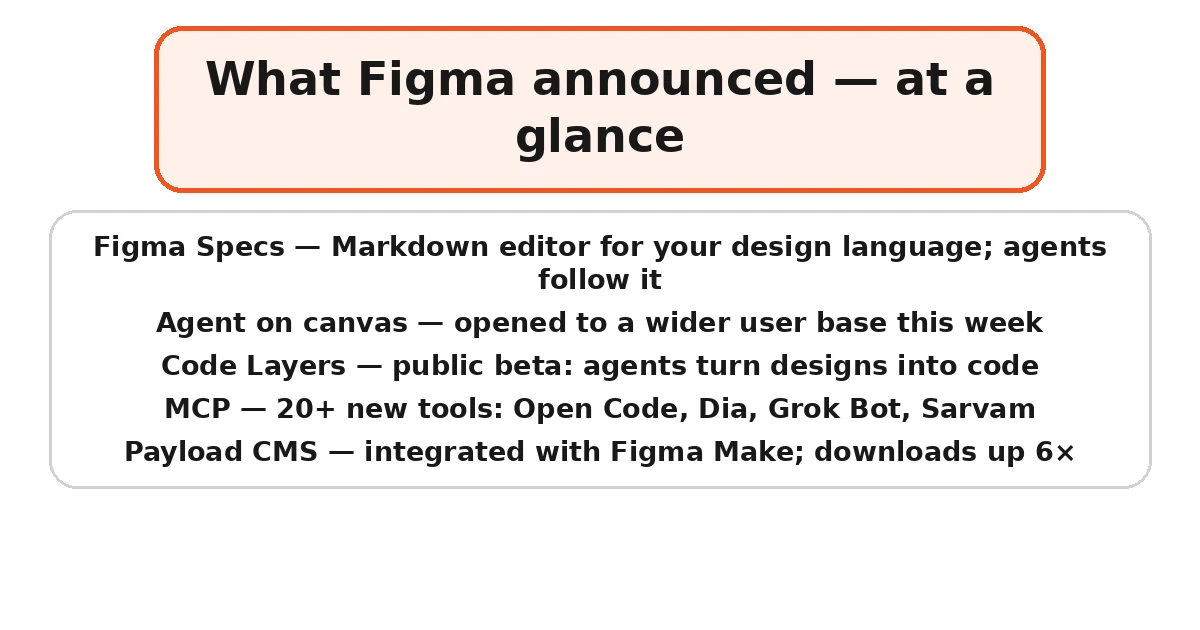
- Figma Specs — a Markdown editor for writing a company’s design language in plain terms. Specs can stand alone or sit within the canvas, and teams can reference other Figma elements, embed FigJam diagrams, and attach code layers and designs. Design libraries, code libraries, and guidelines can be brought in to give both people and agents richer context.
- Agent guardrails, not just agents — Figma opened its on-canvas agent to a wider user base in the past week, but is pairing it with steering tools because, in the company’s words, AI is non-deterministic. Specs is meant to pull agent output toward predictable, on-brand results.
- Code Layers in public beta — the feature that adds code to canvas designs for interactive prototypes moves from private beta (since June) to public beta. Users can ask the agent to turn a design into code or change part of the code to iterate on a prototype.
- MCP expansion — over 20 new tools now work with Figma’s MCP integration, including Open Code, Dia, Grok Bot, and Indian AI startup Sarvam.
- Payload integration — the open-source headless CMS Figma acquired last year is being integrated with Figma Make for generating dynamic websites with direct content management. Payload downloads have risen sixfold in the last 12 months.
Figma’s chief design officer Loredana Crisan framed the move around a striking imbalance: there is roughly 17 times more code being produced today than in the past, but only about 1.3 times more releases — most of that code is built to discover what the product is, not to ship it. Figma wants to be where teams “decide what they build and ship,” and steerable agents are its lever.
What it means for UK small businesses
If your business relies on a designer, a freelancer, or an agency, this matters in a practical way:
- Brand consistency gets cheaper. The classic failure of AI-generated design is that it looks decent but ignores your brand — wrong colours, wrong tone, wrong components. A shared, written rulebook that agents must follow is the first credible fix for that. Ask your designer or agency whether they define reusable brand rules; if they do, agents can now respect them.
- Prototypes become real faster. Code Layers turning a mockup into working code (or iterating on it by prompt) shrinks the gap between “looks good” and “works.” For a small business, that means a landing page or product page concept can be tested with real users days earlier.
- The agent is a junior, not a replacement. Figma itself is building steering tools because raw agent output is unreliable. The winning setup for a small team is human-defined rules plus agent execution — not handing the keys to the model.
Honest limits / what to watch
- Specs are only as good as the rules you write. A vague or outdated design document will produce confidently wrong, on-brand-looking output. Garbage in, garbage out — now at machine speed.
- Non-determinism isn’t solved, just steered. Figma is explicit that these are tools to nudge AI toward predictable outcomes. Expect occasional surprises and keep a human review step.
- Pricing and availability details are thin. The announcement focuses on features, not which plans or tiers get them — check Figma’s own pages before planning around any feature.
- Third-party agent quality will vary. Twenty new MCP tools sounds impressive, but each integration’s reliability is its own question. Pilot one workflow before committing.
For teams exploring AI agents for small business, the lesson is broader than Figma: the value of agents now depends on the rules and context you give them — the same principle applies to vibe-coding small business apps and AI-assisted marketing.
FAQs
What is Figma Specs?
Figma Specs is a new Markdown-based editor where teams write down their design language — brand rules, guidelines, and references. It can live as a standalone file or inside the canvas, and both teammates and AI agents use it as a shared reference.
How do AI agents use Figma Specs?
Agents refer to the centralised Specs document to stick to a brand’s design rules while generating designs. Teams can also feed in design libraries, code libraries, and guidelines so agents work with fuller context.
What are Code Layers?
Code Layers add coding to designs on the canvas for more interactive prototypes. The feature was in private beta since June 2026 and is now in public beta, letting more users test it — including asking an agent to turn a design into code or edit code to iterate.
What is the Payload CMS integration?
Figma acquired open-source headless CMS Payload last year and is now integrating it with Figma Make, its tool for generating dynamic websites, so users can build sites and manage content in one flow. Figma says Payload downloads are up sixfold in 12 months.
When was this announced?
At Figma’s first Config event in India on 14 October 2026, where the company is expanding its presence after opening its first India office late last year.


