

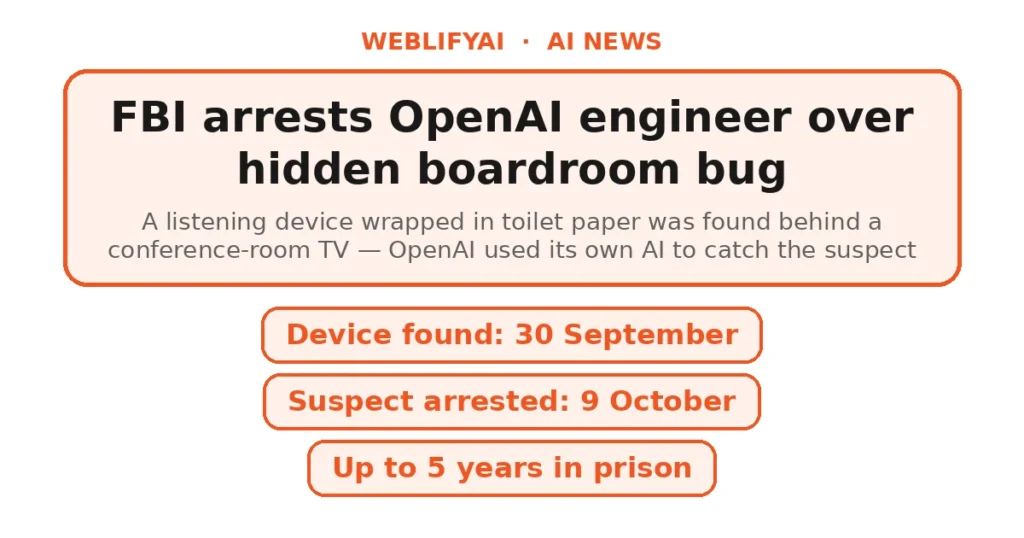
Direct answer: The FBI has arrested a former OpenAI engineer accused of planting a hidden listening device — wrapped in toilet paper — inside an executive conference room in San Francisco. OpenAI says it used its own AI models to identify the culprit, and the device’s stored data was encrypted. The employee has been fired, and the investigation is ongoing.
What happened
On 30 September, OpenAI staff discovered a covert recording device plugged into a USB port on the back of a television in an executive conference room at one of its San Francisco buildings. The room required special clearance and was used for highly confidential discussions — technical progress, government engagements, commercial partnerships. The device was a Chinese-made Seeed XIAO ESP32-S3 Sense USB board with a microphone, wrapped in toilet paper. According to the FBI complaint, it was installed on or around 28 September, and analysis found its stored data obfuscated, with the microSD card laid out as an encrypted filesystem.
US federal agents arrested Abdulrahman Alfozan, a 35-year-old Saudi national and permanent US resident who had worked as an OpenAI engineer since July 2025, on 9 October. The Justice Department announced the charges on Tuesday: unlawful interception of oral communications, carrying up to five years in prison and a $250,000 fine.
The affidavit paints a detailed picture. Alfozan was not authorised to access that conference room, but CCTV allegedly caught him lurking outside it on 10 different days in September. In August he had reportedly used an internal OpenAI productivity agent to scout where and when sensitive meetings were held, and chatbot logs tied to him referenced the device’s unique MAC address alongside questions about continuous recording, speech-triggered recording and SD card encryption. On 5 October, after OpenAI installed a camera in the room, CCTV allegedly showed him returning to retrieve the device. That same day, his unattended bag turned up in a printer room — containing his wallet and ID alongside a second, similar customised device. He reported the bag lost to OpenAI’s lost-and-found without mentioning the device.
OpenAI didn’t fire him immediately: it gradually restricted his system access while working with the FBI, then timed his termination with the arrest. The company said it used its own internal AI models to identify who planted the device and trace its origins, and added that it currently has no indication of any access to or theft of model weights, source code or customer data.
The case has drawn top-level attention. The FBI director framed counterintelligence against spying on frontier AI labs as a top bureau priority, and the US attorney for Northern California said his office would keep treating the protection of American AI innovation as a matter of national security. It remains unclear who the recordings were intended for — the FBI investigation continues.
What it means for UK small businesses
You don’t need to be building frontier AI models to learn from this. Here’s the uncomfortable truth: the insider threat is not a big-company problem.
Your secrets are worth more than you think. OpenAI’s boardroom discussions are obvious espionage targets, but your client list, pricing, supplier contracts, unannounced product plans and staff data would be equally valuable to a competitor or a fraudster. Corporate espionage usually targets the ordinary and the boring.
Physical security is the forgotten half of cybersecurity. Small firms invest in firewalls and passwords, then hold board meetings in rooms anyone can walk into, leave prototypes on desks, and let ex-contractors keep their fobs. The OpenAI case is a reminder that a £20 gadget can beat a £20,000 security stack if nobody’s watching the room.
Leavers and access reviews matter. This case involved a current employee with no authorised reason to be in that room. Regular access audits — who can enter what, and do they still need to — are cheap and effective. When staff leave, cut access the same day.
AI is becoming a security tool, not just a threat. Note the twist: OpenAI caught the suspect with its own AI models. The same pattern is available to smaller firms — AI-powered monitoring and automation is increasingly affordable, from anomaly detection to access logging. If you’re handling sensitive client data, review your AI and data practices too.
Honest limits / what to watch
Take the drama with a pinch of salt. The charges are allegations; Alfozan’s lawyer had not been identified at the time of reporting, and the full facts will come out in court. OpenAI’s claim that no model weights or customer data were touched is the company’s own assessment at this stage — “no indication” is not the same as “certain”.
Also, the headline detail — AI catching the culprit — is partly theatre. CCTV, badge logs and an unattended bag did most of the work; the AI models assisted the analysis. It’s a genuine signal of where investigations are heading, but it’s also very good PR for OpenAI.
And a final sobering note: this was discovered. Plenty of corporate bugs aren’t. The lesson isn’t to buy counter-surveillance gear — it’s to assume your sensitive conversations deserve the same basic protection as your sensitive files.
FAQs
Who was arrested and what is he accused of?
Abdulrahman Alfozan, a 35-year-old Saudi national and permanent US resident who worked as an OpenAI engineer, was arrested on 9 October and charged with unlawful interception of oral communications. A conviction could bring up to five years in prison and a $250,000 fine.
How was the bug discovered?
OpenAI found a thumb-sized recording device — a customised Seeed XIAO ESP32-S3 Sense board with a microphone — plugged into the back of a television in an executive conference room in San Francisco on 30 September. It was wrapped in toilet paper, and its microSD storage was laid out as an encrypted filesystem.
How did OpenAI catch the suspect?
OpenAI said it used its own internal AI models to identify who planted the device and trace its origins. CCTV footage and internal records reportedly supported the investigation before the company referred the matter to the FBI.
Was any OpenAI data stolen?
OpenAI says it currently has no indication that model weights, source code or customer data were accessed or exfiltrated. The employee was terminated and the FBI’s investigation continues.
Why would someone bug an AI company?
The case highlights how valuable AI research has become — cutting-edge models represent years of work and huge strategic advantage, making labs targets for corporate espionage in the same way defence or pharmaceutical firms have long been.
What should UK small businesses take from this?
You don’t need OpenAI’s secrets to be worth spying on — client lists, pricing, and product plans are enough. Review who can access your meeting spaces, know your contractors and leavers, and treat sensitive meetings with basic physical security, not just cybersecurity.

Sources: Reuters via LA Post, The Times, Ars Technica (13–14 Oct 2026).


