

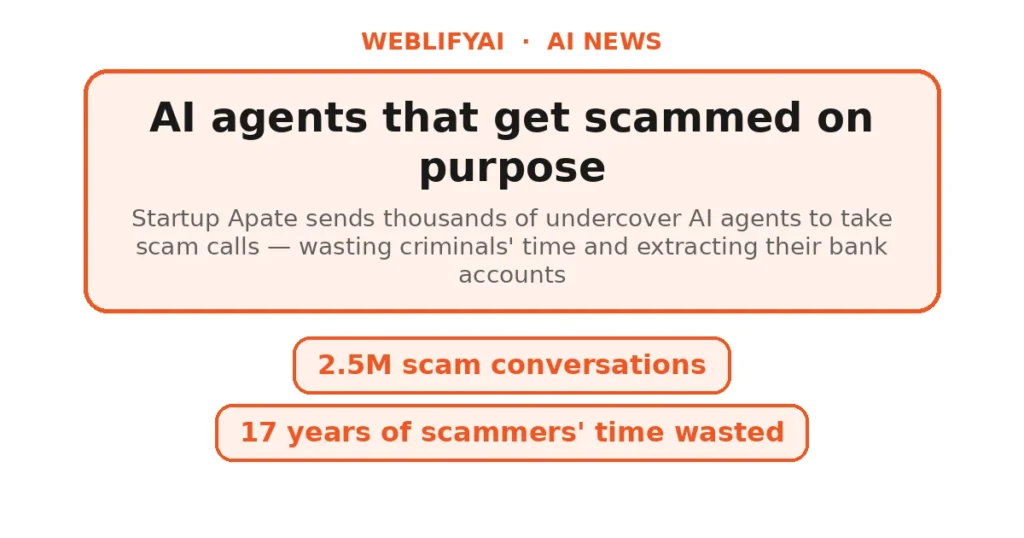
Direct answer: An Australian startup called Apate sends thousands of AI agents out to deliberately get scammed. They answer scam calls, click phishing links and play along as victims — all to waste criminals’ time and extract their bank accounts and crypto wallets before any real person gets hurt. It’s named after the Greek goddess of deception, and it’s planning a London office.
What happened
Most AI startups use agents to sell more or work faster. Apate does the opposite: it built its company on scam-baiting, industrialised.
Founded in 2024 from research at Macquarie University in Sydney, the company deploys fleets of AI agents that masquerade as innocent victims. They pick up scam calls, reply to shady texts and emails, follow phishing links and join dubious social media groups — playing people of every age, gender, accent and language — and keep the scammer engaged long enough to learn something useful.
The useful part is the point. While the scammers are talking, Apate’s agents try to get them to reveal the details usually only discovered after someone’s been ripped off: bank accounts, crypto wallets, phone numbers, malicious websites, and the brands they’re impersonating. That intelligence feeds straight to customers — banks, telecom companies, utilities and government agencies — through an insights portal, and customers can even assign agents specific missions, like extracting a particular scam network’s crypto wallet.
The numbers are striking. Apate says its agents have wasted 17 years of scammers’ time across 2.5 million conversations. TPG Telecom has diverted nearly 590,000 calls to Apate’s agents. Commonwealth Bank reportedly saw a 76% drop in publicly reported scam losses, and an unnamed Australian bank used the outbound agents to disrupt 22 scam campaigns.
The idea started with a real scam call. Founder Dali Kaafar once kept a scammer talking for 44 minutes at a family picnic just to play dumb — then realised those were 44 minutes the scammer hadn’t spent on a real victim, and wondered if the whole thing could be automated.
Investors agree there’s a business in it: Apate raised $8.15 million in seed funding in August from Lobby Capital, OIF Ventures, Investible, Concept Ventures and Baobab Ventures, taking total raised to just under $10 million. The 20-person team plans to spend it on product and international expansion — including a London office.
The timing isn’t accidental. The FBI received more than 22,000 complaints of AI-related crime in 2025, with losses of around $893 million — over $632 million of it from investment scams where fraudsters use AI to run conversations and deepfake voices and faces. Scammers have AI now. Apate’s bet is that defence needs it too.
What it means for UK small businesses
Small businesses are some of the ripest targets. Invoice fraud, fake CEO payment requests, supplier impersonation, “urgent” bank-detail changes — these scams land on small firms every week, and they work because small teams trust each other and move fast. AI has made the fakes harder to spot: cloned voices, flawless written English, personalised phishing.
You can’t buy Apate’s agents directly — it sells to enterprises, not small firms. But its approach is a preview of the defence layer your bank and phone provider will be buying, including a London office on the roadmap. More importantly, the mindset behind it is something you can adopt today:
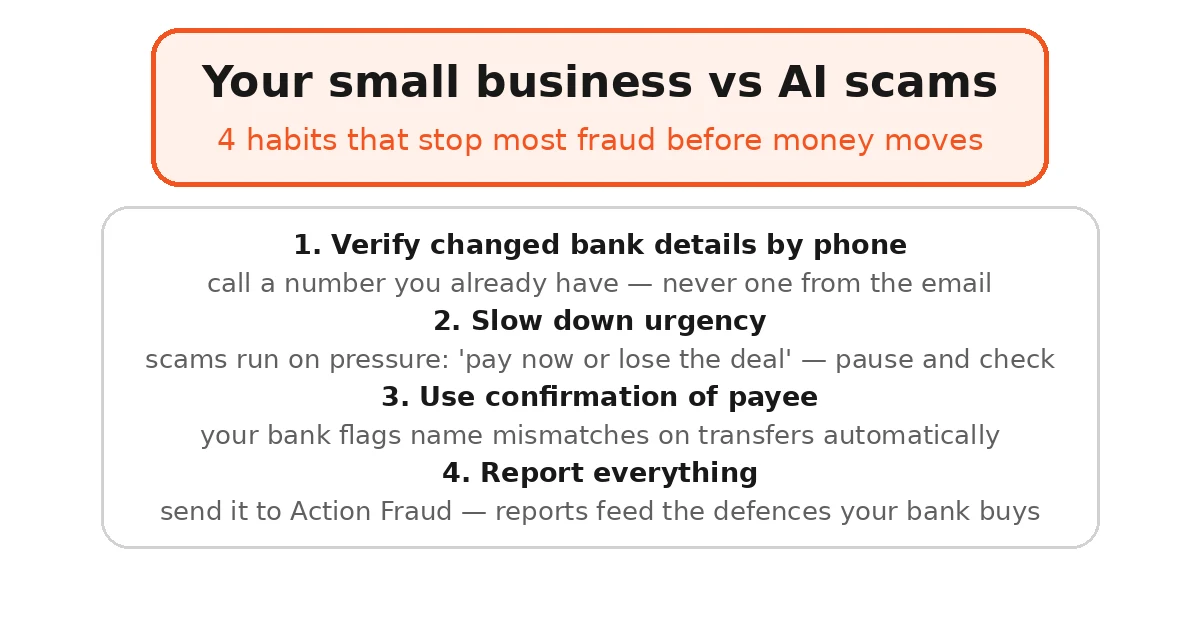
- Verify before you pay. Any changed bank details from a supplier get a phone call to a number you already have — never one from the email. This one habit stops most invoice fraud.
- Slow down urgency. Scams run on pressure: “pay now or lose the deal.” Give your team explicit permission to pause and check.
- Use confirmation of payee for bank transfers — it flags name mismatches automatically.
- Report everything to Action Fraud. Intelligence from reported scams feeds the same defences Apate sells.
And if you’re already exploring AI for your business, consider what Apate represents: AI agents that pick up the phone. Tools like AI call answering are becoming practical for small firms too — for legitimate calls, not just scammers. Read our guide on using AI safely in your business.
Honest limits / what to watch
Apate’s reported figures are its own claims — the 76% drop in scam losses and “17 years of scammers’ time” come from the company and its customers, not independent audits. Take the scale as directionally impressive rather than precise.
This also isn’t a consumer product and won’t be one soon. For now it’s an enterprise tool; the protection reaches small businesses indirectly, through banks and telcos. And scammers adapt: once criminals know undercover AI agents exist, they’ll build countermeasures — it’s already an arms race.
Finally, there’s a legitimate question about where the intelligence goes and who controls it. A private company hoovering up millions of scam conversations holds genuinely powerful data. Customers and regulators will eventually want transparency on how it’s used. That’s a conversation for another day — for now, if your bank’s fraud losses are falling, you’ll take it.
FAQs
What is Apate?
Apate is an Australian startup founded in 2024 out of Macquarie University research. It deploys thousands of AI agents that pose as scam victims to engage fraudsters, gather intelligence, and feed it to banks, telecoms and government agencies.
How do Apate’s AI agents work?
The agents answer scam calls, respond to shady messages and emails, follow phishing links and join social media groups, pretending to be victims of various ages, genders and accents. They keep scammers talking long enough to reveal bank accounts, crypto wallets, phone numbers and malicious websites.
What results has Apate reported?
The company says its agents have wasted 17 years of scammers’ time across 2.5 million conversations. It reports TPG Telecom diverted nearly 590,000 calls to its agents, Commonwealth Bank saw a 76% drop in publicly reported scam losses, and an unnamed Australian bank disrupted 22 scam campaigns.
Is Apate available to UK businesses?
Apate currently sells to banks, telecom companies, utilities and government agencies, not directly to small businesses. But with a London office planned, UK firms should see the benefits through their banks and providers in future.
What can a UK small business do about AI scams today?
Verify any changed bank details with a phone call to a known number before paying, train staff to spot urgent-payment pressure, use confirmation of payee when transferring, and report scams to Action Fraud. Your bank’s fraud team is your best ally — Apate-style intelligence feeds into the same defences.
Will tools like Apate stop scams?
No tool stops scams completely — criminals adapt. Apate’s edge is attacking the problem upstream, extracting intelligence before victims lose money, rather than reacting after the damage is done. It’s one layer of defence, not a cure.
Sources: TechCrunch (14 Oct 2026).


