

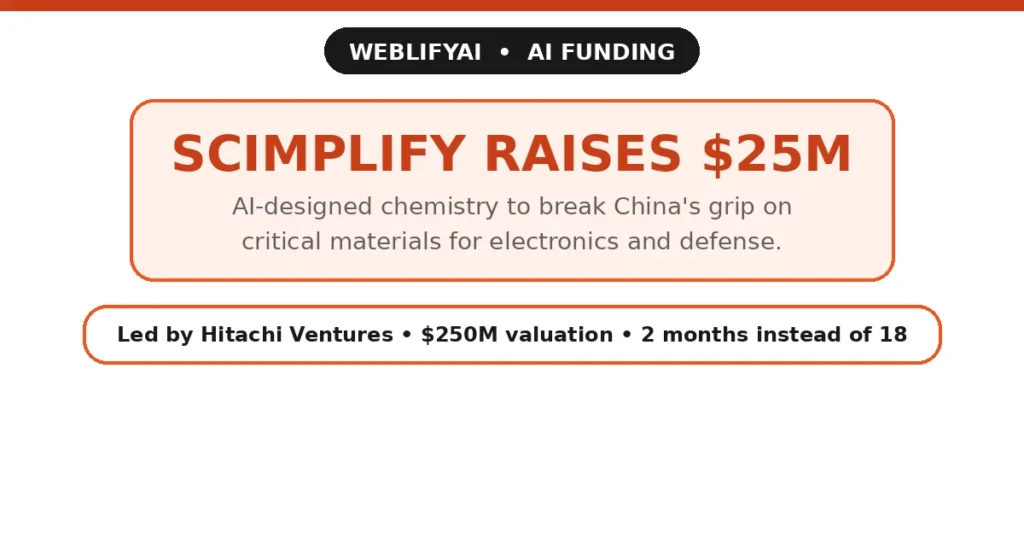
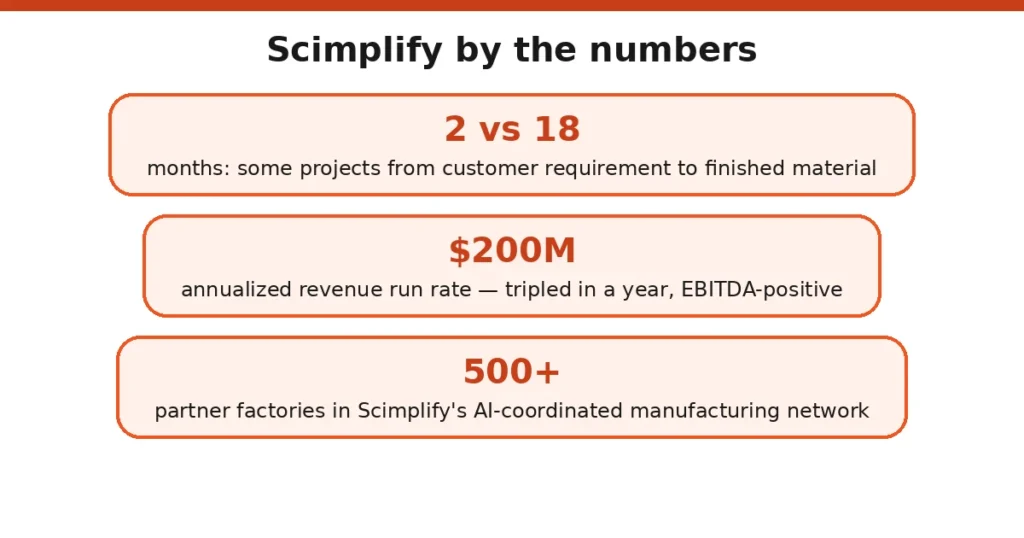
Direct answer: Indian startup Scimplify has raised $25 million, led by Hitachi Ventures, to expand its AI-powered approach to making specialty chemicals and critical materials. The round values the Bengaluru startup at $250 million and brings its total equity funding to $80 million. The company claims it can take some projects from customer requirement to finished material in two months — a process that would typically take 12 to 18 months.
What happened
Scimplify, founded in 2023, sits at the intersection of two stories: AI getting genuinely useful at scientific discovery, and manufacturers scrambling to reduce their reliance on Chinese suppliers. This raise pushes both forward.
The $25 million all-equity strategic round was led by Hitachi Ventures, with two of Scimplify’s own customers — German chemicals giant Henkel and American plastics company Teknor Apex — joining as new investors. Existing backers Accel India, Bertelsmann India Investments, Omnivore, and 3one4 Capital also participated. A person familiar with the transaction put the valuation at $250 million, up from $150 million after a $40 million Series B in March 2025. The company declined to confirm the valuation but said total equity funding now stands at $80 million.
What makes it interesting is how the AI is actually used. Scimplify’s proprietary platform, Scinode, coordinates work across its research facilities in Bengaluru and Hyderabad and a network of more than 500 partner manufacturing sites. It uses specialised AI agents for different functions — research, manufacturing, quality control — each working backward from what the customer asked for. As co-founder Sachin Santhosh told TechCrunch: “This helps us move a lot faster and remember customer context even for future references.”
The numbers behind the story are strong. Scimplify serves more than 1,000 customers across 40+ countries and reports an annualized revenue run rate of about $200 million — triple a year earlier — with a target of $400 million over the next year. It has been EBITDA-positive for the past two months and expects to turn profitable after tax this month. The US has emerged as a key growth market, with its American revenue run rate rising sixfold to $60 million. About 90% of manufacturing currently takes place in India, but the company plans to expand its production network to the US and Japan over the next year.
Energy, electronics, and defense now account for 45–50% of revenue, up from under 15% a year ago. The specific products tell the supply-chain story: Scimplify is working on tungsten derivatives made from scrap and rare-earth materials — both categories where global supply is heavily concentrated in China. Customers include Japanese electronics manufacturer TDK, BASF, and Hitachi.
What it means for UK small businesses
At first glance this is a story about big industry — semiconductors, defense, energy. But the supply-chain reshaping underneath it reaches much further down, and UK manufacturers should pay attention.
The UK’s own Critical Minerals Strategy exists precisely because British industry is exposed to concentrated supply chains for materials like rare earths and tungsten. Any business that makes, machines, assembles, or repairs things — from electronics to tools to vehicles — sits somewhere in the chain this story is describing. If AI-designed chemistry starts delivering finished materials in two months instead of 18, the companies that build that speed into their procurement get a real edge.
The more interesting angle is the model itself: AI agents doing real coordination work, not writing emails. Scimplify’s Scinode — agents for research, manufacturing, and quality control that retain customer context — is a working example of exactly the kind of agentic automation we cover in our guide to AI agents for UK small businesses. The pattern (specialised agents, each owning a function, coordinated through shared context) applies just as well to a quoting workflow or a customer onboarding pipeline as it does to chemicals.
Practical takeaways for a UK manufacturer or importer:
- Map your exposure. If any of your key materials come through supply chains concentrated in one country, know which ones and what the alternatives are.
- Watch the AI-in-manufacturing wave. Tools that shorten development cycles from quarters to weeks change what “just-in-time” can mean.
- Ask your suppliers what they’re doing. If your chemical or materials supplier can’t tell you how AI is changing their process, someone else’s can.
Honest limits / what to watch
Two caveats worth holding. First, the “two months versus 12 to 18” claim is Scimplify’s own, via its co-founder, for “some cases” — timelines vary by project, as Santhosh himself noted. It’s a legitimate proof point, not a universal law. Second, the $250 million valuation comes from a person familiar with the transaction, not the company, which declined to confirm it. The $200 million revenue run rate and EBITDA positivity are also company-stated figures. Treat them as directional, not audited.
There’s also a structural limit: AI can accelerate discovery and process design, but chemistry still has to happen in real factories with real quality standards. Scimplify’s edge is as much its 500-facility manufacturing network as its AI. The honest read is that this is AI compressing the front end of industrial chemistry — genuinely valuable, but not a shortcut past physics.
Watch for: Scimplify’s US and Japan manufacturing expansion over the next year, whether it hits its $400 million revenue target, and whether UK procurement teams start naming it as an alternative supplier.
FAQs
Who is Scimplify and what do they do?
Scimplify is a Bengaluru-based startup founded in 2023. It develops and manufactures specialty chemicals and critical materials using an AI platform called Scinode, with specialized AI agents for research, manufacturing, and quality control. It works across a network of more than 500 partner factories.
How much did Scimplify raise and at what valuation?
The $25M all-equity strategic round was led by Hitachi Ventures, with customers Henkel and Teknor Apex joining as new investors. Existing backers Accel India, Bertelsmann India Investments, Omnivore, and 3one4 Capital also participated. A person familiar with the deal put the valuation at $250M, up from $150M after a $40M Series B in March 2025.
How does Scimplify use AI in chemicals manufacturing?
Its proprietary platform Scinode uses specialized AI agents that work backward from a customer’s requirement to identify suitable production routes and manufacturing facilities, track quality, and handle regulatory requirements — including remembering customer context for future orders.
Why does this matter for UK manufacturers?
The UK’s Critical Minerals Strategy and broader reshoring push mean British manufacturers are actively looking for alternatives to China-concentrated supply chains. Scimplify’s model — AI-designed processes delivered through partner factories — is exactly the kind of option procurement teams should be tracking.
How fast is Scimplify growing?
The company reports an annualized revenue run rate of about $200M, triple a year earlier, with EBITDA-positive results for the past two months and an expectation of turning profitable after tax this month. Its US business alone has a $60M annualized run rate, up sixfold from a year ago.
What materials is Scimplify focusing on?
Tungsten derivatives made from scrap, and rare-earth materials — both categories where global supply chains remain heavily concentrated in China. Customers include TDK, BASF, and Hitachi.


