Direct answer: Anthropic launched Opus 5.5 on September 22, 2026 — and Sonnet 5.5 hasn’t arrived yet (Anthropic says it and Haiku 5.5 “will follow in the coming weeks”). The internet is already arguing about which deserves your money. Short version: the Sonnet tier is the sensible default for most agencies (near-Opus performance at a lower reported cost per task); Opus 5.5 is the flagship for genuinely hard work. Interest is surging — “claude 5.5” up 4,650% in the US, “claude opus 5.5” up 4,400% in the UK, per Google Trends data — so here’s the honest buyer guide: what to buy now, and what to wait for.
What Are Opus 5.5 and Sonnet 5.5, Exactly?
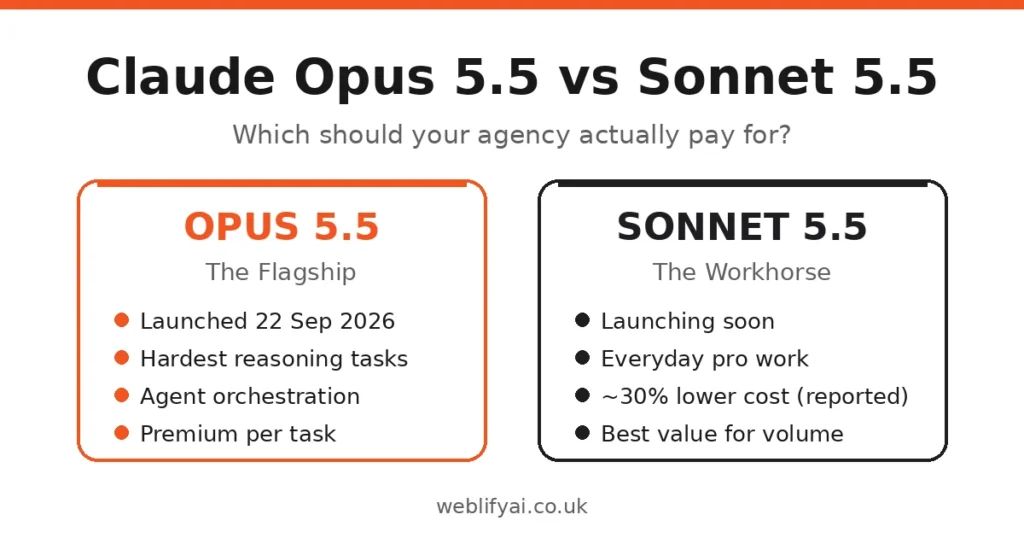
Anthropic sells Claude in tiers, and the naming confuses everyone — so, quickly: Opus is the flagship (biggest, most capable, hardest reasoning tasks); Sonnet is the balanced tier (strong performance, lower cost, everyday professional work). There’s also Haiku, the fast cheap tier — not today’s question.
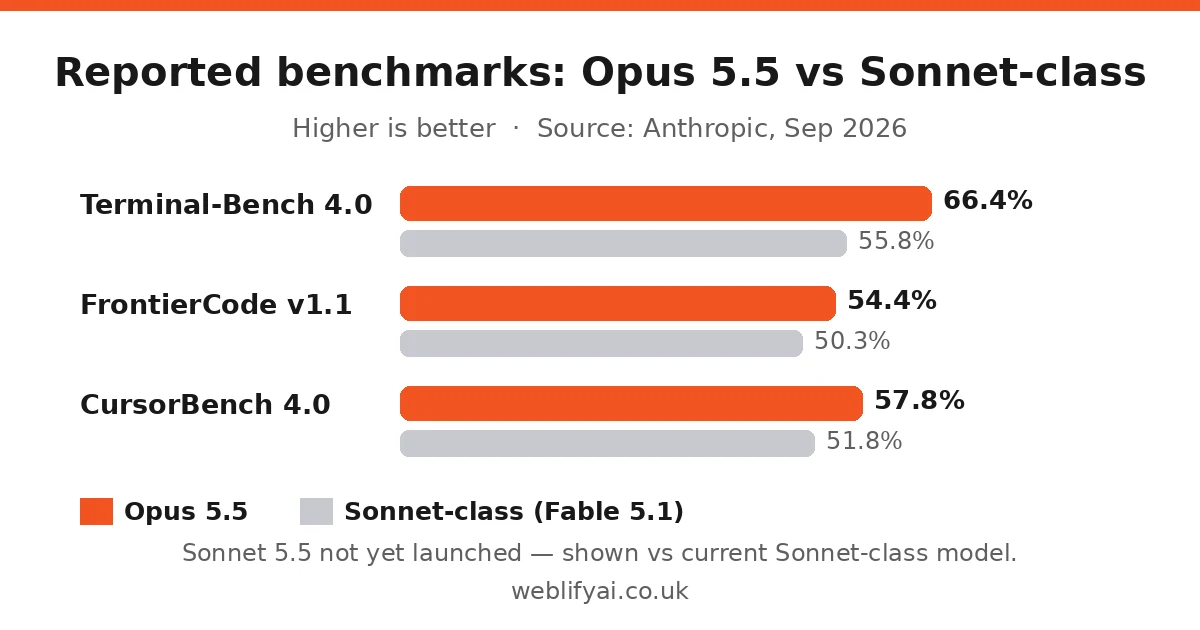
Claude Opus 5.5 launched September 22, 2026: the new top of the range. Claude Sonnet 5.5 hasn’t launched — Anthropic’s official announcement says it and Haiku 5.5 “will follow in the coming weeks”, so everything about it is still pre-release positioning. The number everyone is quoting — near-Opus performance on many tasks at roughly 30% lower cost per task — comes from early coverage and community expectations, not an official Anthropic benchmark. One official data point we do have: Anthropic says the real-world gap between Opus 5.5 and the current Sonnet-class model (Fable 5.1) is “narrower than [benchmark] scores suggest”. The real question isn’t “which is better?” — it’s “which is worth paying for, and when?”
The Flagship Flex: What Opus 5.5 Can Actually Do
The headline demonstration came from the Economic Times (October 6, 2026): 90 Claude Opus 5.5 agents, working together, identified a 27-year-old chemical compound in just 3 days.
Not one model answering a question — ninety agents coordinating on a research problem unsolved for nearly three decades, cracked in 72 hours. That’s multi-agent orchestration at serious scale, and the clearest signal of what the flagship is for: novel, complex, open-ended work where reasoning quality is the bottleneck.
Your agency probably isn’t hunting chemical compounds. But the same capability applies to the hardest agency work: untangling a gnarly codebase, reasoning through a complex client strategy, research spanning dozens of sources. Opus 5.5 is the model you call when the problem is genuinely difficult and the cost of being wrong exceeds the cost of the tokens.
The honest caveat: showcase results show the ceiling, not the floor. Don’t buy the flagship because of a headline; buy it because your hardest workflows need it.
The Workhorse Case: Why the Sonnet Tier Might Be All You Need
The Sonnet tier’s pitch is brutally practical: near-Opus performance on routine professional work at a lower cost per task — and Sonnet 5.5, when it lands, is expected to push that value case further.
Think about what an agency runs through an AI model all day: drafting copy, summarising documents, writing and reviewing code, analysing data, researching topics, generating variations. For the vast majority of this work, the difference between flagship and workhorse output is invisible — and the ~30% gap compounds fast at agency volume.
Most agency AI spending is high-volume, medium-difficulty work — exactly what Sonnet is built for. The agencies overspending are usually running everything through the flagship out of habit, not need.
The Money Debate: Is Claude Actually Worth It?
Two credible sources are telling opposite stories this week.
The bull case: SemiAnalysis argues Anthropic subscriptions offer 5x+ more value than OpenAI’s. If you buy that analysis, Claude isn’t just competitive — it’s dramatically better value per pound.
The bear case: Crypto Briefing reported (October 6, 2026) that Microsoft has cut its Claude spending by more than a third as token bills piled up. When one of the world’s biggest AI spenders trims a line item by a third, that’s a signal that at serious scale, Claude costs bite.
Who’s right? Probably both — they’re measuring different things. Subscription value for a typical professional versus API token bills at enterprise scale are barely the same product. And the pricing landscape is moving: the FT reported broad token price deflation in early October 2026, so today’s cost maths has a short shelf life.
The practical takeaway: don’t outsource this decision to headlines. Run both tiers on your actual workflows for two weeks, measure quality and cost per task, and let your own data decide.
Opus 5.5 vs Sonnet 5.5 vs ChatGPT: The Honest Comparison
| Claude Opus 5.5 | Claude Sonnet 5.5 | ChatGPT (flagship tier) | |
| Launched | Sep 22, 2026 | Not yet — “coming weeks” (Anthropic) | Ongoing |
| Position | Flagship — hardest tasks | Workhorse — everyday pro work | Generalist flagship |
| Reported cost | Highest per task | ~30% cheaper per task than Opus (expected, pre-launch) | Varies by plan |
| Best at | Complex reasoning, agent orchestration, novel problems | Copy, code, analysis, research at volume | Broad versatility, ecosystem |
| Standout proof | 90 agents, 27-year-old compound, 3 days (Economic Times) | Gap to Opus “narrower than scores suggest” (Anthropic, on Fable 5.1) | Largest user base, Dots agents |
| Workspace integration | Yes — new Google Docs/Sheets/Slides sidebar (Oct 6) | Same integration | Deep Microsoft 365 integration |
| Value debate | Premium justified only for hard problems | Strongest value-for-money case | SemiAnalysis says 5x less value; disputed |
Two things to note. First, the “best” column is deliberately about fit, not superiority — the right model is the cheapest one that does your job well. Second, ChatGPT’s inclusion isn’t to declare a winner; it’s to remind you the decision is three-way, and ecosystem lock-in (Google Workspace vs Microsoft 365) may matter more than model benchmarks.
Which Tier for Which Workflow
Copywriting and content: Sonnet tier
Drafting, editing, tone-matching, variations, summarising — Sonnet handles it all. The quality gap on routine content is negligible, and at agency volume the expected ~30% saving is real money. Save Opus for the quarterly flagship piece, not the fifty monthly drafts.
Coding and technical work: mostly Sonnet, Opus for the hard stuff
Boilerplate, debugging, code review, documentation, tests — Sonnet. Architecture decisions, gnarly refactors, novel algorithms, security-sensitive logic — Opus. Most developers feel this split intuitively; formalise it.
AI agents and automation: Opus 5.5
The flagship’s home turf. When agents chain multi-step tasks and make decisions with real consequences, reasoning quality compounds — a slightly worse model produces cascading failures, not slightly worse results. If you’re building agent workflows (see our AI agents for small business UK guide), this is where the premium pays.
Research and analysis: split by depth
Quick research, summarisation, data tidying — Sonnet. Deep multi-source investigation, novel synthesis, anything where a missed nuance costs a client — Opus. When in doubt, start on Sonnet and escalate the failures.
Two Things That Change the Maths
The Startups program expanded. CNBC reported (October 6, 2026) that Anthropic is expanding its Claude Startups program — credits and support for young companies building on Claude. If you’re an early-stage agency with serious AI usage, check eligibility before paying full price.
Google Workspace integration landed. 9to5Google reported (October 6) that Claude now integrates directly with Google Docs, Sheets and Slides via a sidebar. For agencies living in Workspace — and most UK SMEs do — this kills a huge amount of copy-paste friction. The “best” model you never open loses to the good one inside your documents.
The Honest Unknowns
- Sonnet 5.5 hasn’t launched. Anthropic’s official line is “coming weeks” — so any Sonnet 5.5 figure you see today is pre-release positioning, not measured reality.
- The 30% figure is reported, not official. Treat it as directional — your workloads will differ.
- Token prices are deflating. The FT’s reporting means any cost comparison — including this one — decays fast. Re-check pricing quarterly.
- The 5x value claim is one analyst’s model. SemiAnalysis is credible, but Microsoft’s spending cut is equally real data pointing the other way.
- Nobody has long-term data on 5.5 yet. These models are weeks old. Early impressions are useful; they’re not track records.
FAQs
What is the difference between Claude Opus 5.5 and Sonnet 5.5?
Opus 5.5 is Anthropic’s flagship model, launched September 22, 2026 — the most capable tier, aimed at the hardest work. Sonnet 5.5 hasn’t launched yet: Anthropic says it and Haiku 5.5 “will follow in the coming weeks”. It’s positioned as the balanced tier, with early reports suggesting near-Opus performance on many tasks at roughly 30% lower cost per task. Think flagship versus workhorse.
Which Claude model is best for a small agency?
For most agencies, the Sonnet tier is the sensible default: it handles copywriting, analysis, coding assistance and research at a lower reported cost per task, with performance close to Opus on routine work — and Anthropic itself notes the real-world gap between Opus 5.5 and the Sonnet-class Fable 5.1 is narrower than benchmark scores suggest. Reserve Opus 5.5 for the hardest jobs — complex reasoning, agent orchestration, novel problem-solving — where the quality gap actually matters. When Sonnet 5.5 lands, expect that value case to get even stronger.
Is Claude 5.5 better than ChatGPT?
It depends what you measure. SemiAnalysis has argued Anthropic subscriptions offer 5x+ more value than OpenAI’s, while Microsoft has reportedly cut its Claude spending by more than a third as token bills piled up (Crypto Briefing, October 2026). The honest answer: benchmark both on your actual workflows rather than trusting anyone’s headline claim.
How much does Claude Opus 5.5 cost?
Anthropic hasn’t published a single simple price that covers every use case — costs depend on your plan, API usage and volume. What’s reported: the Sonnet tier is expected to run roughly 30% cheaper per task than Opus with near-flagship performance on many workloads — but Sonnet 5.5 itself hasn’t launched, so treat pre-launch figures as directional. Always check Anthropic’s current pricing page before budgeting, because token prices are moving fast — the FT reported broad token price deflation in early October 2026.
What did 90 Claude Opus 5.5 agents actually do?
According to the Economic Times (October 6, 2026), 90 Claude Opus 5.5 agents working together identified a 27-year-old chemical compound in just 3 days — a striking demonstration of multi-agent orchestration for research. It’s a showcase result, not a guarantee of everyday performance, but it signals what the flagship tier is built for.
Does Claude integrate with Google Workspace?
Yes — as of October 6, 2026, Claude launched a Google Docs, Sheets and Slides integration with a sidebar (9to5Google), letting you work with Claude directly inside your documents and spreadsheets. For agencies living in Workspace, this removes a lot of copy-paste friction.
What is the Claude Startups program?
Anthropic’s programme offering startups credits and support for building on Claude — expanded in October 2026 according to CNBC. If you’re a young company with serious AI usage, it’s worth checking whether you qualify before paying full price.