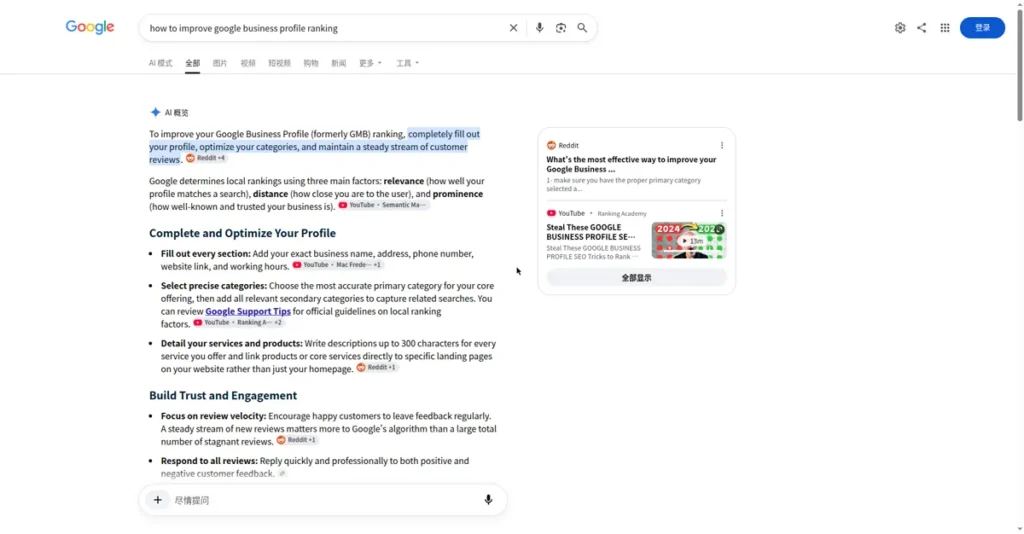
Ranking number one isn’t enough anymore. Because these days, the number-one spot might sit below a big AI-generated summary — and a chunk of searchers will read that summary and never scroll further.
Sound dramatic? Look at your own behaviour. When was the last time you clicked past an AI Overview to check the links underneath? Exactly.
Here’s the shift in one line: generative AI SEO is the practice of optimising your content so AI-powered search features — Google AI Overviews, ChatGPT, Gemini — cite or recommend it inside their generated answers. It’s also called GEO (generative engine optimisation): optimising for AI answer engines, not just the classic list of blue links.
The good news? Nobody has this fully figured out yet — so a well-run UK business can still get ahead. The bad news? There is no guaranteed formula, and anyone selling you one is selling snake oil. What follows is the honest version: nine practical steps that give your content the best possible shot at being cited.
What Is Generative AI SEO, Exactly?
Generative AI SEO means making your content the kind of source an AI wants to quote. Let’s pin down the terms so we’re talking about the same thing.
Generative AI SEO is the practice of optimising content so AI-powered search features cite or recommend it in their generated answers. GEO (generative engine optimisation) is the industry shorthand for the same idea: optimising for answer engines rather than ten blue links. AI Overviews are Google’s version — AI-written summaries at the top of the results page, each stitched from several cited websites, with little link cards pointing at the sources.
Why does it matter? Because the click is no longer the only prize. When an AI Overview answers the question directly, many people never click through — the so-called zero-click search. But the brands named and linked inside that answer still win: visibility, authority, and the clicks that do happen.
Traditional SEO vs Generative AI SEO: What’s Actually Different?
Generative AI SEO doesn’t replace traditional SEO — it stacks on top of it. Here’s precisely how the game has changed.
| Traditional SEO | Generative AI SEO | |
|---|---|---|
| The prize | Ranking in the top 10 blue links | Being cited inside the AI-generated answer |
| Success metric | Rankings and organic traffic | Citations and brand mentions in AI answers |
| Content style | Keyword-optimised pages built to rank | Direct, quotable, well-structured answers |
| Key lever | Backlinks and on-page optimisation | Trust signals, structured data, consistent brand facts |
| User behaviour | Searcher clicks your link | Searcher may never click — visibility still counts |
| Still required? | Yes — it’s the foundation | Yes — AI cites pages Google already trusts |
Notice the last row: AI Overviews cite pages Google already trusts. Every boring fundamental — crawlability, indexation, genuine authority — still matters, possibly more than before. Skip the foundations and your GEO strategy is decoration.
Steps 1–3: Make Your Content Citable
The first three steps share one goal: writing content an AI can lift a clean answer from. Give it good passages.
Step 1: Put the direct answer first
The fastest win in generative AI SEO is answering the question in the first 100 words of the page. Don’t bury the answer under three paragraphs of throat-clearing. AI systems favour content where the answer is obvious and extractable.
When someone — or something — asks “what is generative AI SEO?”, the ideal source gives the definition immediately, then elaborates. Ask yourself: if Google quoted only your first two sentences, would they make sense on their own? If not, rewrite them.
Step 2: Write headings as questions people actually ask
Question-style H2 headings mirror the queries AI Overviews are built to answer. Instead of a clever heading like “The Citation Opportunity”, write “How Do You Get Cited in Google AI Overviews?” — the literal question your customer types.
AI Overviews exist to answer questions, so content organised as questions and answers maps neatly onto what the system is doing. Check Google’s “People also ask” box and let real phrasing guide your headings — they now guide human readers and signal answer-shaped content to the machine.
Step 3: Add FAQPage schema — but know its limits
Structured data like FAQPage schema helps Google understand your content, which improves your chances — but it cannot force a citation. Let’s be blunt about this, because plenty of agencies won’t be: schema is a comprehension aid, not a magic ticket.
So use it: mark up your FAQs, keep heading hierarchy clean. You’re removing every excuse for Google to misunderstand your page. Just don’t mistake “Google understands my content” for “Google must cite my content” — the second is Google’s editorial choice, and nobody outside Google controls it.
Steps 4–6: Prove You Deserve the Citation
Here’s an uncomfortable truth: AI systems are picky about who they quote.
Step 4: Show real E-E-A-T signals
AI Overviews favour content that demonstrates experience, expertise, authoritativeness and trust — so make yours visible. That’s Google’s E-E-A-T framework, and in the AI era it carries extra weight: the system needs reasons to trust you before quoting you.
In practice: named authors with real bios, an about page that says who you actually are, a contact page with a real address, content showing first-hand experience rather than paraphrased generalities. None of it is glamorous and none of it can be faked convincingly — which is exactly why it works as a filter.
Step 5: Publish original, first-hand content
AI systems have no reason to cite the tenth rewrite of the same generic advice — original, first-hand content is what gets quoted. The AI is assembling the best answer from many sources; why would it pick your page if five others say the identical thing?
Original means your own data, process, examples, and opinions earned from doing the work — not academic research. A UK agency writing about what actually happened when they tested something beats a generic “ultimate guide” every time, for humans and machines alike. As AI agents increasingly browse the web on our behalf (see how Dots AI is changing the landscape), real experience becomes even more distinctive — it’s the one thing AI can’t generate about you.
Step 6: Keep your brand facts consistent everywhere
AI systems cross-check facts across the web, so inconsistent business details undermine your citability. Your business name, address, phone number, services and descriptions should match across your website, your Google Business Profile, your social profiles, directories — everywhere.
These systems build a picture of entities from multiple sources. If your website says one thing, your Business Profile says another, and a directory says a third, the AI’s confidence drops. Consistency is a quiet trust signal most small businesses get wrong — audit yours this week; it costs nothing.
Steps 7–9: The Technical and Strategic Foundations
The final three steps are the ones people skip — and the ones that quietly decide whether steps 1–6 can work at all.
Step 7: Make sure Google can actually read your pages
An AI Overview can only cite pages Google has crawled and indexed — check Search Console before doing anything else. This sounds obvious, and yet it’s the most common failure we see: businesses optimising pages that Google hasn’t even indexed.
Open Search Console, check your Coverage report, and confirm key pages are indexed and crawlable. Fix the basics — leftover noindex tags, blocked resources, slow pages. Generative AI SEO multiplies technical SEO, and anything multiplied by zero is zero.
Step 8: Track AI visibility and keep content fresh
You can’t improve what you don’t measure — start tracking whether your brand appears in AI answers. Traditional rank tracking misses this; ask the questions your customers ask — in Google, ChatGPT, Gemini — and note where you’re cited.
Then treat it as a programme, not a project: update pages when facts change, expand answers getting cited, rewrite sections that aren’t. AI systems favour maintained content over pages untouched for two years. Set a quarterly rhythm and stick to it.
Step 9: Make a deliberate choice about opting out
UK publishers can now opt out of AI Overviews entirely — so decide consciously instead of drifting. A CMA ruling in June 2026 gave UK publishers the right to stop Google using their content in AI Overviews, and there’s genuine backlash: “hide google ai overviews” is a breakout search query.
Should you opt out? For most businesses that want visibility, no — opting out of AI Overviews also means opting out of being cited, handing the answer box to competitors. It’s still a legitimate choice for publishers whose model depends on the click. The wrong move is not choosing at all.
What Won’t Work (Read This Before You Spend Money)
Let’s clear the minefield — this space is already full of bad advice.
There is no guaranteed formula for AI Overview citation. Anyone selling “guaranteed AI Overview placement” is selling something Google has never offered. The steps above improve your odds; none of them is a promise.
Keyword stuffing 2.0 doesn’t work either. Cramming “generative AI SEO” into every sentence doesn’t make you more citable — it makes your content worse, for humans first and machines second. Write for the question, not the keyword count.
Copying whoever’s currently cited is a losing game. By the time you’ve reverse-engineered someone’s AI Overview appearance, the landscape has moved. Build the underlying qualities — clarity, trust, originality — and citations follow as a side effect.
And finally: don’t neglect traditional SEO while chasing GEO. AI cites pages Google already trusts — the businesses winning citations are, almost without exception, the ones already winning organic search. If your fundamentals are weak, fix those first.
The Bottom Line for UK Businesses
So where does this leave you? With a genuine opportunity and a clear-eyed view of it.
The opportunity: AI-mediated search is still young, most competitors haven’t adapted, and the habits that win citations are simply good publishing. Do them well and you win twice: in classic rankings and in AI answers.
The clear-eyed part: no shortcuts, no guarantees, no magic schema. Just the unglamorous work of being the most trustworthy, most quotable source on the questions your customers ask.
For UK small businesses, start with an audit: are your key pages indexed, do they answer questions directly, and does your business look like a real, trustworthy entity across the web? If you want help turning that audit into an action plan, that’s exactly what we do — and the same AI shift is already reshaping how small firms operate, as we’ve explored in our guide to AI agents for small business in the UK.
FAQs
What is generative AI SEO?
Generative AI SEO (sometimes called GEO) is the practice of optimising your content so AI search tools — Google AI Overviews, ChatGPT, Muse — cite and recommend your business. Where traditional SEO chases rankings, generative AI SEO chases citations: being the source the AI quotes when it answers.
How do I get my business cited in Google AI Overviews?
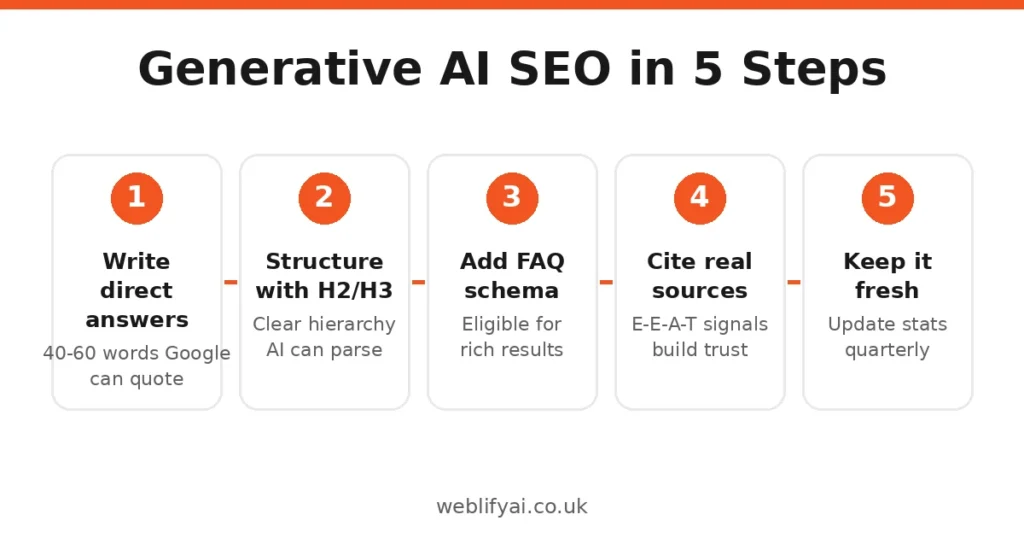
Write clear, direct answers (40–60 words) near the top of relevant pages, structure content with descriptive H2/H3 headings, add FAQ schema markup, cite credible sources, and keep your Google Business Profile complete and consistent. AI Overviews favour content they can quote cleanly.
Does traditional SEO still matter for AI search?
Yes — more than ever. AI search tools draw heavily on the same signals as classic SEO: relevance, authority, fresh content and technical health. Generative AI SEO is an extension of good SEO, not a replacement. Sites with strong traditional SEO are the ones getting cited.
Can a small business compete with big brands in AI Overviews?
Often yes — sometimes more easily than in classic rankings. AI answers favour the clearest, most specific answer over the biggest domain. A plumber with a precise, well-structured page on ’emergency boiler repair in Leeds’ can get cited ahead of a national directory with generic content.
Do I need schema markup for AI search?
It’s not officially required, but it helps enormously. FAQ, HowTo, LocalBusiness and Article schema give AI systems structured facts to quote. It’s one of the cheapest wins in generative AI SEO — a few lines of code per page.
Will AI Overviews kill my website traffic?
They change it rather than kill it. Informational queries get answered on the results page, but commercial and local queries still drive clicks — and being cited in an Overview builds the trust that brings the click. Optimise for citations AND conversions, not just traffic volume.