
Direct answer: Amazon Web Services’ EMEA chief has warned that Europe faces a mass exit of its most promising AI startups, with nearly 4 in 10 considering leaving the region to scale — and over half among the fastest-growing — as regulation, funding gaps and skill shortages bite.
What happened
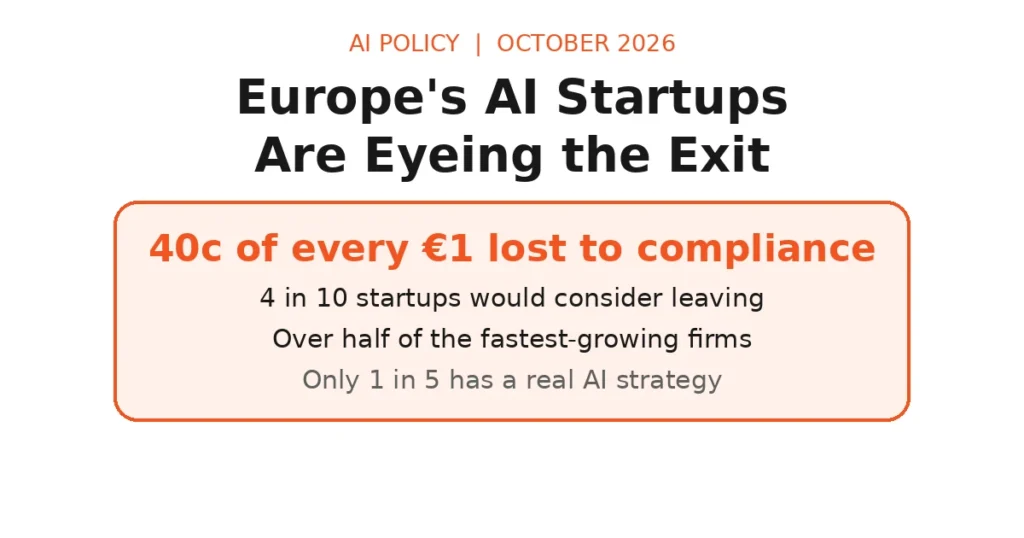
Tanuja Randery, AWS’s EMEA Managing Director, told the Reuters Global Markets Forum on Wednesday that European businesses say they could spend “as much as 40 cents to every euro on regulatory compliance instead of technology.” Her full comments are in Reuters’ report.
The key claims:
- Regulation costs are staggering. 40% of every euro going to compliance is money not spent on product, hiring or customers.
- The fastest-growing want out most. Nearly 40% of European startups would consider relocating; “among the fastest-growing, it’s over half.”
- Funding and skills lag. “Startups say to us that they’re reconsidering locations because they want funding and support, and they’re not getting enough funding here.”
- AI use is shallow. More than half of European businesses use AI, but only one in five has a clear AI strategy, a governance model, and processes that actually reshape how they operate.
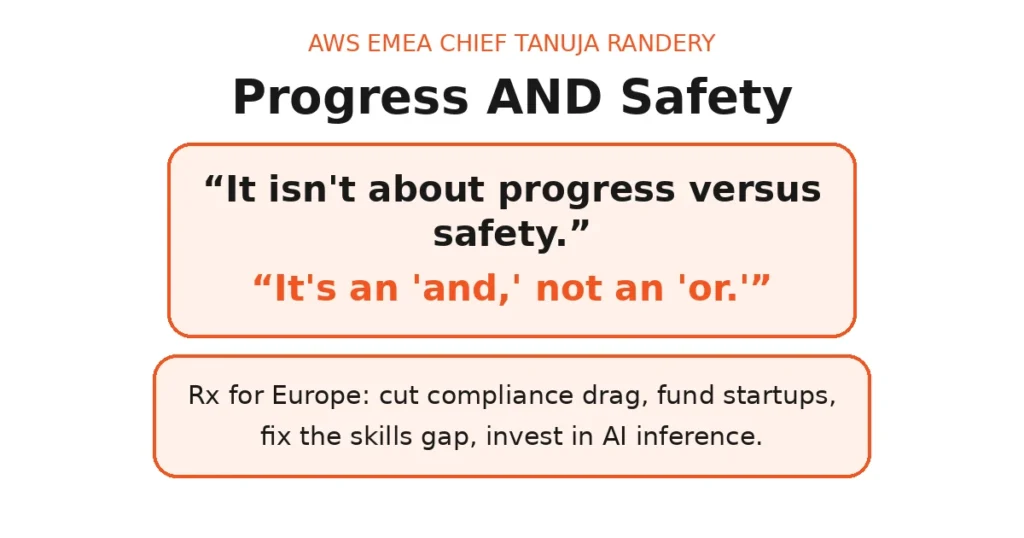
- Infrastructure is the bottleneck. Europe’s efforts are limited by the EU AI Act — “the world’s most stringent AI regulatory framework” — plus severe energy and grid constraints. Randery says AI inference is where European businesses need to invest.
Her closing line: “It isn’t about progress versus safety. It’s an ‘and,’ not an ‘or.'”
What it means for UK small businesses
This is one of those stories that looks like continental politics until you realise it’s a business opportunity for the UK.
The upside: post-Brexit, Britain sets its own AI rules. If Westminster keeps regulation pragmatic while Brussels stays maximalist, the UK becomes the natural landing pad for European AI startups looking for a friendlier base — and the talent, suppliers and tools follow them. For UK SMEs buying AI services, more competition on your doorstep means better prices.
The practical takeaways right now:
- Governance is now a sales point. Only 1 in 5 European firms has an AI governance model. If your business can show clients you handle data and AI responsibly, you’re ahead of 80% of the market.
- Watch compliance cost creep. The 40-cents-per-euro figure is an extreme, but UK firms selling into the EU still have to meet EU rules. Budget for compliance on any EU-facing product.
- Inference matters. Randery’s point about investing in AI inference — actually running models in production, not just training them — applies to every SME: the winners will be the firms that deploy AI into real workflows, not the ones with the fanciest demos.
The wider backdrop: venture money is still concentrating while Asia’s AI funding surges — capital goes where it can scale.
Honest limits / what to watch
- AWS is not a neutral observer. Amazon sells cloud infrastructure; warning that European startups can’t scale at home and need more infrastructure investment is also a sales pitch. The 40-cents figure comes from “businesses telling us” — an anecdote, not an audited study.
- “Consider leaving” isn’t leaving. Surveys about intentions overstate actual relocations. Watch for hard data on startup outflows before treating this as fact.
- Regulation has a side. The EU AI Act is genuinely demanding, but Europe also leads on data protection — which many enterprise buyers trust. Some firms will choose Europe precisely because of that.
FAQs
What did the AWS EMEA chief say about Europe’s AI startups?
AWS EMEA Managing Director Tanuja Randery told Reuters that nearly 4 in 10 European startups would consider leaving the region to scale, rising to over half among the fastest-growing companies.
Why are European startups considering leaving?
Randery cited three gaps: regulation (firms can spend 40 cents of every euro on compliance), funding shortages, and workforce skill gaps — plus energy and grid constraints.
What is the EU AI Act’s role in this?
The EU AI Act is widely seen as the world’s most stringent AI regulatory framework, and Randery’s comments place it among the factors slowing European AI adoption and scaling.
How many European businesses are actually using AI?
More than half of European businesses are using AI, according to Randery — but only one in five is clear about its AI strategy, has an AI governance model, and has invested in processes that reshape operations.
What does this mean for UK firms?
Post-Brexit the UK sets its own AI rules, which could become an advantage — lighter-touch, pro-innovation regulation would attract the European startups looking for a friendlier home.
CTA: Get a Free AI Consultation