
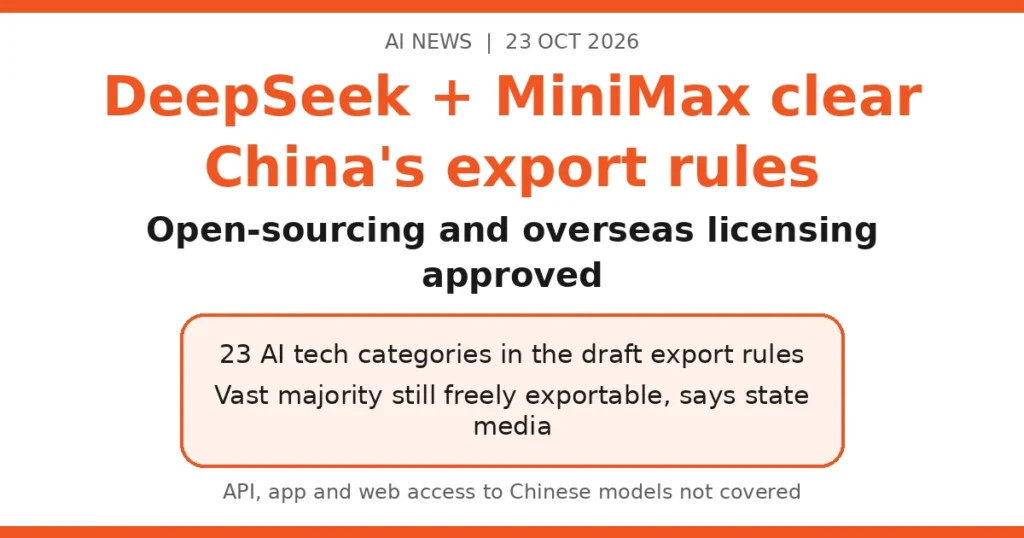
Direct answer: DeepSeek and MiniMax have completed China’s new AI export registration procedures, clearing both companies to keep open-sourcing models and licensing AI technology overseas — days after Beijing proposed sweeping export controls on 23 AI-related technologies. The message from Beijing, via state media: the door stays open, but the paperwork is now mandatory.
What happened
Yuyuan Tantian, an influential social media account affiliated with state broadcaster CCTV, reported on Thursday evening that DeepSeek and MiniMax had completed the required registrations after Beijing proposed adding export control restrictions and prohibitions to 23 AI-related technologies last week — covering large language models, AI agents and computing clusters.
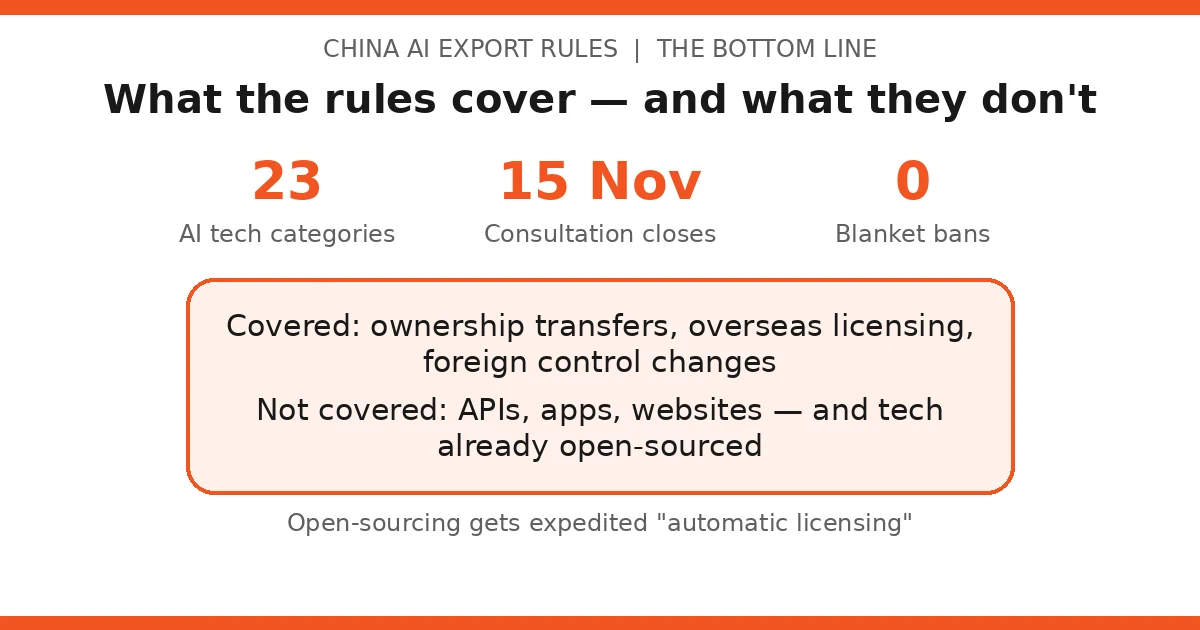
The draft proposal from the Ministry of Commerce (MOFCOM) and Ministry of Science and Technology included provisions that took immediate effect, requiring official registration for covered technologies: transfers of technology ownership, overseas licensing arrangements, and changes in ownership or control involving foreign entities.
The announcement raised the obvious question: was Beijing clamping down on its AI champions’ overseas expansion, just as China’s open-weight models were winning international adoption? According to Yuyuan Tantian, no. The measures are intended to establish clearer regulatory boundaries rather than shut the door on Chinese AI technology exports. “Simply put, AI companies can continue with their commercialisation efforts as usual. Once the relevant measures are officially implemented, the vast majority of artificial intelligence technologies will still be freely exportable.”
The details favour openness more than the headline suggests. A MOFCOM spokesperson said overseas access to Chinese AI models through APIs, official websites and mobile applications would not be covered by the proposed controls. For open-sourcing, expedited “automatic licensing” would apply — as fast as “immediate reporting and export.” Technology already in the public domain through open-source release would fall outside export management.
Both companies have been busy: DeepSeek upgraded its V4.1 Flash model and open-sourced its in-house inference framework, while MiniMax open-sourced its M3.1 model. MiniMax has also set up a formal application route for organisations in regions previously excluded by its licence — including the UK — to request permission for local deployment.
What it means for UK small businesses
This matters because cheap, open-weight Chinese models have quietly become infrastructure for thousands of small businesses and developers. If you or your agency use open-source models to power chatbots, content tools, or automation — or rely on providers who do — this is the regulatory backdrop keeping those models available. Beijing just signalled it wants them to stay available, with paperwork.
The deeper signal is strategic. Beijing is drawing a line the US keeps crossing in the other direction: distinguishing between transferring underlying AI technology abroad (which it will control for national security reasons) and providing commercial AI services overseas (which it will encourage). Meanwhile the US Department of Homeland Security this week ordered federal agencies to remove DeepSeek and tools built on it — a move Beijing called discriminatory, and one that echoes the earlier US government ban on DeepSeek covered here.
For UK businesses, the practical takeaway is diversification awareness. Your AI stack now spans two regulatory regimes pulling in opposite directions. Building on open-weight models is still viable and still cheap — but know where your models come from and what happens if either side tightens the rules.
Honest limits / what to watch
This is a draft proposal, not final law — public consultation runs until November 15, 2026, and the final rules could be stricter (or looser) than what’s on the table. The “vast majority will remain freely exportable” line comes from a state-affiliated social media account, not the regulation’s text.
Also, read the direction of travel honestly. Even friendly-sounding export controls give Beijing the power to track where its most advanced models go — and the New York Times notes many details remain unclear, especially for labs releasing new versions every few weeks. “Encouraging openness” and “controlling technology transfer” are both true at once; which one dominates in practice is what the next year will show.
And the US side isn’t standing still. Congress is weighing bills to further clamp down on advanced chip exports to China — the same chips Chinese labs need to train the models everyone wants to use. The two export-control regimes are coupled, even when they pretend not to be.
FAQs
What did DeepSeek and MiniMax secure?
Both companies completed export registration procedures under China’s proposed AI export rules, allowing them to proceed with open-source releases and overseas licensing activities.
What are China’s new AI export rules?
A draft proposal from the Ministry of Commerce and Ministry of Science and Technology adds export control restrictions and prohibitions to 23 AI-related technologies, covering large language models, AI agents and computing clusters. Public consultation runs until November 15, 2026.
Does this mean China is banning open-source AI exports?
No. State-affiliated media say the measures are meant to establish clearer regulatory boundaries, not shut the door. The vast majority of AI technologies will still be freely exportable, and ordinary API, app and web access to Chinese AI models would not be covered.
What about open-sourcing specifically?
A MOFCOM spokesperson said expedited “automatic licensing” would apply to open-sourcing AI technologies — as fast as “immediate reporting and export”.
What have the companies released recently?
DeepSeek upgraded its V4.1 Flash model and open-sourced its in-house inference framework; MiniMax open-sourced its M3.1 model.
Sources: South China Morning Post, AI Affairs