
If you can’t find the service you need, just write to us and we’ll figure something out [email protected]
If you can’t find the service you need, just write to us and we’ll figure something out [email protected]

Direct answer: Vibe coding means building software by describing it in plain English — “build me a booking page with a calendar” — while AI writes the code. Tools like Lovable (from $25/month), Base44 (from $16/month) and Bolt.new turn chat into working apps, most with free tiers to start. For a UK small business, it’s genuinely useful for prototypes, internal tools and simple customer-facing apps. The honest limit: AI builds the demo brilliantly, but security, scale and maintenance still need a real developer once the app matters. Here’s what you can build, what it costs, and where the line is.
The term was coined by Andrej Karpathy — OpenAI founding member, ex-Tesla AI chief — in February 2025. Collins Dictionary named it Word of the Year for 2025. Search interest is still running hot (“vibe coding” holding strong into October 2026, with Lovable and Base44 both breakout queries). The hype is loud; this is the practical cut.
Traditional route: hire a developer, wait six weeks, pay thousands. Vibe coding route: open Lovable, type “a booking website for my salon with services, prices and a contact form in my brand colours”, and get a working site in minutes. Then keep chatting — “make the header blue”, “add a testimonials section” — and it updates.
The name comes from Karpathy’s original framing: coding where you “forget that the code even exists”. One detail people skip: he pitched it for throwaway weekend projects, not for building a company. That distinction is the whole article, really.
The tools fall into two camps:
| App builders (for non-coders) | AI coding tools (for developers) | |
|---|---|---|
| Examples | Lovable, Base44, Bolt.new, v0 | Cursor, Replit, Claude Code |
| You write | Plain English descriptions | Code, with AI assistance |
| Skill needed | None | Programming |
| Output | Working app/website, hosted | Code you own and deploy |
| Cost | Free tier; ~$16–$30/month | ~$10–$30/month |
For a small business owner with no technical background, the first camp is the story.
Be concrete. These are real, working use cases:
Lovable tends to produce the prettiest interfaces; Base44 (now owned by Wix) is the most all-in-one — database, logins and hosting built in rather than bolted on.
The pricing is refreshingly small-business-friendly:
The catch is the credit model: you’re not paying for software, you’re paying per AI message. A simple app might take 20 messages; a fiddly one with lots of “no, not like that” revisions can burn through credits fast. Budget $25–$50/month for a serious project, and write clear, specific prompts — vague instructions are the most expensive kind.
Compare: a freelance developer charges £300–£600+ per day in the UK. A vibe-coded MVP costs less than one hour of developer time. That’s the economic earthquake, even with the caveats below.
Security isn’t automatic. AI-written code can have holes — insecure data handling, exposed keys, weak auth. Fine for a prototype; dangerous for anything holding customer data or payments. Get a developer to review before real users and real data arrive.
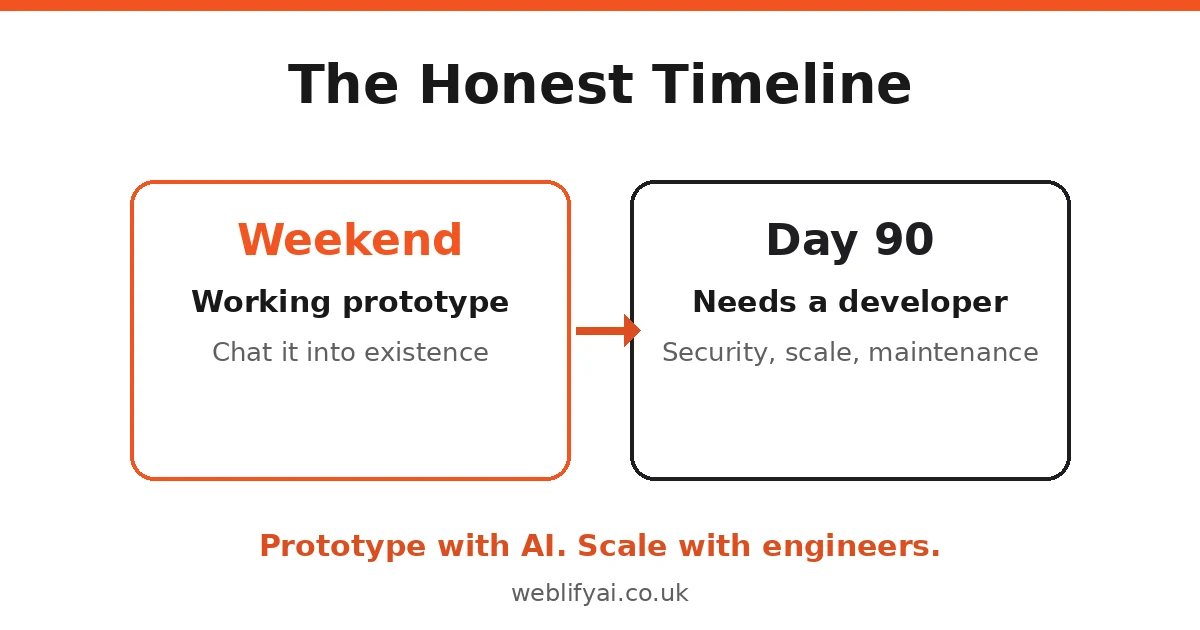
Day 90 is the real test. The demo is easy. Month three — with users, edge cases, and something breaking at 2am — is when “who owns this code?” matters. Vibe-coded apps can become hard to maintain precisely because nobody fully understands what was built.
You’re renting the platform. Your app lives on their infrastructure, priced in their credits. Export options exist (most let you take the code), but migration is never as smooth as promised. For a core business system, that dependency deserves thought.
Complex logic still needs humans. Multi-step workflows, integrations with legacy systems, regulated industries — the AI guesses, and guesses compound. The tools are honest about this in their fine print; read it.
Design taste varies. Lovable’s outputs look genuinely good. Others can look template-ish. If brand perception matters, budget for a designer’s eye at the end.
| Vibe coding | Freelance developer | Agency | |
|---|---|---|---|
| Cost | $0–$50/month | £300–£600+/day | £5,000+ per project |
| Speed to prototype | Hours | Days–weeks | Weeks |
| Best for | MVPs, internal tools, simple apps | Custom logic, integrations | Complex/regulated builds |
| Security review | On you | Included | Included |
| Maintenance | Fragile at scale | Owned | Owned |
The smart play isn’t either/or — it’s sequential: vibe-code the MVP to prove demand, then hire properly once revenue justifies it. The worst outcome isn’t a failed experiment (that cost $25); it’s a successful app with no one who can maintain it.
And when the app outgrows the chat box — when you need integrations, security review, or scale — that’s when a proper build makes sense. If that’s where you’re heading, our agency team builds AI products for UK businesses every day.
Building software by describing what you want in plain language and letting AI write the code. You chat with a tool like Lovable or Base44 — ‘build me a booking page with a calendar’ — and it generates a working app you keep refining by conversation.
Andrej Karpathy — a founding member of OpenAI and former head of AI at Tesla — coined it in February 2025, describing coding where you ‘forget that the code even exists’. Collins Dictionary named it Word of the Year for 2025.
For non-technical founders: Lovable (from $25/month) and Base44 (from $16/month, now owned by Wix). For rapid prototypes: Bolt.new. Developers tend toward Cursor, Replit or Claude Code. All have free tiers to start.
Most tools have free tiers, with paid plans roughly $16–$30/month. The real cost is credits: every message to the AI spends them, so heavy iteration can push you up tiers. Budget $25–$50/month for a serious small project.
Yes — for prototypes, internal tools, booking pages, dashboards and simple customer-facing apps. The honest limit is day-90 reality: security, scale, and maintenance need real engineering. Build the MVP with AI, hire a developer when revenue justifies it.
Not automatically. AI-generated code can have security holes, and tools vary in what they handle. Don’t put sensitive customer data or payments through a vibe-coded app without a developer reviewing it first.
No — it replaces the blank page, not the engineer. It compresses the prototype phase from weeks to days. Someone still needs to own security, architecture and the 2am outage. For complex or regulated software, start with a developer.