
If you can’t find the service you need, just write to us and we’ll figure something out [email protected]
If you can’t find the service you need, just write to us and we’ll figure something out [email protected]

Direct answer: Zach Yadegari — the 19-year-old who built the calorie-tracking app Cal AI, sold it to MyFitnessPal, and famously got rejected by 15 universities — has raised $10 million for Persona, an AI assistant that books flights, schedules meetings, drafts emails and does multi-step tasks for you. The headline device is a $179 wristband launching in December that activates by button or wrist gesture rather than always listening. For a UK small business, the device is a curiosity — but the shift underneath it, AI that does things instead of just answering questions, is worth understanding now.
Persona announced its $10 million raise on 8 October 2026, led by Vine Ventures with participation from Cory Levy (founder of Z Fellows), Collective Global, and the wellness brands WHOOP and Eight Sleep. The funding follows Yadegari’s departure from MyFitnessPal in June — months after the March 2026 acquisition of Cal AI, which had passed 15 million downloads and was generating more than $30 million in annual revenue within two years, according to TechCrunch’s reporting.
The product pitch is simple: an AI assistant that completes everyday tasks — booking travel, ordering food, arranging rides, responding to emails, answering questions — across websites, emails and phone calls, without you opening a dozen apps. “Our mission is really to just make computing seamless with human life, and that’s what physical hardware actually allows,” Yadegari told Inc.
The assistant is already live as a free beta over iMessage, with thousands trying it, and the $179 wristband is up for pre-order with December deliveries planned. On privacy — the question that sank earlier AI wearables — Persona says the band won’t continuously listen (it activates via a physical button or wrist movement), AI processing happens in the cloud with encryption, users get data-deletion options, and the assistant won’t hold credit card details: purchases need explicit approval through external providers like Stripe Link. The company says it’s also building safeguards against phishing and prompt-injection attacks.
Forget the wristband for a moment. The important trend is the category: agentic AI assistants that act on your behalf rather than chat with you. That’s directly relevant to how small firms will work in the next two years:
Persona’s own track record is the genuine wildcard here: Yadegari has actually shipped a product millions of people used, which is more than most AI-hardware founders can claim. That makes Persona more credible than the average “trust us, AI device” pitch — but it’s still a seed-stage startup selling a pre-order.
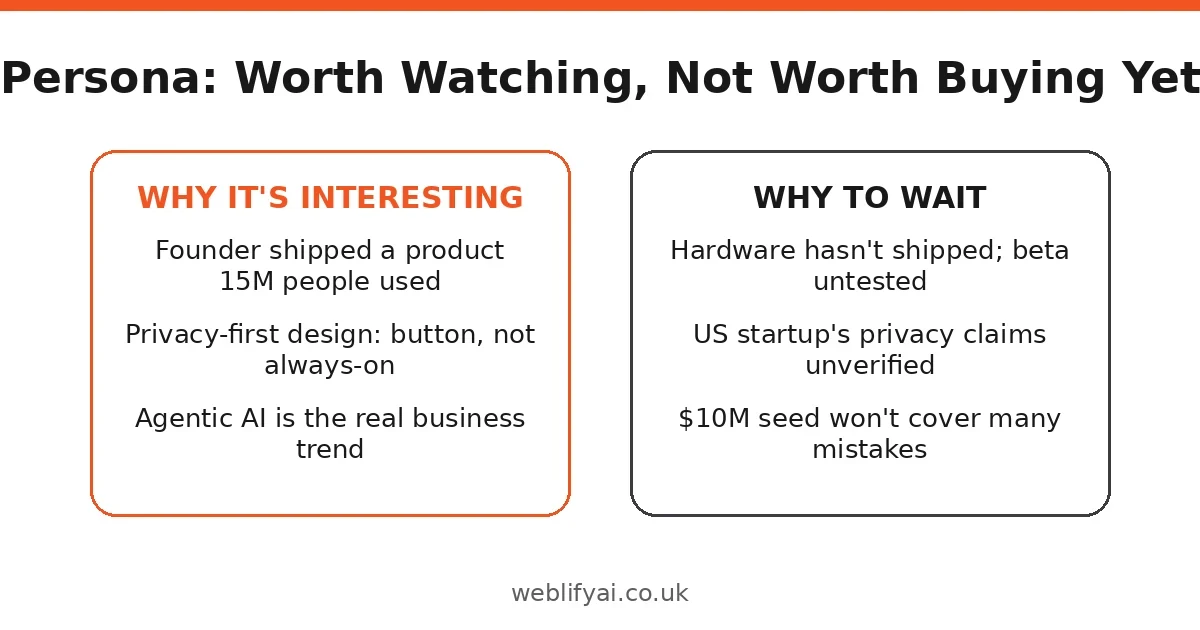
Bottom line: Persona is one to watch rather than one to buy — a credible founder, an interesting privacy-conscious design, and a genuinely important trend (AI that does tasks, not just answers). Let the early adopters test the wristband. In the meantime, pilot agentic features inside the tools you already use, with strict boundaries on what the AI can touch.
Persona is an AI assistant startup founded by Zach Yadegari. It offers a free assistant over iMessage and is building a $179 wearable wristband (planned for December 2026) that lets users talk to the AI, ask it to book flights, schedule meetings or draft emails, and carry out multi-step tasks.
A 19-year-old entrepreneur from Long Island, New York. He co-founded Cal AI, a photo-based calorie-tracking app that passed 15 million downloads and $30 million in annual revenue before being acquired by MyFitnessPal in March 2026. He left MyFitnessPal in June to build Persona.
The wristband is priced at $179, with deliveries planned from December 2026. The AI assistant itself is available free as a beta over iMessage.
The pitch is agentic: Persona is designed to complete multi-step tasks on your behalf — moving between websites, emails and calls — rather than just answering questions. It’s also betting on a screenless wristband instead of your phone.
Not yet as a core system. Persona is brand new and its wearable hasn’t shipped. The category is promising for delegation tasks (scheduling, drafting, follow-ups), but for now treat any startup AI assistant as a trial — with clear boundaries on what it can access — until it proves reliability and longevity.
The big ones are always-on listening and where your data goes. Persona says its band activates by button or wrist gesture (not continuous listening), processes AI in the cloud with encryption, and offers data deletion. Verify any such claims before trusting it with business data — and ask where data is stored relative to GDPR.
Sources: Inc. · Refresh Miami · Hindustan Times