
If you can’t find the service you need, just write to us and we’ll figure something out [email protected]
If you can’t find the service you need, just write to us and we’ll figure something out [email protected]

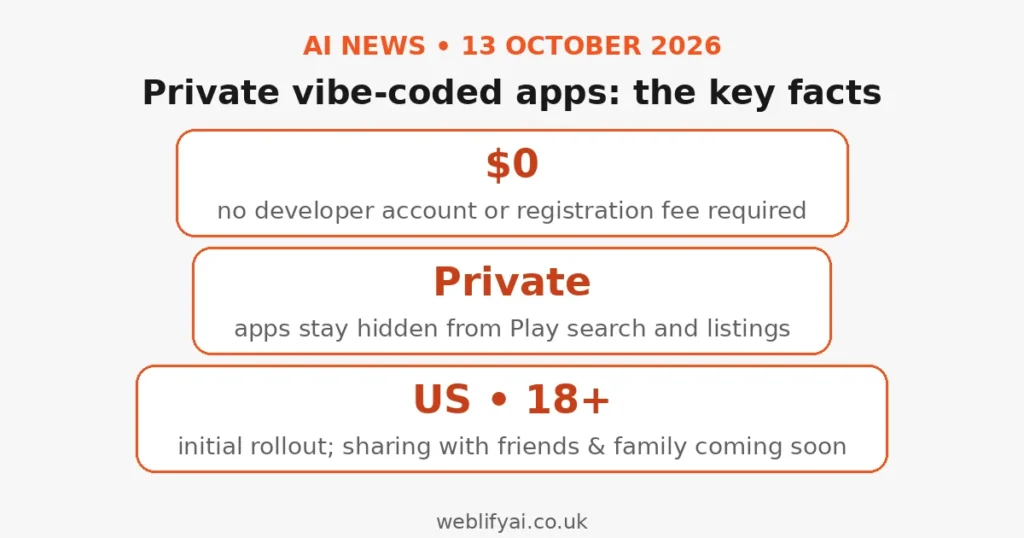
Direct answer: Google announced on 13 October 2026 that anyone can now build an app in Google AI Studio and run it privately on their own Android phone through Google Play — no developer account, no registration fee, no public listing. The apps stay invisible to everyone else, and the rollout starts in the United States for users aged 18 and over.
The change removes the biggest friction in personal app-building. Until now, getting a self-built app onto your own Android phone meant either plugging the phone into a computer and installing it through developer tools, or publishing it to the whole Play Store — potentially exposing a half-finished personal project to the store’s roughly 3 billion users. The middle option, a private testing track, required a Google Play developer account and its one-off $25 registration fee.
Now the flow is simple: describe the app you want in Google AI Studio, Google’s free browser-based tool for building with Gemini, which writes a native Android app for you. Google Play then lets you launch that app on your own device using nothing more than your ordinary Google account. It sits alongside your downloaded apps but never appears in Play search or listings, and Google keeps it separate from the public store catalogue — only you can access it.
Private doesn’t mean lawless. Google says these personal apps still have to comply with the Play Store’s existing policies, so the feature is a workshop, not a loophole. Google’s Sam Bright, VP and GM for Google Play and the developer ecosystem, framed the shift as moving “from ‘there’s an app for that’ to ‘there’s an app for me'”, describing Play’s future as “personal, secure, and built by everyone”.
Two expansions are promised in the coming months: sharing your creations with a close circle of trusted friends and family (Google’s examples included family organisers and a child’s t-ball league stat tracker), and a path to graduate a personal app into a full public Play Store listing — which does go through the usual trust and safety reviews.
The personal-apps feature arrived as part of a wider Play Store update also announced on Tuesday: a personalised game recommendation engine called Game Finder, an updated Ask Play assistant that can compare similar apps side by side, user-curated game lists, community Q&A sections, 48-hour gaming challenges called Sprints, and a new Family Link option that shares a child’s age range (not exact birthdate) with developers for age-appropriate experiences.
First the honest bit: this is US-only at launch, and Google hasn’t given a date for the UK. Nobody in Britain can use it yet. But the direction of travel matters, because it points at a future where app prototyping stops being a £10k developer project.
Think of the tools a small firm actually wishes existed: a stock checker that matches how your storeroom is organised, a job-quote calculator tuned to your pricing, a delivery checklist for your drivers, a simple rota viewer for your team. Today those either cost real money to build or get bodged together in spreadsheets. Private personal apps are aimed exactly at this tier — software built for one person, one household, or one team, not for millions of users.
This is the practical side of vibe-coding for small business we’ve been covering: plain-language app building that non-technical owners can experiment with directly. With no developer account and no fee, the cost of trying something is now close to zero — you can prototype an internal tool, live with it for a week, and throw it away if it’s useless.
The limitation for teams is that sharing isn’t here yet. Today’s feature runs only on the creator’s own device, so don’t plan a staff-wide rollout around it. The promised friend-and-family sharing is the thing to watch — that’s the version a business owner could actually hand to a small team.
For now, the smart move for UK firms is free preparation: get comfortable describing apps in Google AI Studio’s playground now, so that when the feature does reach Britain, you’re testing ideas on day one instead of learning the tool.
Not yet. The feature launched in the United States for users aged 18 and over, and Google has not given a date for the UK. Treat it as a preview of what’s coming rather than something to build on today — AI Studio itself is accessible now, so you can start learning the tool while you wait.
No. Private apps launch through Google Play with a standard Google account — no developer account, no registration fees, no publishing process. The developer account only enters the picture if you later graduate the app to a public Play Store listing.
No. Google says personal apps are kept separate from the public store catalogue. They don’t show up in Play search results or listings, and only the person who created them can access them. It’s a private workshop, not a storefront.
Google AI Studio is Google’s free browser-based tool for building with Gemini. You describe the app you want in plain language and the AI writes a native Android app for you. It’s the same tool developers use to experiment with Google’s models — the new feature simply gives non-developers a way to run what they build on their own phones.
Not yet. Today’s release only runs the app on the creator’s own device. Google says that in the coming months you’ll be able to share creations with a close circle of friends and family, and eventually graduate them to a public listing. Neither option is live yet, so don’t promise staff an app you can’t deliver.
Yes. Google has confirmed there will be a path from a personal app to a full public Play Store listing, but it goes through the same trust and safety reviews and quality standards applied to every public app. A rough prototype won’t sail through — it needs to meet the same bar as professional releases.