
If you can’t find the service you need, just write to us and we’ll figure something out [email protected]
If you can’t find the service you need, just write to us and we’ll figure something out [email protected]

Your website works around the clock, but for most UK businesses it only captures leads during working hours. Someone browses your services at 9pm on a Sunday, has a question, finds no quick way to ask it, and leaves. By Monday morning they’ve moved on, quite possibly to a competitor who answered faster. An AI chatbot for website lead generation closes that gap: it talks to visitors the moment they arrive, answers their questions, and turns passing interest into named, qualified enquiries.
In this guide, we explain how lead-generation chatbots actually work, what they can and cannot do, how they compare with live chat and contact forms, what good chatbot copy looks like, and how to set realistic expectations before you invest.
Think of your website as your hardest-working salesperson. It never sleeps and talks to every visitor. But most websites are passive: they display information and hope the visitor fills in a contact form. Forms feel like effort, especially on a phone, and they carry an unspoken promise of ‘we’ll get back to you… eventually’.
Think of it this way: every hour you do not respond to an enquiry, the chance of converting it drops. Visitors who get an instant, helpful answer stay; visitors who face silence leave. A chatbot closes that gap by responding in seconds, at any hour, without you hiring a night shift.
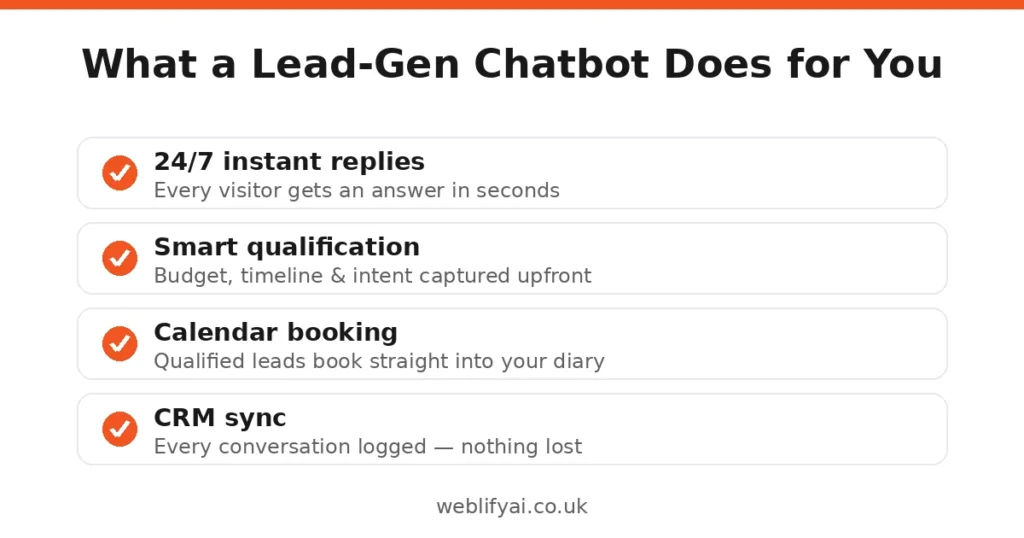
A lead-generation chatbot isn’t a gimmick that pops up saying ‘Hi!’. Done properly, it runs a structured conversation with one goal: spotting visitors with genuine intent and capturing their details. Here’s how that typically works.
The chatbot greets visitors proactively, ideally triggered by behaviour: time spent on the page, scrolling to pricing, or returning for a second visit. Timing and targeting matter more than most businesses realise. A message that appears after someone has spent 30 seconds on your pricing page feels helpful; the same message firing the instant the homepage loads feels like an interruption. The opening line matters enormously too. ‘Hi, looking for help with X? I can answer questions or book you in for a quick call’ beats a generic ‘How can I help?’ every time.
This is where chatbots earn their keep. Instead of dumping every enquiry into your inbox, the chatbot asks two to four focused questions: what the visitor needs, their timeline, budget range, where they’re based. Answers come one at a time, conversationally, which feels far lighter than a ten-field form. You define ‘qualified’; the chatbot applies it just as consistently at 3am as 3pm. Fewer, better enquiries: your team spends time on prospects who are actually ready to talk.
For service businesses, the chatbot checks your real availability and books a call or consultation there and then, syncing with your calendar. The visitor picks a time, enters their details, both sides get a confirmation. No email tennis, no ‘what time suits you?’ threads fizzling out. Strip steps between interest and booking and more conversations actually happen.
Some visitors prefer to continue on WhatsApp; others want a summary by email. A good chatbot offers the handover: ‘Shall I send this conversation to your WhatsApp so you can pick it up later?’ The lead stays warm, the conversation history travels with them, and your team gets the full context. And if the chatbot cannot answer something, it hands over to a human gracefully instead of looping or guessing. A clumsy handover undoes good work in seconds.
Worth being clear about what a chatbot replaces, because each option does a different job. A contact form is passive: it waits for the visitor to do all the work, and only the most motivated convert. Live chat is better, but it needs a human on the other end, so it goes quiet exactly when your team does: evenings, weekends, busy periods.
An AI chatbot sits between the two: always available like a form, conversational like live chat, without the staffing cost. It won’t match a great human for nuance or rapport, and it should never pretend to. But for capturing and qualifying enquiries around the clock, it consistently beats a form on its own. Most businesses we work with keep all three: the chatbot as the front door, live chat for complex conversations during working hours, a simple form as fallback for visitors who’d rather type at length.
The technology gets the attention, but the words do the work. Brilliant AI with sloppy copy still underperforms. What good chatbot copy comes down to:
The tone should sound like your business on its best day: helpful, direct, and human. Write the conversation the way your best salesperson talks, then trim it by half. Then test it on real visitors and keep trimming.
Straight talk: a chatbot is a multiplier, not a miracle. It won’t create demand that doesn’t exist, and it won’t rescue a website nobody visits. What it does is convert more of the traffic you already have. If your site gets a steady flow of visitors, even a modest conversion lift compounds into meaningful extra enquiries each month.
Expect a tuning period. The first version is a starting point. Review its conversations each week, spot where visitors drop off or ask unexpected questions, and refine the flows. Businesses that treat the chatbot as a living part of their sales process, not a set-and-forget widget, see the best results over time.
Some visitors will ignore it entirely. Fine. A chatbot doesn’t need to engage everyone; it needs to catch the interested visitors who’d otherwise slip away unnoticed. Even a small lift in captured enquiries compounds month after month.
Chatbots give you better data than most marketing channels, so use it. The metrics that matter: how many visitors start a conversation (engagement rate), how many finish your qualification questions (completion rate), and how many become qualified enquiries or bookings (conversion rate). Track weekly, not daily — you’re after trends, not noise.
Watch where conversations end. If visitors keep dropping off at the same question, it’s probably too early, too personal, or badly worded. If the chatbot hands over to a human unusually often on one topic, that topic needs a better answer. This review takes under an hour a week, and it’s the highest-leverage habit in chatbot ownership.
Judge the chatbot on enquiries and revenue, not chat volume. Fewer, longer conversations that produce more qualified bookings beat chatting to everyone and converting no one. Tie it back to the numbers you already use for marketing: cost per qualified enquiry, and enquiries that become customers.
Only if it is badly designed: popping up instantly on every page, blocking content, or trapping people in loops. A well-built chatbot waits for the right moment (triggered by behaviour, not by page load), stays dismissible, and adds obvious value within seconds. Most visitors either engage or close it without a second thought. If your bounce rate climbs after adding a chatbot, the timing or targeting is wrong, not the concept.
It can handle most of what a contact form does, usually better, because a conversation feels like less effort than a form. Many businesses keep a simple form as a fallback for visitors who prefer it, and the two coexist happily. The chatbot catches the visitors who would never have filled in the form; the form catches the ones who prefer to write at length.
A focused lead-generation chatbot can be designed, written, and launched in a matter of weeks, not months. The biggest variable is usually the quality of the conversation design (the copy, the qualification logic, the handover points) — which is why working with a team that writes the copy properly matters more than the choice of platform. Ongoing tuning continues after launch, but that is refinement, not delay.
Not necessarily. If you get even a handful of qualified visitors a day, capturing more of them can justify the investment quickly. That said, a chatbot multiplies existing traffic rather than creating it, so pairing it with steady marketing gives the best return. If your traffic is very low, fix that first; a chatbot on an empty website is a solution waiting for a problem.
No. Chatbots perform best on high-intent pages: pricing, service pages, and contact pages, where visitors are already considering you. Putting it on every page, including the homepage and blog posts, trains visitors to ignore it and can annoy the ones who are just browsing. Start where buying intent is highest, then expand only if the data supports it.
Ground it in your own content and limit its scope. A lead-generation chatbot should answer questions about your services, pricing, and process, not the whole internet. Give it clear sources to draw from, a defined list of topics it covers, and a graceful handover for everything else: ‘I am not sure about that, let me connect you with the team.’ Review conversations weekly at first to catch mistakes early.
Yes, and in some ways B2B benefits more. Business buyers research outside working hours just like consumers do, and they are often happier answering three qualification questions than filling in a ‘request a demo’ form. The conversation design differs: more focus on fit, timeline, and decision process, less on instant purchase — but the mechanics of capture, qualify, and book translate directly.
We build AI chatbots for lead generation for UK businesses: smart qualification, calendar booking, and WhatsApp handover, written in your brand’s voice and connected to the tools you already use. It is one part of our wider AI automation services. If you
would like to see what a chatbot could do for your website, contact us for a no-pressure conversation.