Direct Answer
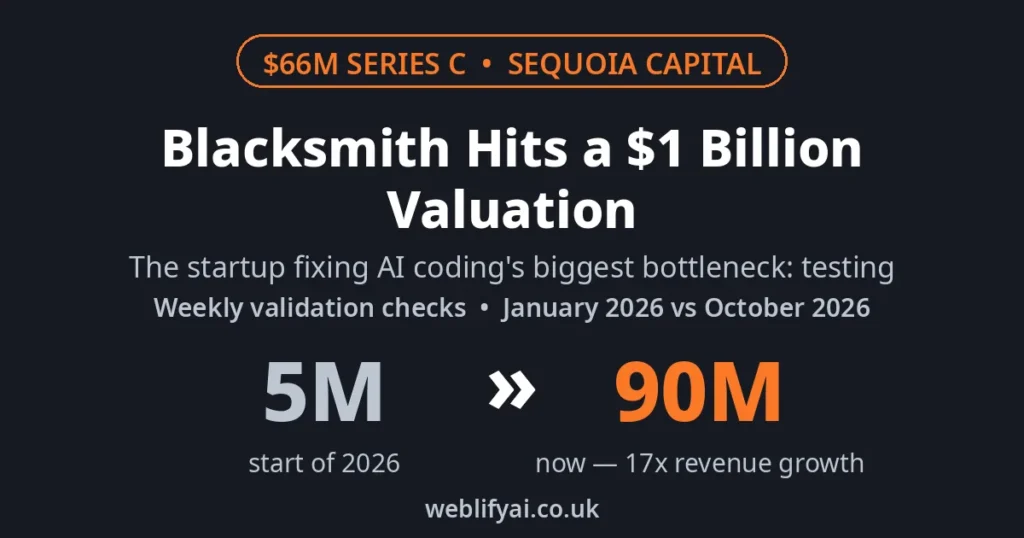
Direct answer: Blacksmith, a two-year-old startup that runs the infrastructure companies use to test code before it ships, has raised a $66 million Series C led by Sequoia Capital at a $1 billion valuation. The round — just two months after a $45 million Series B valued it at $550 million — shows where AI coding has really changed the industry: writing code is no longer the slow part; *validating* it is.
What happened
Blacksmith announced the $66M Series C, led by Sequoia Capital with participation from Premji Invest and existing investors Peak XV Partners, GV and Y Combinator, bringing total funding to about $125 million. Details from Fortune and the company’s own announcement (PR Newswire):
- Growth is extreme. Blacksmith ran 5 million validation checks per week in January 2026; it now runs 90 million. Its customer base doubled from ~5,000 to over 10,000 companies since August — including Granola, Handshake, Supabase and LangChain. Annual recurring revenue grew 17x to the tens of millions; its largest customers each spend more than $1 million a year.
- The business model is unusual. While most continuous-integration providers run on rented AWS, Google Cloud or Azure servers, Blacksmith buys its own machines — tens of thousands of them, installed in data centres worldwide — and writes its own orchestration software to eliminate the repetitive setup each test run would otherwise redo.
- The money goes to compute. CEO and cofounder Aditya “JP” Jayaprakash said most of the new funding will buy more computing power. The company has about 40 employees across San Francisco and New York and plans to reach ~75 by year end.
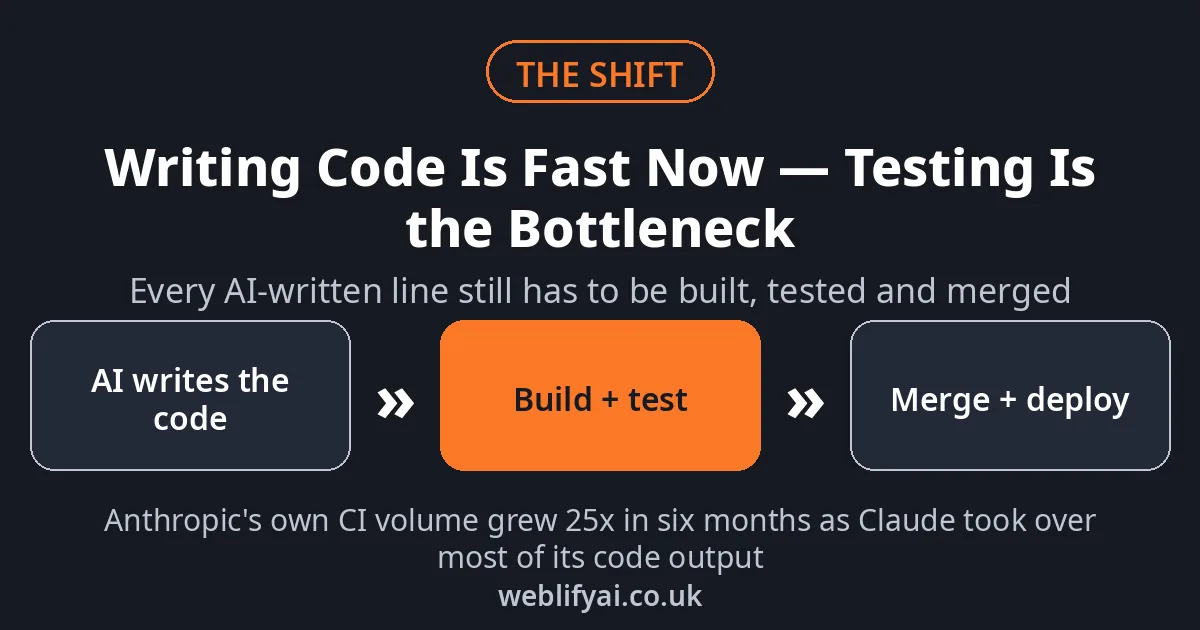
- The cause is AI coding agents. “Since Claude Code took off in March, almost every conversation we’ve had with a large engineering team has started the same way. Developers who used to push three or four pull requests a day are now pushing orders of magnitude more and their CI infrastructure can’t keep up,” Jayaprakash said. Anthropic itself reported its CI volume grew 25x in six months as Claude took over most of its code output.
What it means for UK small businesses
You don’t need to buy Blacksmith — but the trend behind it touches every small business that builds or buys software:
- Your agency’s “AI-written” code needs harder questions, not faster delivery. If your web developer now ships features in days instead of weeks using AI tools, ask what percentage of the code is AI-generated, what automated tests it passes through before release, and whether a human reviews the logic of AI-generated sections. The writing got fast; the *checking* is what keeps you safe.
- Vibe coding is fun until it breaks in production. AI-written apps and prototypes are great for testing ideas. But the Blacksmith story is a reminder that professional software lives or dies on testing — if your “AI-built app” has no test suite, treat it as a demo, not a product.
- Software costs may shift. AI coding tools have cut writing time, but testing infrastructure is getting more expensive. For fixed-price projects, clarify with your developer whether testing and validation are included — you don’t want AI-written features shipped without proper checks because “the code looked fine.”
- Security is the real exposure. AI-generated code can introduce subtle vulnerabilities that only surface under testing. This pairs with recent supply-chain incidents — like the OpenCode hack — as evidence that code quality discipline matters more, not less, in the AI era.
Honest limits / what to watch
- It’s one company’s metrics. The 17x ARR and 90M-check figures come from Blacksmith and its investors. The trend (AI code flooding CI pipelines) is corroborated by Anthropic’s own 25x figure and widespread industry reporting, but treat Blacksmith’s exact numbers as company-reported.
- Competition is coming. GitHub, GitLab, CircleCI and the AI vendors themselves (whose tools increasingly handle testing internally) could compress this market. The moat is hardware ownership and speed — powerful but not unassailable.
- Valuation doubled in two months. A $550M-to-$1B jump in ~60 days is investor enthusiasm as much as fundamentals. The underlying trend is real; the price is what investors were willing to pay in a hot market.
- For small businesses, the takeaway is process, not product. You don’t need enterprise CI. You need your developers to be able to answer the three questions above — and a testing habit that keeps pace with AI-assisted writing.
FAQs
What does Blacksmith do?
Blacksmith sells continuous integration (CI): the automated builds and tests code must pass before it can be merged and deployed. It owns tens of thousands of its own servers in data centres worldwide rather than renting cloud instances, and writes its own software to strip out the repetitive setup that slows each test run.
Why did Blacksmith reach a $1 billion valuation?
Because AI coding tools created a validation bottleneck. Blacksmith went from 5 million weekly validation checks in January 2026 to 90 million now; its customer base doubled from 5,000 to over 10,000 companies since August, and annual recurring revenue grew 17x to the tens of millions. Sequoia Capital led the $66M Series C, two months after a $45M Series B at a $550M valuation.
Why is testing the bottleneck when AI writes code so fast?
AI assistants like Claude Code, Cursor and OpenAI Codex have collapsed writing time, but every line still needs to be built, tested and merged — a process still running on cloud infrastructure that was never designed for that volume. Anthropic reported its own CI volume grew 25x in six months as Claude took over most of its code output.
Does AI-written code need different quality checks?
Yes — AI-generated code can look plausible while containing subtle bugs or security flaws, so automated tests plus human review of the logic matter more than ever. Blacksmith’s rise is a signal that shipping AI-written code without rigorous validation is becoming the risky part of software development, not the writing.
What should a small business ask its developers about AI code?
Ask three things: what percentage of the code is AI-generated, what automated tests it passes through before release, and whether a human reviews the logic of AI-generated sections. If your agency can’t answer clearly, you’re exposed to bugs you can’t see.