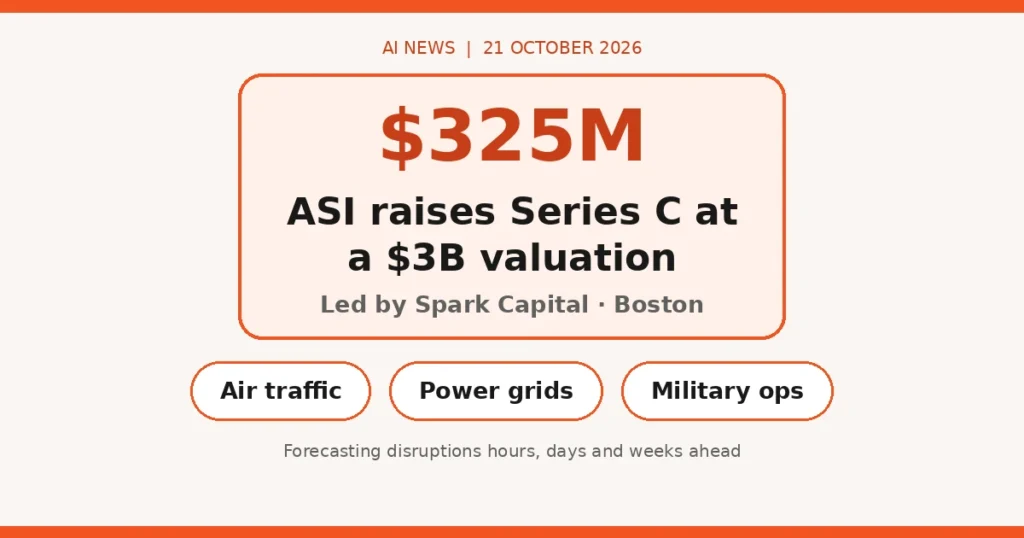
Direct answer: Boston-based ASI has raised $325 million at a $3 billion valuation in a Series C led by Spark Capital. The startup builds AI that forecasts disruptions in air traffic, power grids and military operations hours, days or weeks ahead — and the round is a loud bet that practical, physical-world AI is where the real money is going.
What happened
ASI — formerly Air Space Intelligence — announced on Tuesday that it had closed a $325 million Series C valuing the company at $3 billion. Spark Capital led the round, with affiliates of Citadel Securities, Meritech Capital, Craft Ventures, Energy Impact Partners and Andreessen Horowitz participating, according to Reuters, Bloomberg and the company’s own announcement.
The numbers tell the story of a company hitting escape velocity: its Series B in 2023 was $34 million. Dealroom ranks this raise in the 99th percentile of all-time US Series C rounds in the security sector.
What ASI actually does is refreshingly concrete. Its simulation and monitoring software helps operators forecast disruptions — hours, days or weeks in advance — across complex physical systems: air traffic, power grids, military operations. Founder and CEO Phillip Buckendorf framed it bluntly: “While the broader tech ecosystem spent hundreds of billions teaching AI to manipulate words and generate text, ASI is deeply focused on AI systems that can manage and control physical assets.”
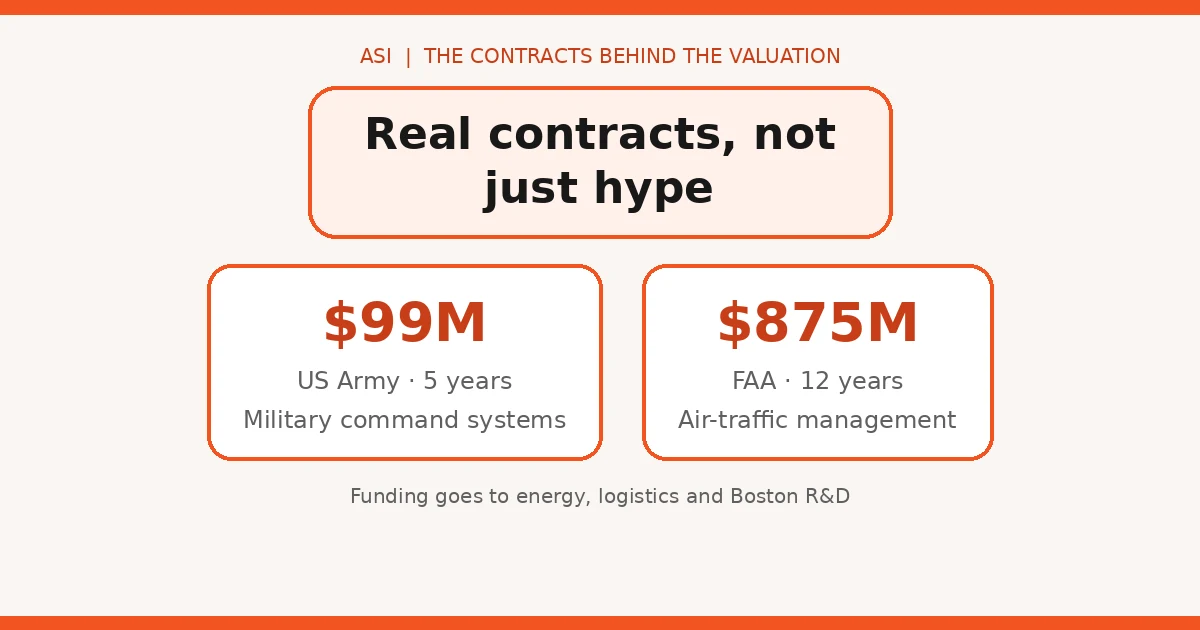
This isn’t a company running on slides. ASI secured a five-year, $99 million US Army contract in October and a 12-year, $875 million Federal Aviation Administration contract in June, covering military command systems and air-traffic management respectively. The new money goes toward expanding into energy and logistics deployments and growing the Boston research and engineering teams.
What it means for UK small businesses
Strip away the billions and there’s a useful signal here for smaller firms: investors are rotating from AI that talks to AI that does.
If you’re in logistics, energy, facilities or transport: ASI’s pitch — forecast the disruption before it happens — is the template for where operational AI is heading. You don’t need a $3 billion valuation to apply the idea. Predictive maintenance, demand forecasting, route optimisation: these are the unsexy AI applications with the clearest ROI for UK SMEs, and this funding round validates the whole category.
If you’re raising money or selling AI services: notice what got funded. Not another chatbot wrapper — software tied to physical assets and measurable outcomes, with government contracts as proof. When you pitch investors or clients, “it saves X hours” and “it prevents Y failures” beats “it’s powered by the latest model” every time. See how AI startups are capturing venture funding in 2026 and how Asian AI funding is surging on the same thesis.
For everyone else: the broader lesson is about where AI value is accruing. The chatbot layer is commoditising fast; the money is moving to AI embedded in real operations. If your business has physical operations — stock, vehicles, equipment, premises — that’s where AI can pay for itself first.
Honest limits / what to watch
A $3 billion valuation is not $3 billion of value delivered. We don’t know ASI’s revenue, and defence-adjacent startups can look invincible on contract announcements while the actual software gets stress-tested for years. The FAA’s $875 million is spread over 12 years — serious, but not a lottery win.
There’s also the customer concentration risk: when your biggest contracts come from the US military and the FAA, you’re one procurement cycle away from a very bad quarter. And “forecast disruptions weeks ahead” is a bold claim — Reuters itself noted the announcement gave no forecast-accuracy figures. Prediction is easy to promise and hard to verify.
Still, the direction of travel is real. Money is flowing to AI that touches the physical world, and that trend survives even if any single startup stumbles.
FAQs
What is ASI?
ASI — formerly Air Space Intelligence — is a Boston-based AI startup that builds simulation and monitoring software to help operators forecast disruptions hours, days or weeks ahead across air traffic, power grids and military operations.
How much did ASI raise and at what valuation?
$325 million in a Series C round, valuing the company at $3 billion. That’s a huge step up from the $34 million Series B it closed in 2023.
Who led ASI’s Series C round?
Spark Capital led the round, with participation from affiliates of Citadel Securities, Meritech Capital, Craft Ventures, Energy Impact Partners and Andreessen Horowitz.
What will ASI do with the $325 million?
Expand deployments across energy, logistics and military environments, and grow its research and engineering teams in Boston.
Does ASI have real customers or just investor hype?
Real contracts: a five-year, $99 million US Army agreement signed in October 2026 and a 12-year, $875 million Federal Aviation Administration contract from June 2026 covering military command systems and air-traffic management.
Why are investors betting on ‘physical AI’?
As ASI’s CEO Phillip Buckendorf put it: while tech spent hundreds of billions teaching AI to manipulate words, ASI focuses on AI that manages physical assets — planes, vessels, energy grids. Investors increasingly want AI tied to measurable real-world outcomes.
Sources: Reuters (20 Oct 2026); Channel News Asia (20 Oct 2026); Dealroom.