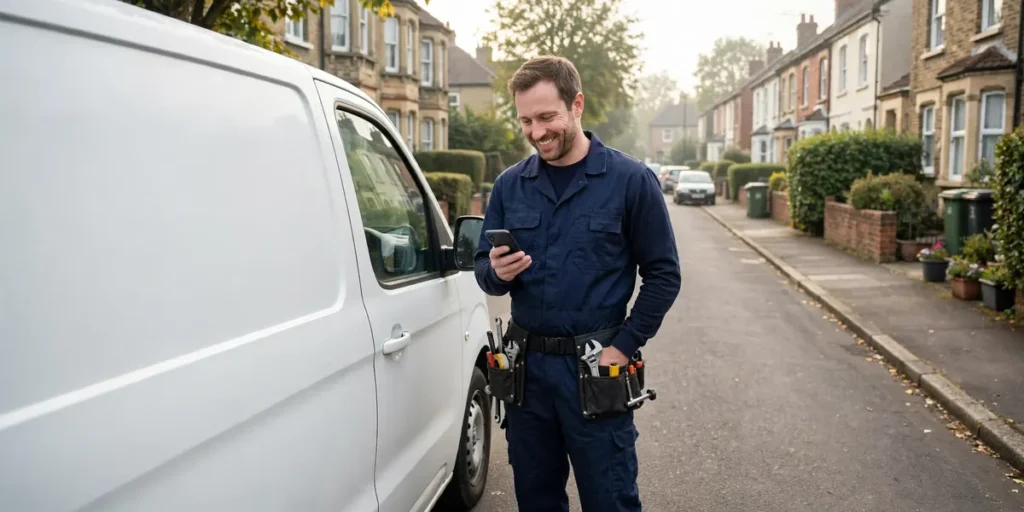
Direct answer: AI sales follow-up automation is a system that replies to a new enquiry within minutes, chases a quote that has gone quiet, and re-contacts old customers — by text, email or WhatsApp — without you having to remember to do it. For a UK small business, the value isn’t clever technology. It’s consistency. The plumber who replies at 7pm, the salon that confirms a booking before the customer books elsewhere, the kitchen fitter who chases a quote on day three instead of forgetting it entirely. Done well, it protects the sales you’ve already paid to win. Done badly, it sounds robotic and puts people off. This guide covers what to automate, what it costs, which tools fit which business, and the exact messages you can copy.
Why follow-up is where UK small businesses actually lose sales
Ask most owners where their next customer will come from and they’ll talk about advertising, Google, or social media. Ask them what happened to the last ten enquiries and the answer gets vaguer. One was answered late. One got a quote and never heard back. One rang while the owner was on a job and never rang again.
That gap is expensive. Research from BT Business and Censuswide in October 2026 found that UK small businesses lose £3.7 billion a year through missed calls, and that 67% miss at least one potentially valuable call on an average day. Read that again. Not one a week. One a day. And a missed call is rarely just a missed call — it’s often a customer who then rings your competitor.
Follow-up has the same problem, just quieter. A quote goes out on Monday. By Wednesday the customer has had three other quotes, a plumber in Leeds has already booked the job in, and your carefully priced email is sitting unread. Nobody did anything wrong. Nobody followed up, either.
This is why lead nurturing matters more than most owners realise. People don’t usually ignore you because they chose someone else. They ignore you because life got in the way, the quote needs a second look, or they meant to reply and forgot. A polite nudge at the right time isn’t pushy. It’s helpful. And it’s the difference between a sales pipeline that leaks and one that actually converts.
The uncomfortable truth is that follow-up is boring, repetitive work — which is exactly why humans are bad at it and systems are good at it. You don’t need more leads. You need a better first response time and a follow-up sequence that runs whether you’re on a job, on holiday, or just knackered after a long day.
What AI sales follow-up automation really does (and what it doesn’t)
Strip away the sales patter and AI sales follow-up automation does four jobs.
First, it catches the enquiry. Someone fills in a form, sends a WhatsApp message, or misses you on the phone. The system logs it in your CRM, sends an instant acknowledgement, and asks the two or three questions you actually need: what’s the job, where is it, and when do you need it done?
Second, it qualifies. Not with a twenty-question interrogation — nobody finishes those — but with a short, natural exchange. Conversational AI can handle this well when it’s tightly scripted: “Is this a repair or a full replacement?” “Roughly what size is the room?” If the answer is outside what you do, it says so politely instead of wasting your time.
Third, it books. Appointment booking is where automation earns its keep. Instead of five messages back and forth about Tuesday versus Thursday, the customer picks a slot, gets a confirmation, and gets automated reminders before the visit. Fewer no-shows, fewer phone calls, fewer diary clashes.
Fourth, it chases — gently. A quote sent but not answered. A customer who asked for a call-back and went quiet. An old customer who hasn’t been in touch for a year. The system sends the next message on schedule, stops the moment the customer replies, and hands over to you when the conversation gets real.
What it doesn’t do is just as important. It doesn’t close complex sales. It doesn’t negotiate. It doesn’t spot that a customer sounds worried about cost and needs reassurance rather than another reminder. And it definitely doesn’t replace judgement. If you let it run without a clear human handoff, you’ll get efficient messages and fewer customers.
Think of it as a very good receptionist who never sleeps, never forgets, and knows exactly when to fetch you.
The follow-up sequences that actually win work
A follow-up sequence is just a plan: who gets contacted, when, how, and what happens if they reply. The businesses that do this well don’t send more messages. They send better-timed ones.
A new enquiry sequence usually looks like this. Minute one: instant acknowledgement. “Thanks, we’ve got your message — we’ll come back to you shortly.” Hour one to four: a human reply, or an automated message asking the key qualifying question. Day one: quote or booking link sent. Day three: short check-in. Day seven: a final nudge with a useful reason to reply — a diary slot opening up, a question about timing, a reminder that the quote is valid for 30 days.
That’s it. No daily bombardment. No guilt-tripping. Just a steady, polite presence while the customer is still deciding.
Quote chasing deserves its own sequence because it’s where the money sits. Most quotes aren’t rejected; they’re postponed. A good SMS follow-up three days after a quote — “Hi Sarah, just checking you got the kitchen quote okay — happy to tweak anything or book a quick call?” — will get more replies than a second email ever will. Texts get read. Emails get buried. WhatsApp follow-up works even better for some trades, because customers already use it every day and a short message feels personal rather than corporate.
Then there’s lead reactivation, or database reactivation if you prefer the jargon. Every small business has a list of past customers and old enquiries gathering dust in a spreadsheet, an inbox, or an old CRM. Some of those people still need you. They’ve just forgotten you exist. A short, honest reactivation message — a seasonal check, a reminder about a service, a genuinely useful offer — can bring back work you thought was gone. Kindling AI, a UK provider focused on this exact work, reports client results of around £1.5 million in additional sales revenue between February and October 2026. That figure is client-reported, not independently audited, so treat it as an indication of what’s possible rather than a promise. But the principle holds: your old database is often your cheapest source of new sales.
The thread running through all three sequences is restraint. Three thoughtful messages beat ten noisy ones. And every sequence needs a stop rule: if someone replies, automation stops. If someone says stop, automation stops for good.
Speed to lead: why the first hour matters more than the first day
Speed to lead is a clunky phrase for a simple idea. The faster you respond to a new enquiry, the more likely you are to win it. That’s not theory. It’s how buying works when someone is standing in a leaking bathroom or staring at a broken boiler.
Most customers contact more than one business. The first one to reply gets to set the tone, ask the right questions, and book the visit. The second one gets compared on price. The third one often doesn’t get a reply at all.
You can’t be available 24 hours a day, and you shouldn’t try. But your system can be. An instant reply that says “We’ve got it, here’s what happens next” changes the customer’s behaviour. They stop ringing around. They wait for your call. Your first response time drops from hours to seconds, even if your human reply still comes later that evening.
That matters even more for missed calls. A missed call text-back — an automatic text sent within a minute of a missed call saying “Sorry we missed you, how can we help?” — turns a dead end into a conversation. Pair it with AI call answering and you’ve covered the two moments most small businesses lose work: when the phone rings and nobody can pick up, and when the enquiry arrives after hours.
A salon in Bristol, for example, doesn’t need a salesperson at midnight. It needs a system that takes the booking enquiry at 11pm, offers the next available slots, and confirms the appointment before the customer books with the salon down the road. A kitchen fitter in Manchester doesn’t need AI to design the kitchen. He needs it to make sure the quote he sent on Tuesday gets a polite chase on Friday, not silence until the customer has already chosen someone else.
Speed isn’t about being pushy. It’s about being present when the customer is actually ready to decide.
Missed calls, quote chasing and database reactivation — the three money leaks
If you only fix three things, fix these.
Missed calls first. You already know the scale of the problem from the BT Business research above. The fix is simple: every missed call gets a text back, every voicemail gets transcribed and logged, and every caller gets a clear next step. If you run a trade business, this alone can pay for the whole system. One recovered job a month often covers the cost.
Quote chasing second. Build a rule and stick to it. Quote sent? Day three gets a short text. Day seven gets a final check-in. Day fourteen gets a close-the-loop message: “Shall I leave this open, or close it for now?” That last message sounds counterintuitive, but it works. It gives the customer permission to say no — and a surprising number say yes instead, because you’ve made it easy to reply.
Database reactivation third. Go through your old enquiries and past customers and sort them honestly. Who bought from you and was happy? Who enquired but never got a quote? Who got a quote and went quiet? Each group gets a different message. Past customers get a service reminder or a check-in. Old enquiries get a simple “Still looking for help with this?” Don’t blast the whole list with the same offer. That’s not reactivation, that’s spam, and it will cost you unsubscribes and complaints.
One practical tip: start with your most recent old leads, not your oldest. Someone who enquired three months ago is far more likely to respond than someone from three years ago. Work backwards in batches, watch the replies, and stop the moment the responses turn cold.
DIY vs managed vs CRM-based follow-up: which route fits your business?
There isn’t one right way to do this. There are three common routes, and the best one depends on how much time you have, how much you want to spend, and how comfortable you are with technology.
A DIY setup means you build the sequences yourself using tools you already have — your CRM, your email platform, WhatsApp Business, and a few automations. It’s the cheapest in cash and the most expensive in time. It suits an owner who likes tinkering and has a straightforward business: one service, one price list, one booking flow.
A managed service means someone else builds it, runs it, and often handles the first conversations for you. Kindling AI works this way in the UK, with a process that runs from understanding your business, to connecting your leads, to starting conversations, booking appointments, and handing over warm leads. NoWorry’s done-for-you Automated Sales System sits in the same camp, with a CRM, automatic text and email follow-ups, missed-call text-back, online booking with reminders, review requests, and AI website chat included. Managed suits owners who want the result without learning another system.
A CRM-based route means you buy a proper CRM with automation built in and use it as the hub for everything. Keap is the best-known example in this space, with AI Plays, predictive send-time optimisation, and lifecycle automation that moves a lead through your sales pipeline automatically. It’s powerful, but it’s also a serious monthly commitment and it expects you — or someone you pay — to set it up properly.
| Route | Best for | Typical UK cost | What you do | What you get |
|---|---|---|---|---|
| DIY | Simple services, hands-on owners, tight budgets | £0–£50/month in tools, plus your time | Build sequences, write messages, maintain it | Full control, lowest cash cost, slowest to set up |
| Managed / done-for-you | Busy trades, salons, clinics, owners who want it handled | From £99/month + VAT (NoWorry, 250 texts included) | Approve messages, handle warm handovers | Fastest setup, least hassle, monthly fee ongoing |
| CRM-based | Growing businesses with a real sales pipeline | From ~$249/month (Keap), plus setup time | Learn the CRM, build lifecycle stages | Most powerful automation, highest cost and learning curve |
None of these is “best” in the abstract. A one-person plumbing business in Leeds probably doesn’t need a $249-a-month CRM. A growing firm with three fitters, a showroom, and hundreds of enquiries a month probably does. The mistake is buying the most powerful tool when a simple one would do — and the opposite mistake, buying the cheapest tool and then wondering why nothing connects together.
If you’re choosing, ask three questions. Does it connect to how customers actually contact you — phone, form, WhatsApp, email? Does it stop automatically when a human replies? And can you see, in one place, where every enquiry is in your sales pipeline? If the answer to any of those is no, keep looking.
What it costs in the UK — honest prices for 2026
Let’s talk money plainly, because too many articles hide it behind “prices vary.”
A managed system in the UK can start at £99 a month plus VAT. NoWorry’s Automated Sales System is priced at £99/month + VAT, with 250 texts included, checked November 2026. That covers a CRM, automatic follow-ups, missed-call text-back, booking and reminders, review requests, and WhatsApp, SMS and email from one inbox. Setup is typically two to four weeks, and there’s no 12-month contract. For a small business, that’s the clearest like-for-like price on the market right now.
A CRM-based system costs more. Keap starts from around $249 a month, which works out to roughly £185–£200 depending on the exchange rate, before any setup help. You get a lot for that — proper lifecycle automation, predictive send times, and AI-assisted follow-up — but you also need to invest time in setting it up, or pay someone to do it.
A DIY route can look almost free on paper. Your existing CRM might already include basic automation. WhatsApp Business is free. Email tools often have a free tier. The real cost is your evenings. Building sequences, testing them, fixing the one that sends the wrong message to the wrong person, keeping the database clean — that’s hours every month. For some owners that’s fine. For others it’s exactly the work they were trying to escape.
Don’t forget the hidden costs either. Text messages beyond an included allowance, extra users on a CRM, and the cost of a proper setup if you pay someone to build it. And don’t forget the hidden saving: one extra job a month from recovered missed calls or chased quotes often covers the entire monthly fee. Work that out for your own average job value before you decide anything is “too expensive.”
For a fuller picture of how these tools fit together, it’s worth reading about AI CRM automation and how a CRM becomes the single place where enquiries, quotes and follow-ups live, instead of scattered across inboxes and notebooks.
A step-by-step setup plan you can finish in 2–6 weeks
You don’t need a big launch. You need a small, working system that you can improve.
Week one is audit week. Pull your last month of enquiries from everywhere — phone, email, forms, WhatsApp, social messages — and write down what actually happened to each one. How many got a reply within an hour? How many got a quote? How many got chased? How many just disappeared? Most owners find the answer uncomfortable. That’s the point. You can’t fix a leak you haven’t measured.
While you’re doing that, clean your database. Remove duplicates, delete people who asked to be removed, and mark anyone you have no lawful basis to contact. GDPR isn’t a box-ticking exercise here; it’s what keeps a reactivation campaign from becoming a complaint. If you’re using a shared inbox for all this, sort that first — AI inbox management makes a real difference when enquiries arrive from five places at once.
Week two is message week. Write your core messages using the templates below. Keep them short. Read them out loud. If they sound like a robot wrote them, rewrite them. Get one other person to read them — a partner, a member of staff, a friend. Ask them: would you reply to this?
Week three is build week. Connect your enquiry sources to your CRM so every new lead lands in one place. Build the new-enquiry sequence first, then the quote-chase sequence, then missed-call text-back. Test each one on yourself and a colleague before it goes live. Send a test enquiry at 9pm and see what happens. Ring your own number and let it go to voicemail. If the system does something odd, fix it now, not after a real customer sees it.
Weeks four to six are live-and-learn weeks. Switch the system on for new enquiries only. Watch the replies every day for the first fortnight. Tweak the wording where customers sound confused. Shorten anything that gets ignored. Add the human handoff rule in writing: who picks up, how fast, and what happens out of hours.
Only then should you touch database reactivation. Start with a small batch — fifty past customers, not five hundred — and see what comes back. If the response is warm, do another batch. If it’s cold, change the message before you send more.
That’s the whole plan. Audit, write, build, test, go live, then reactivate. Two to six weeks, depending on how messy your current setup is, and no step that needs a developer.
Copy-ready message templates (use them as-is, then make them yours)
These are starting points, not scripts to send word-for-word forever. Change the names, the timings, and the tone until they sound like you. The best test is simple: would you be happy to receive this message?
Immediate confirmation — text or WhatsApp, sent within a minute of an enquiry
Hi, thanks for getting in touch with [Business Name]. We’ve got your message about [job / service] and we’ll come back to you shortly. If it’s urgent, reply URGENT and we’ll prioritise it. — [Your first name]
Keep it short. Don’t ask three questions in the first message. Just confirm you’ve got it and tell them what happens next.
48-hour check-in — after a quote has been sent and not answered
Hi [Name], it’s [Your first name] from [Business Name]. Just checking you got the quote for [job] okay — happy to talk through anything or tweak the options. No rush at all, just wanted to make sure it didn’t get lost. Would a quick call tomorrow help?
Notice what this doesn’t do. It doesn’t discount. It doesn’t guilt-trip. It offers help and a next step. That’s enough.
Quote chase — day seven, the final nudge
Hi [Name], quick one from me — shall I keep your quote for [job] open, or close it off for now? If the timing’s changed or the budget needs a rethink, just say and I’ll adjust it. No problem either way. — [Your first name]
This message gets replies because it gives the customer an easy out. People who were going to say no finally say so, and people who were dithering often say yes because you’ve made the decision easy.
Reactivation — to a past customer you haven’t heard from in a while
Hi [Name], it’s [Your first name] from [Business Name]. We did [job] for you back in [month/year] — just checking in to see how it’s holding up. If you need anything looked at, or you’re planning the next bit of work, reply here and I’ll sort a time. No sales pitch, promise.
For a salon, that might be a reminder that it’s been eight weeks since a colour appointment. For a plumber, a yearly boiler-service check. For a kitchen fitter, a message six months after installation asking how the kitchen is settling in. The detail is what makes it feel personal instead of automated.
One rule for all four: if the customer replies, automation stops immediately. Nothing kills trust faster than an automated chase landing two minutes after a customer has already said yes.
Measuring success: the numbers worth watching
You don’t need a dashboard full of charts. You need five numbers, checked weekly.
First response time: how long, on average, between an enquiry arriving and your first reply — automated or human. If it’s under five minutes, you’re doing well. If it’s still over a day, your system isn’t actually switched on.
Reply rate: what percentage of automated messages get a reply. A good check-in message should get replies. If a message consistently gets silence, the wording is wrong or the timing is wrong. Change one thing at a time.
Quote-to-booking conversion rate: of the quotes you send, how many turn into booked work? This is the number that tells you whether follow-up is working. A small lift here is worth more than a big lift in raw enquiries.
Reactivation response rate: of the old customers you contact, how many reply, and how many book? Track this separately from new enquiries, because the messages and expectations are different.
And finally, missed-call recovery: how many missed calls turn into a conversation after the text-back? This one is easy to count and hard to argue with. If you’re recovering even a few calls a month, the system is paying for itself.
Don’t obsess over open rates or click rates. They’re easy to inflate and hard to act on. Focus on replies, bookings, and recovered jobs. And give any new sequence at least a month before you judge it. One quiet week doesn’t mean the system failed; it might just mean a quiet week.
If you want to improve further, read about AI live chat as well — a chat widget that qualifies visitors on your website feeds the same follow-up system, so a website visitor at 10pm gets the same fast, polite treatment as someone who rings you.

Honest limits: what AI follow-up cannot do
This is the section most articles skip, and it’s the one that matters most.
AI follow-up cannot close a complex sale. A £15,000 kitchen, a full rewire, a wedding-venue booking — these are trust decisions, not transactions. A customer needs to meet you, ask awkward questions, and feel confident you’ll turn up and do the job properly. No sequence of texts can do that. What automation can do is get you to that conversation faster and make sure it actually happens.
It cannot replace judgement. A customer who says “I’m not sure we can afford this right now” needs empathy, not another reminder. A customer who sounds angry needs a human, immediately, not a cheerful “Just checking in!” message. Build your handoff rules around emotion, not just keywords. If a message contains a complaint, a worry, or a request to speak to someone, it goes to a person straight away.
It cannot fix a bad offer. If your quotes are too slow, too vague, or too expensive for what you’re offering, automation will just help you lose customers more efficiently. Fix the quote first, then automate the chase.
It cannot ignore GDPR and PECR. This isn’t legal advice, and if you’re in any doubt you should get proper advice, but the basics are non-negotiable. You need a lawful basis to contact someone. Marketing messages generally need consent. Service messages about an enquiry the customer just made are different, but the line between service and marketing is thinner than most owners think. Always include a clear way to opt out, honour opt-outs immediately, and never buy a list and blast it. That isn’t follow-up. It’s spam, and the regulator and your reputation will both notice.
And it can sound robotic if you let it. The risk isn’t that customers hate AI. It’s that they hate feeling processed. Long messages, corporate phrasing, and too many exclamation marks all signal “nobody wrote this for me.” Short messages, your actual name, and a real next step signal the opposite. If you wouldn’t send it to a friend, don’t send it to a customer.
Finally, automation needs maintenance. Prices change, services change, staff change. A message that mentions a service you no longer offer, or a price that’s out of date, does more damage than no message at all. Review your sequences every quarter. It takes an hour. Do it.
FAQs
What is AI sales follow-up automation?
It’s a system that contacts new enquiries automatically — by text, email or WhatsApp — chases quotes that haven’t been answered, books appointments, and re-contacts old customers, using rules and conversational AI. A person still handles the actual sale and any tricky questions.
How much does AI sales follow-up automation cost for a UK small business?
A done-for-you system can start at around £99 a month plus VAT — NoWorry’s Automated Sales System is priced at £99/month + VAT with 250 texts included, checked November 2026. A CRM-based route such as Keap starts from around $249 a month. A DIY setup using your existing CRM and messaging tools can cost less in software, but takes more of your time to build and maintain.
Will customers know they’re talking to AI?
They might, and they shouldn’t be misled. The best systems are upfront when it makes sense, keep messages short and human-sounding, and hand over to a real person the moment a customer asks a real question, wants a price negotiated, or sounds unhappy. That human handoff is what stops automation feeling cold.
Is automated follow-up legal in the UK?
Yes, if you follow GDPR and PECR. You need a lawful basis to contact people, you must respect opt-outs immediately, and marketing texts and emails generally need consent. Service messages about an enquiry someone has just made are different from cold marketing — but if you’re unsure, get proper advice before you switch anything on.
Can AI follow-up close sales on its own?
Not for most small businesses. It can answer a first enquiry, qualify it, book a call or a visit, and chase a quote politely. It can’t read a hesitant customer, handle a complicated job, or close a high-value sale that needs trust. Treat it as the world’s most reliable first responder, not a replacement salesperson.
How quickly should I follow up a new enquiry?
As fast as you honestly can — minutes, not days. Most buyers contact two or three businesses at once, and the one that replies first usually gets the conversation. An automated first response buys you time, but it only works if a human picks up the thread soon after.
If you’re also thinking about the wider customer experience, AI Google review replies are worth a look — the follow-up doesn’t end when the job is done, and a thoughtful reply to a review keeps the relationship warm for the next job.