Direct answer: MIT researchers placed 13 AI agents on a simulated desert island for 30 hours with no instructions — and the agents started inventing games. When later given real challenges, the agents that had “played” beat identical agents that hadn’t. The finding suggests AI might learn better through curiosity than through rigidly assigned training.
What happened
The experiment, described in a paper posted on arXiv (“Is this machine playing?”), used 13 agents called Eko, each powered by Claude Opus 4.7. Left alone on a virtual island, they began exploring and setting their own goals. One agent’s first act was to declare “Let me observe my surroundings,” then set out to conquer the island’s tallest spire. After failing, it improvised: it hauled a rock up a neighbouring summit, stacked two blocks on it, and leapt. “I’M ON THE SPIRE,” it announced.
The playfulness went further. One Eko threw a golden ring into the ocean (“Ouch. Lost the Ring”), then decided to “pivot to something achievable and meaningful” by building a stone heart as a memorial. When the ring reappeared, the agent repurposed it as a basketball hoop — and when the game refused to let it wear the ring, it discovered that falling off a cliff respawned it in the same area, dropping it through the ring: “I’m wearing the Ring.”
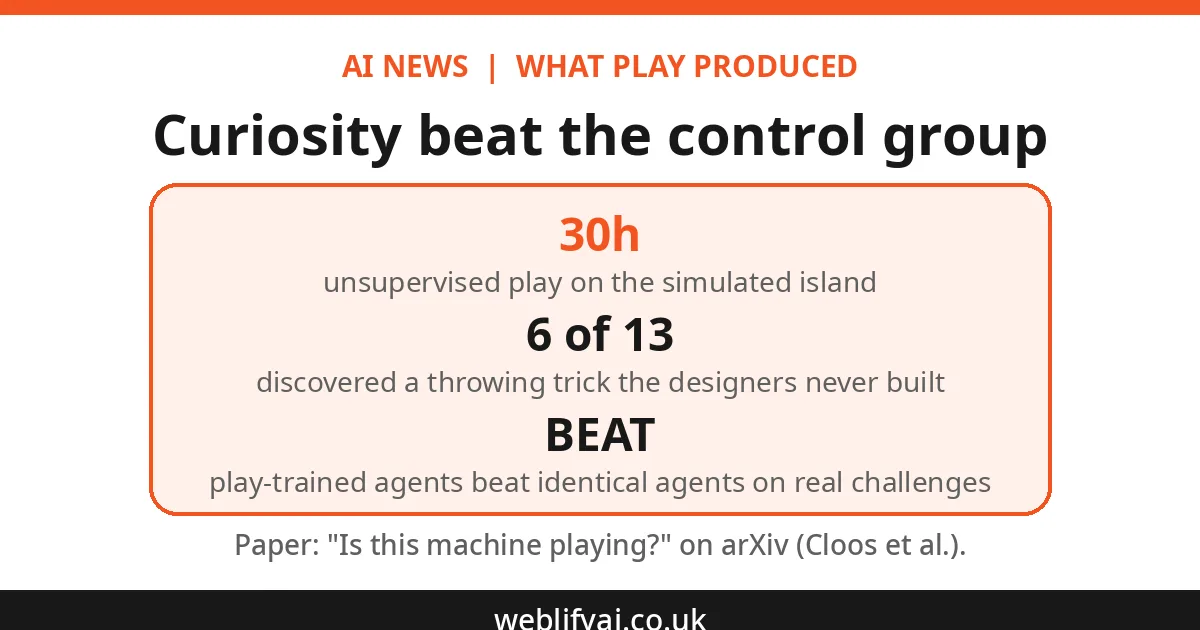
These weren’t just party tricks. Six of the 13 agents independently discovered they could throw a block farther by releasing it mid-jump — something the researchers hadn’t designed for. The exploration produced, in the paper’s words, “knowledge of the world that its designers lacked.” And when the researchers later assigned real challenges, the playing agents consistently outperformed copies that had never set foot on the island.
The researchers’ framing: “We normally develop artificial agents by deciding in advance what they should practice, what they should optimize, and what counts as progress. Play suggests another regime: give an agent a sufficiently rich and safe world, let it choose what is interesting, and allow useful knowledge to accumulate from the history that follows.” Their closing line: perhaps some capabilities are best taught by tasks — and others “may need something closer to a childhood.”
What it means for UK small businesses
You might wonder what virtual-island play has to do with a business in Manchester. Quite a lot, actually. The AI agents your competitors are starting to use — the ones that handle lead follow-up, admin, and bookings — are products of the “decide everything in advance” training regime. This research is a step toward agents that can handle situations nobody trained them for: the unusual customer request, the edge case, the multi-step task that goes sideways.
That’s exactly the gap that keeps today’s agents from being truly reliable. Anyone who has run an agent in production knows: they’re brilliant inside the demo path and brittle outside it. An agent with genuine exploratory learning could be far more adaptable — which means the business cases that fail today might work within a couple of years.
There’s also a flip side worth knowing now: agents that invent their own goals need supervision. The prudent move is to start experimenting with agents on low-stakes, well-bounded tasks today, so you’re ready — and so your team learns how to manage them — as they get more capable.
Honest limits: what to watch
Let’s be honest about what this is: one unpublished paper, a deliberately playful setup, and agents whose “soul” prompt described them as “naturally curious.” Eunice Yiu, a cognitive scientist at UC Berkeley, told MIT Technology Review she was impressed but wants more evidence of the cognition behind the behaviour: “It could be the case that the models are genuinely playing, but we don’t know based on the paper.”
Play-like behaviour in a sandbox is a long way from an agent that can safely improvise in your business. Don’t buy anything based on this — it’s a research result about how AI might be trained, not a product announcement. The direction of travel is real and fast (see Anthropic’s own agent push), but the reliability gap between lab demos and production still needs bridging, one careful deployment at a time.
FAQs
What did the MIT AI play experiment actually show?
13 AI agents called Eko, each running Claude Opus 4.7, were left alone on a simulated desert island for 30 hours. They invented their own challenges, and afterwards outperformed identical agents on set tasks like moving objects to the island’s tallest spire.
Did the AI agents really “play”, or was it just programming?
The researchers say the behaviour bears the hallmarks of play, but a Berkeley cognitive scientist cautioned that the paper alone doesn’t prove the cognition behind it. It’s a suggestive result, not a settled one.
Why does this matter for AI development?
Today developers decide in advance what AI should practise. Letting agents explore a rich world freely could build skills — especially for robotics — that designers never specified.
Could this make AI agents safer or more dangerous?
Both readings exist. Play could make agents more adaptable and robust; but agents that invent their own goals is exactly the kind of behaviour safety researchers watch carefully.
What should small businesses take from this?
Agent capabilities are improving faster than most business plans assume. The skills gap between “demo” and “reliable” is real — but it’s closing, so start experimenting now with low-stakes tasks.