

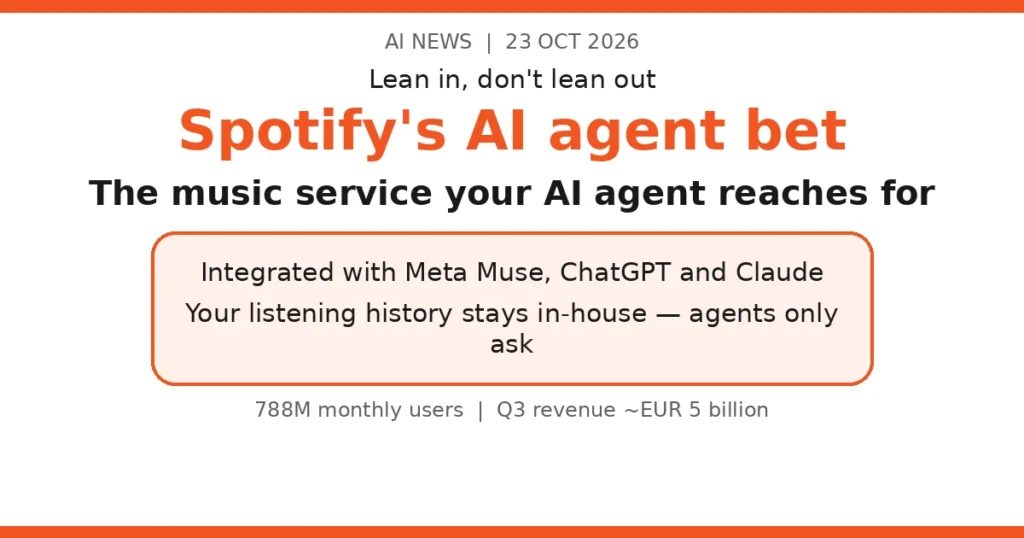
Direct answer: Spotify doesn't fear AI agents — it wants to be the service they reach for. On the company's third-quarter earnings call, co-CEO Gustav Söderström said Spotify is positioning itself as "the media service that you use from any agent," arguing that music streaming is one of the few categories that actually thrives in the agentic age. It's a strikingly confident play: turn the agent wave into a tailwind.
What happened
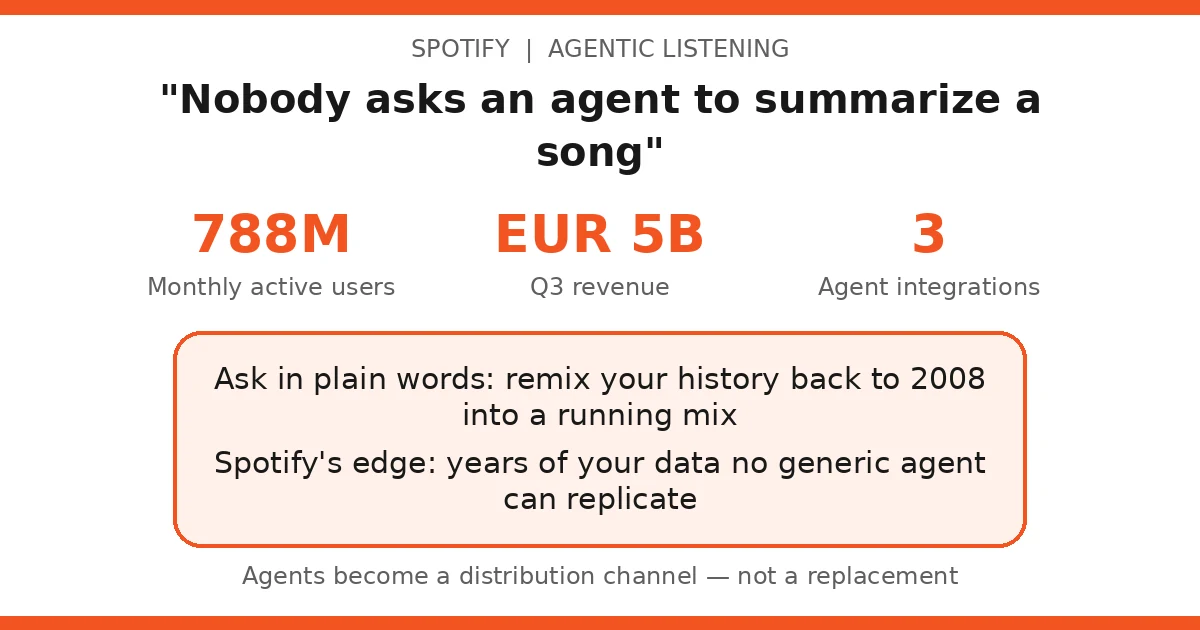
Spotify posted a strong Q3 — 788 million monthly active users and nearly €5 billion (around $5.6 billion USD) in revenue. But the headline from the earnings call was strategic. Söderström told investors that agents are good at taking care of things people would rather not do. "People love getting rid of chores. But entertainment is the opposite. Nobody asks an agent to 'summarize a song' for them."
Instead of opening Spotify, searching for an artist, and building a playlist manually, listeners could ask an AI assistant to do it — music for a run, a podcast about something they've been discussing with an AI, or an audiobook recap that picks up exactly where they left off. Spotify wants to be the service those agents turn to, letting people discover music and interact with Spotify through conversations rather than just its own app.
Spotify is already wired into the agent ecosystem: it was the first music service to integrate with Meta's Muse assistant, and it also integrates with ChatGPT and Claude. "We are seeing really good adoption of Spotify inside these agents," Söderström said. "Many are leaning out, we are actually leaning in."
The pitch goes beyond convenience. Söderström describes Spotify as "an intelligent media service encapsulated as an agent" — one you can talk to, ask questions of, and instruct. His example: ask Spotify to go through your listening history song by song back to 2008, pick your true favourites, adjust their tempo, sort them by key and BPM, and mix them into a running playlist at your exact cadence.
On privacy, he drew a clear line: Spotify isn't sending listener data to partners. The agent asks Spotify for something, and Spotify's own systems reason about the request and choose what to play — years of listening history (artists you return to, songs you skip) stay inside Spotify.
What it means for UK small businesses
This is a case study in the right response to AI disruption: lean in. Where Amazon has blocked Meta's Muse from shopping on its platform, Spotify is making itself the default endpoint for agents. For any UK business that sells through a service — bookings, orders, customer support — the lesson is blunt: if AI assistants become the front door to your market, you want to be the business the agent recommends.
That means making your services machine-readable and agent-friendly: structured booking options, clear menus, and integrations with the assistants your customers actually use. The rise of AI agents handling logins and tasks on people's behalf is already pushing businesses to rethink access — Spotify's approach shows the commercial upside of embracing it.
There's also a content angle. Spotify's example — "mix my history into the perfect running playlist" — is really about personalisation at a depth only years of first-party data allow. Small businesses sitting on customer data (purchase histories, preferences, booking patterns) have a version of this advantage. The question is whether they build on it or let a generic AI do a worse job instead.
Honest limits / what to watch
The strategy depends on agents staying open to third-party services — and the friction is already showing. Amazon blocking Meta's Muse from shopping on its platform illustrates how quickly a major player can restrict outside agents over access, security, or commercial control. Spotify's tailwind could turn if assistants start preferring their own built-in media options or charging tolls for access.
Also note what Söderström is really saying: Spotify's edge is its proprietary data — years of listening history no generic agent can replicate. That's a moat, but it's also a reminder that the value concentrates with the platform, not the artist or the listener.
And for all the confident talk, the agent economy is still early. "Good adoption inside agents" is encouraging, but Spotify hasn't quantified it. Watch whether the next quarters show agent-driven listening growing — or plateauing as novelty wears off.
FAQs
What is Spotify's AI agent strategy?
Co-CEO Gustav Söderström says Spotify wants to be the media service AI agents turn to — people will discover music and interact with Spotify through conversations with their assistant rather than only through Spotify's own app.
Does Spotify share your listening data with AI agents?
No. Söderström says Spotify isn't sending listener data to partners. The agent asks Spotify for something, and Spotify uses its own systems to reason about the request and choose what to play.
Which AI assistants does Spotify integrate with?
Spotify was the first music service to integrate with Meta's Muse assistant, and it also integrates with ChatGPT and Claude.
Why does Spotify think it benefits from AI agents?
Söderström argues agents excel at replacing chores people don't enjoy, but entertainment is the opposite — nobody asks an agent to summarise a song. So agents become a distribution channel for Spotify rather than a replacement.
How big is Spotify right now?
Spotify reported a strong third quarter, reaching 788 million monthly active users and generating nearly €5 billion (around $5.6 billion USD) in revenue.
Sources: TechCrunch