

Direct answer
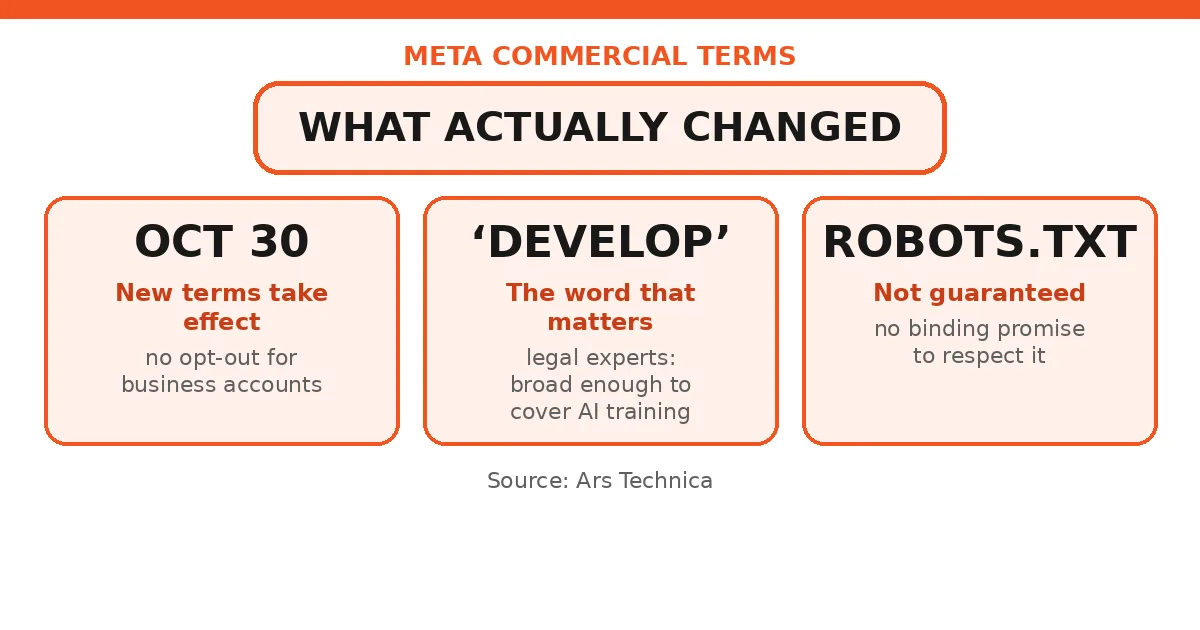
Direct answer: Meta has quietly deleted the word “train” from its new commercial terms of service after a fierce backlash from publishers and legal experts — but the broad right to crawl and scrape your website remains, and lawyers warn the remaining language (“develop” advertising and business products) is still wide enough to cover AI training. As Ars Technica reported, the terms take effect on 30 October 2026, and business accounts get no opt-out before then.
What happened
Two weeks ago, Nieman Lab flagged new language in Meta’s upcoming commercial terms. They would have given Meta the right to use automated tools “to access, index, cache, analyze, collect, retrieve, or crawl the domains, web pages, or URLs (and any content available through them)” associated with a business account — and then use “any content” to “provide, develop, improve, research, train, and maintain the integrity” of Meta products.
That covers virtually every digital publisher, since almost all have at least one Meta business account to manage their Facebook Pages, Instagram profiles, Threads accounts or WhatsApp channels. Legal experts warned it could let Meta scrape paywalled content — the terms even mentioned generating “test credentials” to crawl sites — and avoid paying licensing fees worth millions.
The backlash was swift and global:
- Danielle Coffey, president and CEO of the News/Media Alliance, called the terms “outrageous and probably illegal” and “a clear abuse of the company’s market power,” urging regulators to block implementation on 30 October.
- Theo Bamber, chief executive of the UK News Media Association, accused Meta of a “shameless land grab” built on “arrogant tech platform bullying” and urged UK regulators to stand up for British creators.
- The European Publishers Council asked the European Commission to intervene.
Meta’s response, published on Friday and confirmed by spokesperson Daniel Roberts to The Verge: delete “train” and “any content”, and narrow the purpose to “provide, develop, improve, research, and maintain advertising and business products.” Meta stressed the change “does not change how Meta uses web crawlers” and that site owners can still use robots.txt. Meta did not alert business users to the edit.
Legal experts are unimpressed. Matt Topic of Loevy & Loevy told Nieman Lab that “develop” is broad enough to include “train,” since Meta is plainly developing AI business products. Cornell’s James Grimmelmann said the language is “still broad enough to drive a truck through,” and Professor Benjamin Sobel noted the terms contain no binding commitment to respect robots.txt — meaning Meta could lean on the enforceable terms over a website’s blocking instructions.
What it means for UK small businesses
This isn’t just a publishers’ problem. Here’s why it matters to you:
- Your website is in scope. If you run Facebook, Instagram, Threads or WhatsApp business accounts — and most UK small businesses do — your website is a domain “associated with” a business account. Meta’s terms claim crawling rights over it.
- Robots.txt is not a contract. Meta says it respects robots.txt “signals,” but nothing in the terms binds it to do so. If you don’t want your content harvested, relying on robots.txt alone may not be enough — read the terms when they take effect on 30 October and talk to your legal adviser if your content is valuable.
- Your competitors’ AI ads could be trained on your work. Even under the revised terms, content collected to “develop… business products” sits adjacent to Meta’s generative advertising tools — the tools your competitors use. Your product descriptions, case studies and photos could feed systems that help rivals out-advertise you.
- The UK voice in this fight is yours. The UK News Media Association is lobbying regulators over this — but the precedent set for publishers becomes the precedent for every business site. Watch what the UK regulators do here.
If you want help auditing what your site shares and what it’s worth, our AI consultation is free.
Honest limits / what to watch
- The core crawling right is unchanged. Meta never denied it wants to scrape; it only narrowed the stated purpose. The “win” here is largely semantic — the lawyers on the record say so plainly.
- “Develop” is the word that matters now. If Meta trains an AI business product — and it is clearly building them — that fits comfortably inside “develop… business products.”
- No opt-out before 30 October. Business accounts are bound by the terms whether they like them or not. The only “opt-out” is quitting Meta’s business tools entirely, which is not realistic for most small businesses.
- Regulatory pressure is real but slow. The EU Commission, UK regulators and US watchdogs have all been urged to act, but the terms take effect in days, not months.
- We haven’t seen any independent verification of what Meta’s crawlers actually do in practice — the debate so far is about what the contract permits, not what Meta does.
FAQs
What did Meta change in its commercial terms of service?
Meta removed the word “train” (and the phrase “any content”) from the upcoming commercial terms, and narrowed the stated purpose to “provide, develop, improve, research, and maintain advertising and business products.” The terms take effect 30 October 2026. Meta did not alert business users to the changed language.
Does Meta’s change stop it scraping websites for AI training?
Not clearly. Legal experts say the remaining word “develop” is broad enough to include AI training, and the terms still grant Meta sweeping rights to access, index, crawl and collect content from websites associated with business accounts. Nothing in the terms requires Meta to respect robots.txt.
Why were publishers upset with Meta’s original terms?
The original wording would have let Meta scrape any website “associated with” a business account — covering virtually every news publisher with a Facebook Page — and use the content to “train” Meta products. The News/Media Alliance called the terms “outrageous and probably illegal”; the UK News Media Association’s chief executive called it a “shameless land grab.”
Which websites does Meta’s commercial TOS cover?
Any domain, web page or URL “associated with” a business account on Facebook, Instagram, Threads or WhatsApp — which includes business websites, publisher sites, and potentially any site linked from a business profile. Business accounts cannot opt out before the terms take effect.
Can I block Meta’s crawler with robots.txt?
Meta says you can use robots.txt to signal preferences, but the revised terms contain no guarantee that Meta will honour those signals. University of Wisconsin law professor Benjamin Sobel notes robots.txt compliance is voluntary, so Meta could rely on the legally enforceable terms instead.