
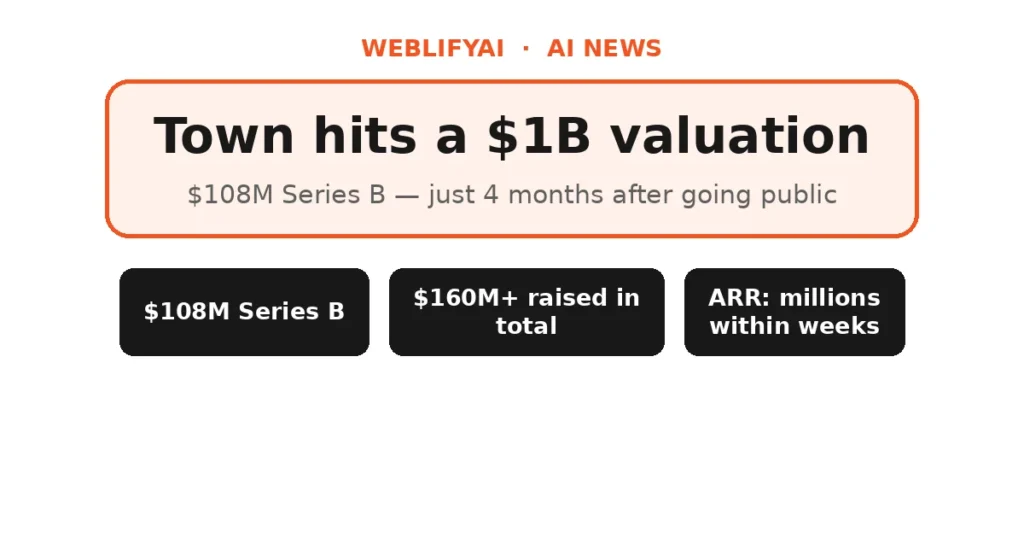
Direct answer: Town, a San Francisco startup building an AI assistant for every employee, has hit a $1 billion valuation after raising a $108 million Series B round — just four months after launching publicly. The company says it reached millions of dollars in annual recurring revenue within weeks of going live.
What happened
Town announced the round on Monday, co-led by Forerunner Ventures and Menlo Ventures, with Andreessen Horowitz, Serena Ventures and First Round Capital also taking part, according to TechCrunch. The two-year-old company, founded by former Plaid CTO Jean-Denis Greze, has now raised at least $160 million in total, following a $55 million Series A in June.
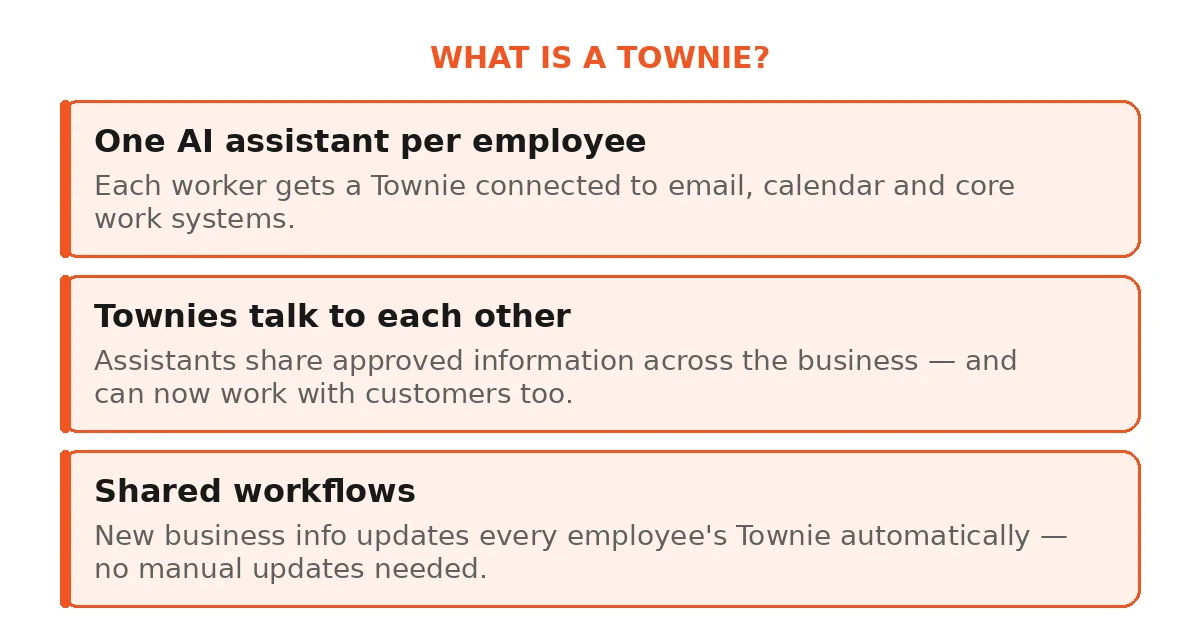
Town’s pitch is straightforward: every employee gets their own AI assistant — a “Townie” — connected to email, calendars and other core work systems. Townies can talk to each other and share approved information, so a question asked by one employee can be answered by another’s assistant. Alongside the funding, Town announced a shared workflow feature that automatically pushes new business information to every employee’s Townie, rather than each person updating their own.
One telling detail, reported by Crypto Briefing: Index Ventures had signed a term sheet to lead the round but withdrew in September after Instinct — a rival AI assistant startup in its portfolio — raised a conflict-of-interest concern. Money follows momentum, and investors are picking sides in the assistant race fast.
What it means for UK small businesses
This is one of the clearest signals yet that the next enterprise software battle is over who owns the employee’s AI assistant. Town’s speed — millions in ARR within weeks — suggests businesses are no longer running AI pilots; they’re buying.
For a UK small business, the practical takeaway is simple: AI assistants tied into your actual tools (email, calendars, documents) are becoming normal workplace equipment, not a luxury. You don’t need to wait for Town or any unicorn — see our guide to AI agents for small business for what’s deployable today. And if you’re weighing the fundraising story, read our broader look at AI startup funding in 2026 for context on where investor money is going.
Honest limits / what to watch
- Valuation is not revenue. A $1 billion valuation on a company that launched four months ago is a bet on future growth, not proof of a durable product. The ARR figure comes from Town itself and hasn’t been independently verified.
- Data access is the risk. An assistant with read access to everyone’s email and documents is enormously powerful — and enormously sensitive. UK businesses should demand clear answers on data retention, UK/EU data residency and GDPR compliance before plugging any assistant into company systems.
- Crowded field. Town is one of dozens of AI assistants competing for the same budgets. Fast ARR now doesn’t guarantee a moat later.
FAQs
What is Town?
Town is a San Francisco startup founded by former Plaid CTO Jean-Denis Greze. It gives every employee an AI assistant called a Townie that connects to email, calendars and other work systems to handle tasks, scheduling and information lookup.
How did Town reach a $1B valuation so fast?
Town announced a $108M Series B co-led by Forerunner Ventures and Menlo Ventures, four months after its public launch. It says it reached millions of dollars in annual recurring revenue within weeks, and has raised at least $160M in total.
What is a Townie?
A Townie is Town’s per-employee AI assistant. Townies can talk to each other and share approved information across a business, and can now also work with customers and people outside the company. A new shared workflow pushes business updates to every employee’s Townie automatically.
Who invested in Town’s Series B?
The round was co-led by Forerunner Ventures and Menlo Ventures, with Andreessen Horowitz, Serena Ventures and First Round Capital participating. One investor, Index Ventures, reportedly withdrew from an earlier term sheet after a conflict-of-interest concern from a portfolio rival.
What should UK small businesses take from this?
Employee-level AI assistants that connect to your real work tools are where enterprise budgets are heading. Small businesses don’t need a unicorn budget — lightweight assistants hooked into email and calendars already deliver most of the value.